Quick Start
From zero to an interactive mind map in three steps — all from a chat with Claude Code. No setup beyond installing the skill.
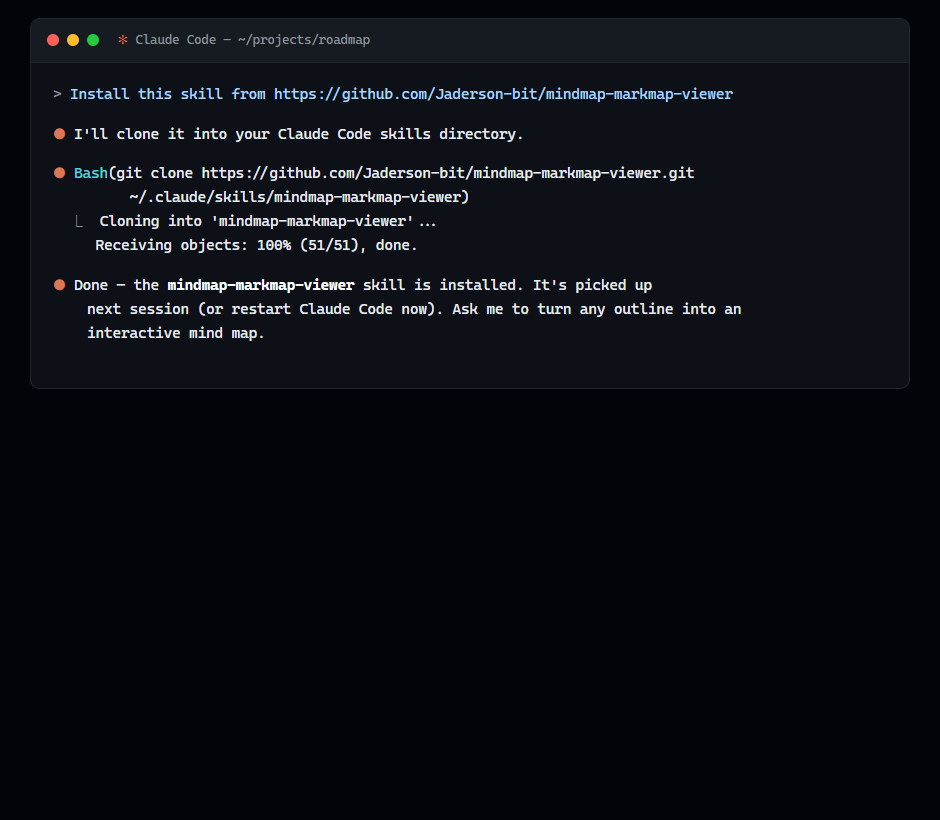
Just ask Claude Code to install it from the repo:
Install this skill from https://github.com/Jaderson-bit/mindmap-markmap-viewer
Claude clones it into ~/.claude/skills/mindmap-markmap-viewer. It's picked up on the next session (or restart Claude Code now).
💡 Prefer the command line?
git clone https://github.com/Jaderson-bit/mindmap-markmap-viewer.git ~/.claude/skills/mindmap-markmap-viewer
Paste an outline (headings + nested bullets) and ask for a mind map. Claude applies sensible markmap presets and writes a portable, offline bundle:
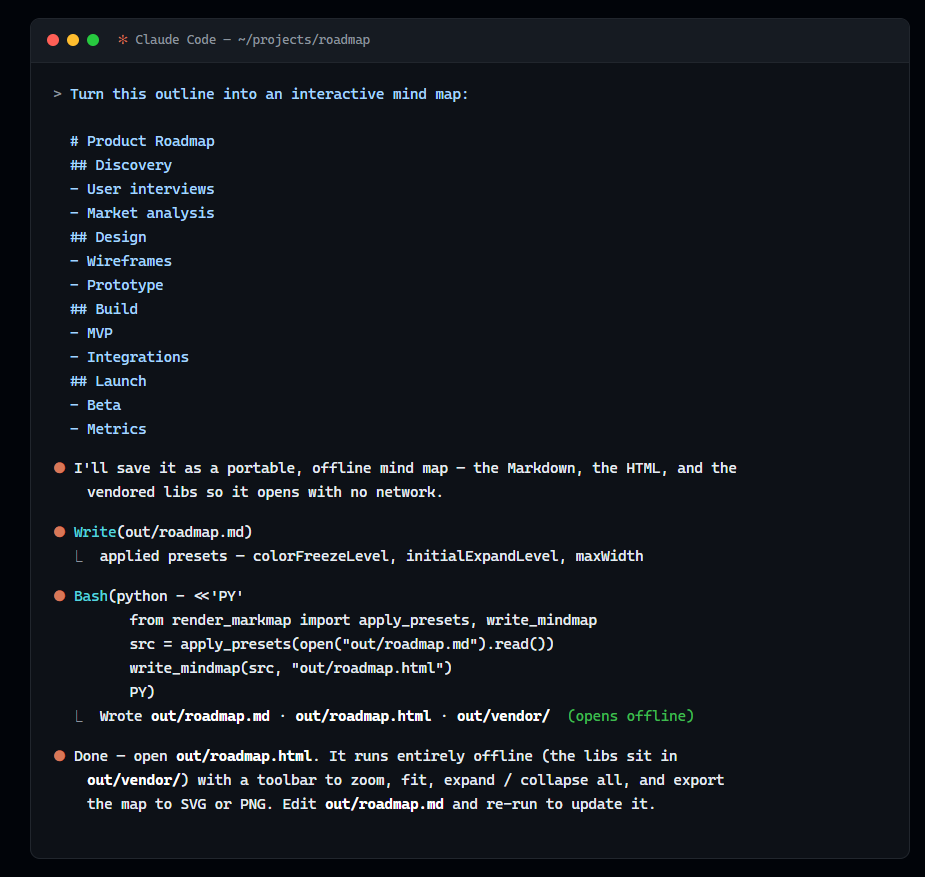
Under the hood it calls the skill's helpers — apply_presets to fill the frontmatter (colorFreezeLevel, initialExpandLevel, maxWidth) without overriding anything you set, then write_mindmap to emit three things next to each other:
| File | What it is |
|---|---|
roadmap.md |
the editable source of truth (plain Markdown) |
roadmap.html |
the render (open this) |
vendor/ |
d3 + markmap, copied in so the map opens offline |
To change the map, edit the .md and re-run — the HTML carries no content of its own.
Open the .html. You get a white-on-dark interactive map with a toolbar in the bottom-right:
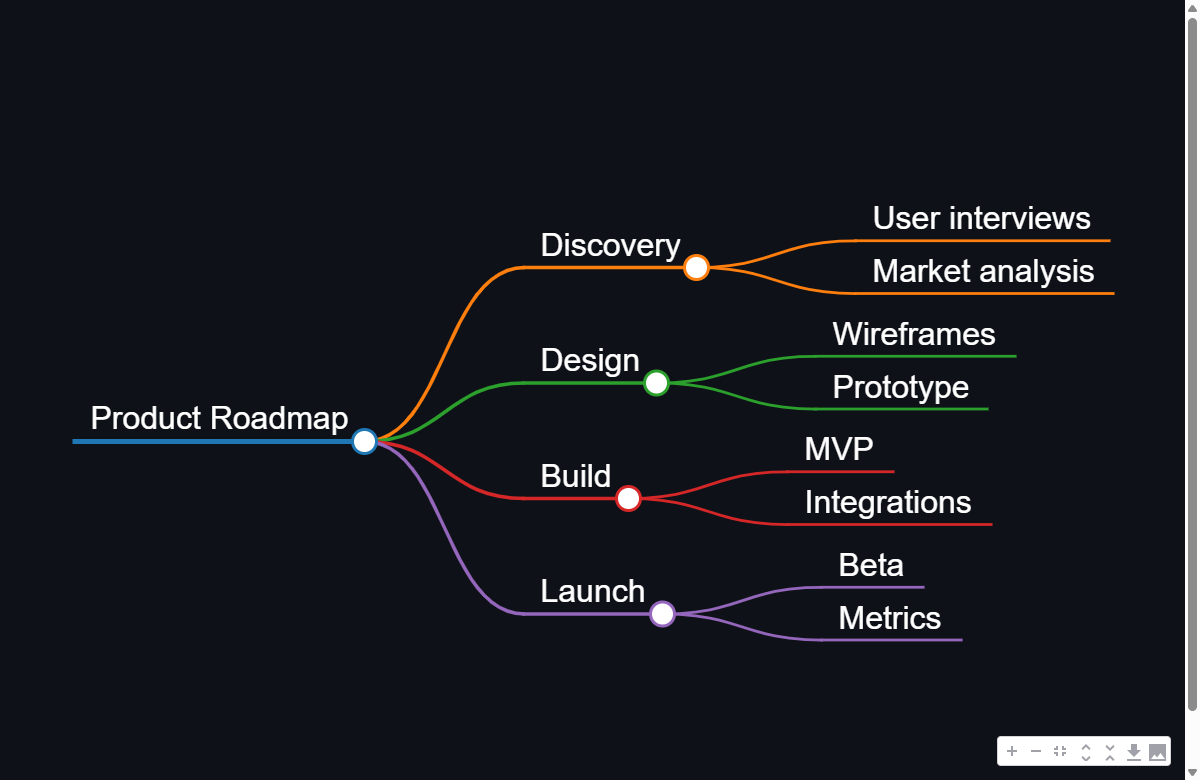
The toolbar, left to right: zoom in / out, fit to screen, expand all, collapse all, download SVG, download PNG. Click any node to fold/unfold its branch. Exports snapshot the current fold state.
🔌 Offline by default. The map loads its libraries from the sibling
vendor/folder — no CDN, no network request. Keep the.htmlandvendor/together when you move or share it.
A mind map is a glance tool, so shape the outline to stay scannable:
- 5–8 main branches off the root — group related ideas rather than spilling past 8.
- 3–6 children per branch, kept roughly even — lopsided branches read as unfinished.
-
Labels of 1–3 words — a node is a handle, not a sentence. Put the explanation on a child node (
- Term→- what it means), not inline. - Balanced depth — avoid one branch tunneling deep while others stay shallow.
-
Let
apply_presetsset the frontmatter so you don't hand-tune each map.
Search keeps context: type a term and the map filters to matching nodes plus their ancestors and their whole subtree, so a hit never floats alone. Matching ignores accents and case.