This repository contains controlled rendering stress experiments built in Unity (URP + OpenXR) to analyze real-time GPU and CPU bottlenecks under XR constraints.
This specific experiment isolates transparent overdraw and measures its impact on render-thread cost and fragment workload scaling.
To demonstrate:
- How transparent stacking affects fragment workload
- Why overdraw scales render-thread cost linearly
- How to validate bottlenecks using:
- Unity Profiler (CPU + Render Thread)
- Frame Debugger (pass-level inspection)
- Controlled baseline vs stress comparison
This is not an FPS measurement exercise. This is a pipeline-level validation exercise.
- Unity (URP)
- OpenXR enabled
- Mock HMD for XR simulation
- Forward Rendering
- Opaque geometry only
- No transparent stacking
- Identical camera + resolution as stress test
- MSAA and render scale held constant
- 201 transparent quads
- Identical mesh (4 vertices, 6 indices)
- Same material
- Alpha blending enabled
ZWrite Off- Stacked in the same screen region
This ensures fragment overlap and disables early depth rejection.
| Condition | PlayerLoop |
|---|---|
| Baseline | ~0.5 ms |
| Overdraw | ~0.5 ms |
CPU cost remained stable.
No script or update bottleneck introduced.
| Condition | RenderLoop |
|---|---|
| Baseline | 6.37 ms |
| Overdraw | 13.64 ms |
Δ ≈ +7.27 ms
Transparent stacking nearly doubled render-thread cost.
Under DrawTransparentObjects:
- 201 sequential
Draw Meshcalls - Same quad mesh
- Same material
- Blend:
SrcAlpha / OneMinusSrcAlpha ZWrite Off
Because depth writes are disabled:
- Early-Z rejection cannot occur
- Every fragment executes
- Cost scales linearly with layer count
This confirms fragment-bound behavior.
Transparent objects:
- Are rendered after opaque pass
- Are sorted back-to-front
- Cannot rely on depth buffer for early rejection
- Execute full fragment shader per layer
When stacked in the same pixel region:
Fragment workload = Layers × Pixel Coverage
Under XR (dual eye rendering), this cost is effectively doubled again.
This experiment validates:
- Overdraw is a fragment-bound GPU bottleneck
- Transparent stacking directly impacts render-thread cost
- CPU remains unaffected
- Frame Debugger confirms pass-level multiplication
The bottleneck shift is measurable, reproducible, and pipeline-consistent.
In XR:
- Render resolution is high
- Stereo rendering doubles workload
- Fragment cost scales aggressively
- Frame budget (72–120 Hz) is tight
Transparent overdraw becomes significantly more expensive under headset constraints.
Understanding pass-level behavior is critical for:
- UI systems
- Particle systems
- Post-processing overlays
- Shader-heavy VFX
To maintain experiment validity:
- Same resolution
- Same MSAA
- Same render scale
- Same camera
- Same lighting
- Only transparent stacking modified
No unrelated variables introduced.
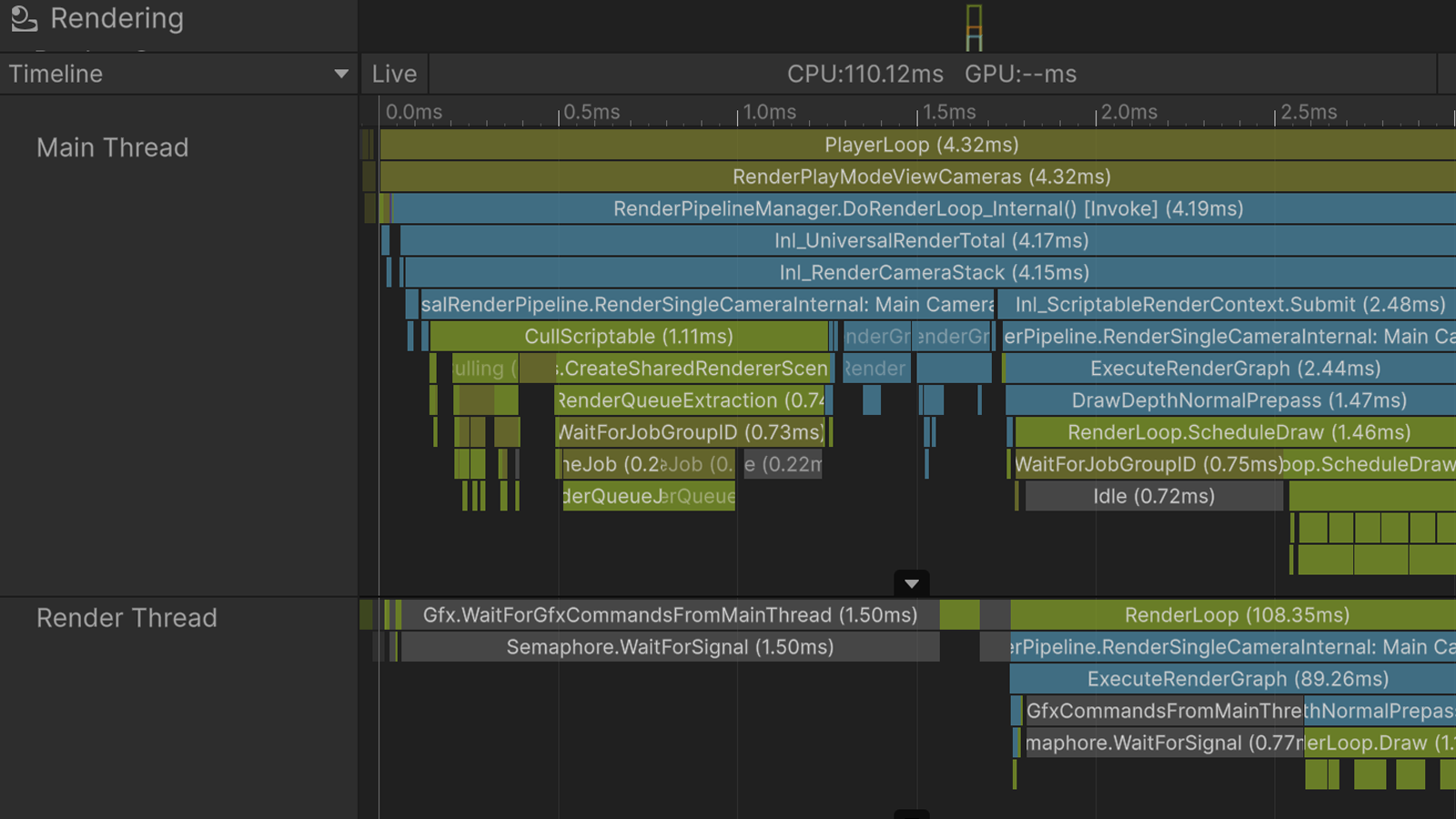
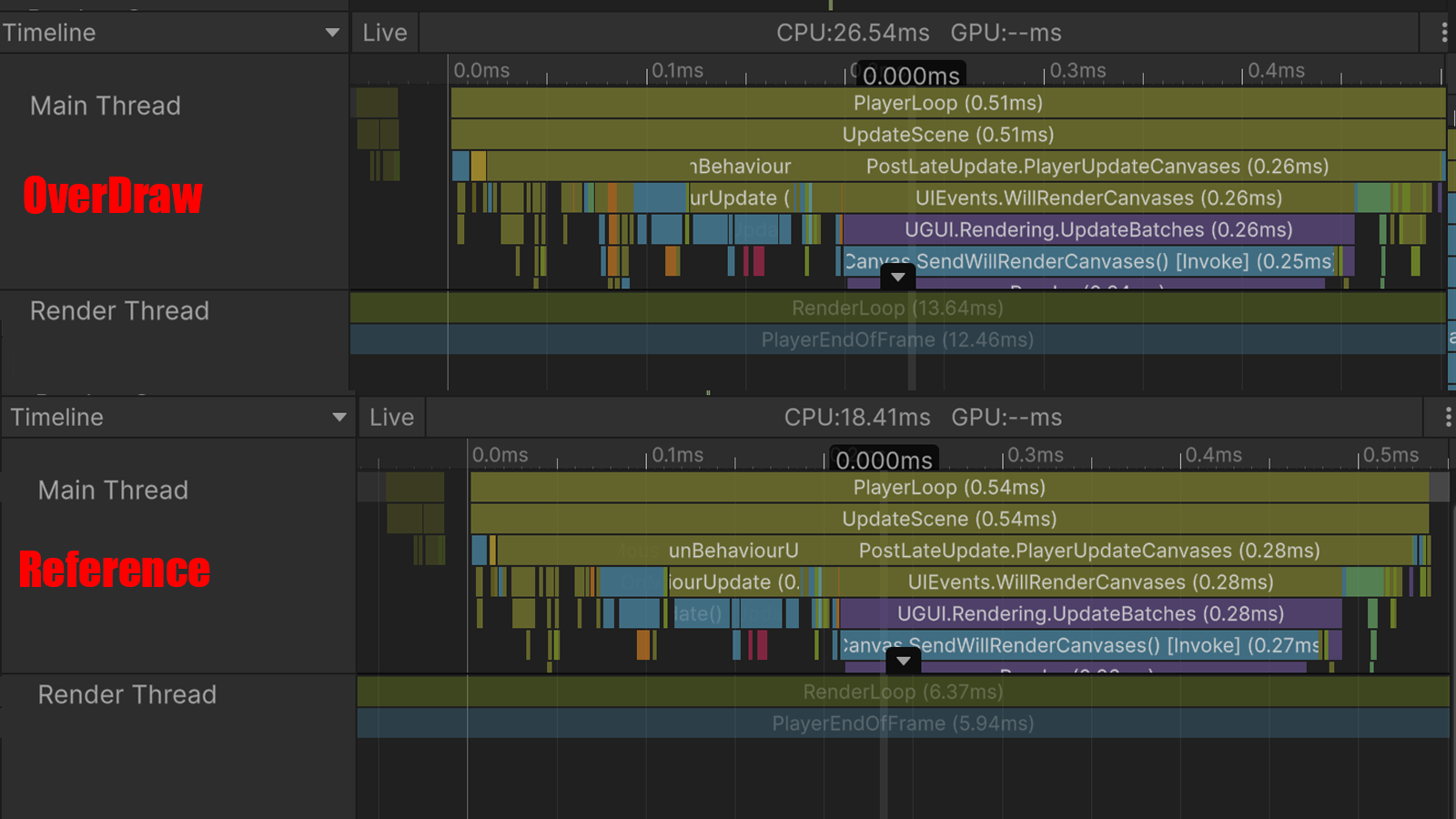
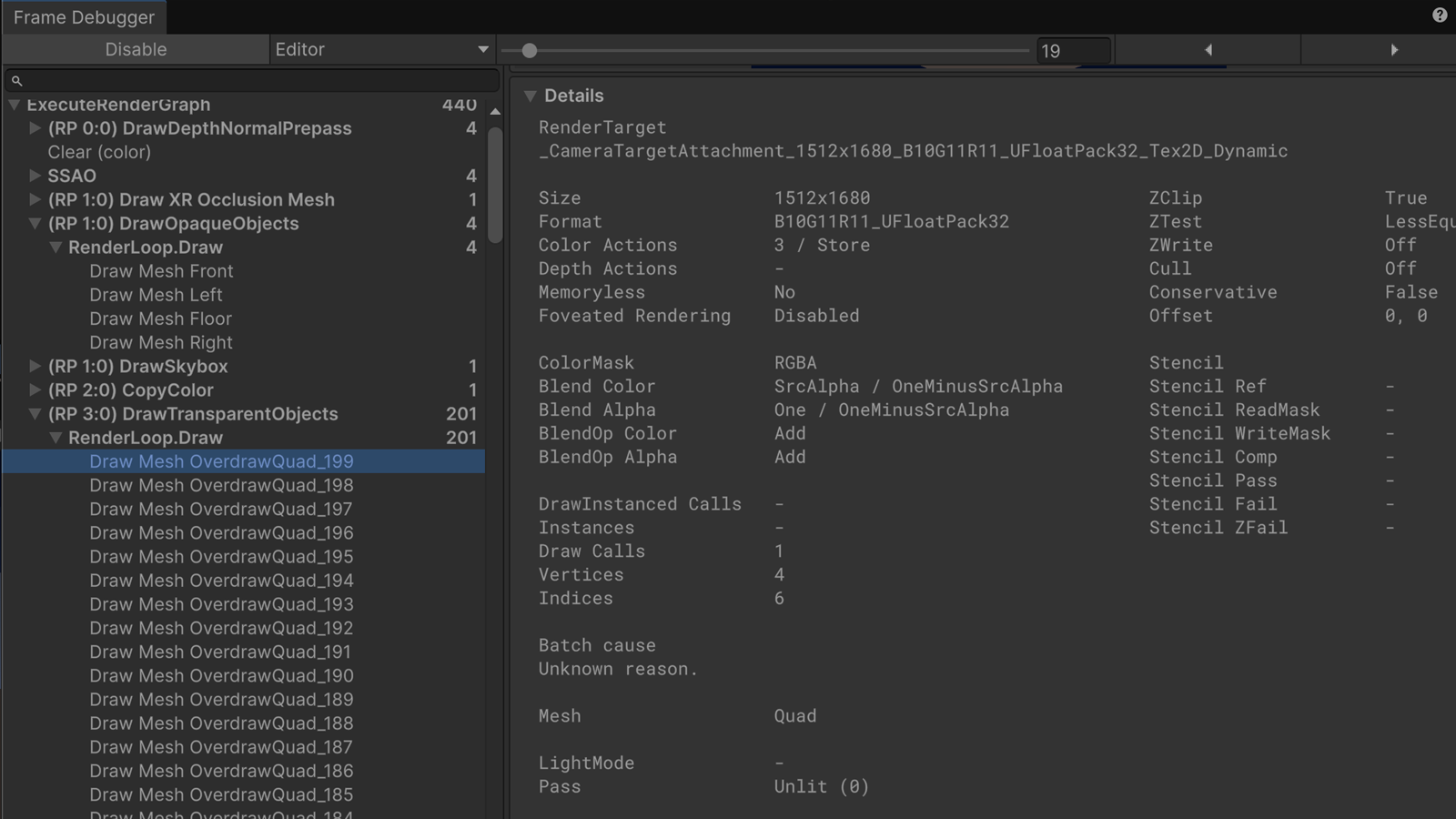
Each capture corresponds to the metrics reported above.
- Repeat test with MSAA x4 vs x1
- Repeat with Cutout (ZWrite On) for comparison
- Measure scaling at 2× resolution
- Repeat under real headset hardware
- Compare against instancing stress
James De Raja
Senior Real-Time Performance Engineer
Unity Rendering | Frame Pacing | XR Optimization
Portfolio | LinkedIn
MIT (for experimental code only)