Repository navigation
Floorplan
This page shows the regions of layer 1 (host, fixed) and layer 2 (core, replaceable, pb_l2) of the FPGA, and the area that the cores use in layer 2. The region limits are those of host/build.tcl (floorplan B, which the pipeline selects). State of 2026-11-02: T164 (host package 2) is merged into main (run 1139 green); the figures of the host and of c64ref are those of run 1122, the cut of T164. The host is routed together with the build-only reference core c64ref; the machines that do not fit the partition are built flat and leave it (large cores).
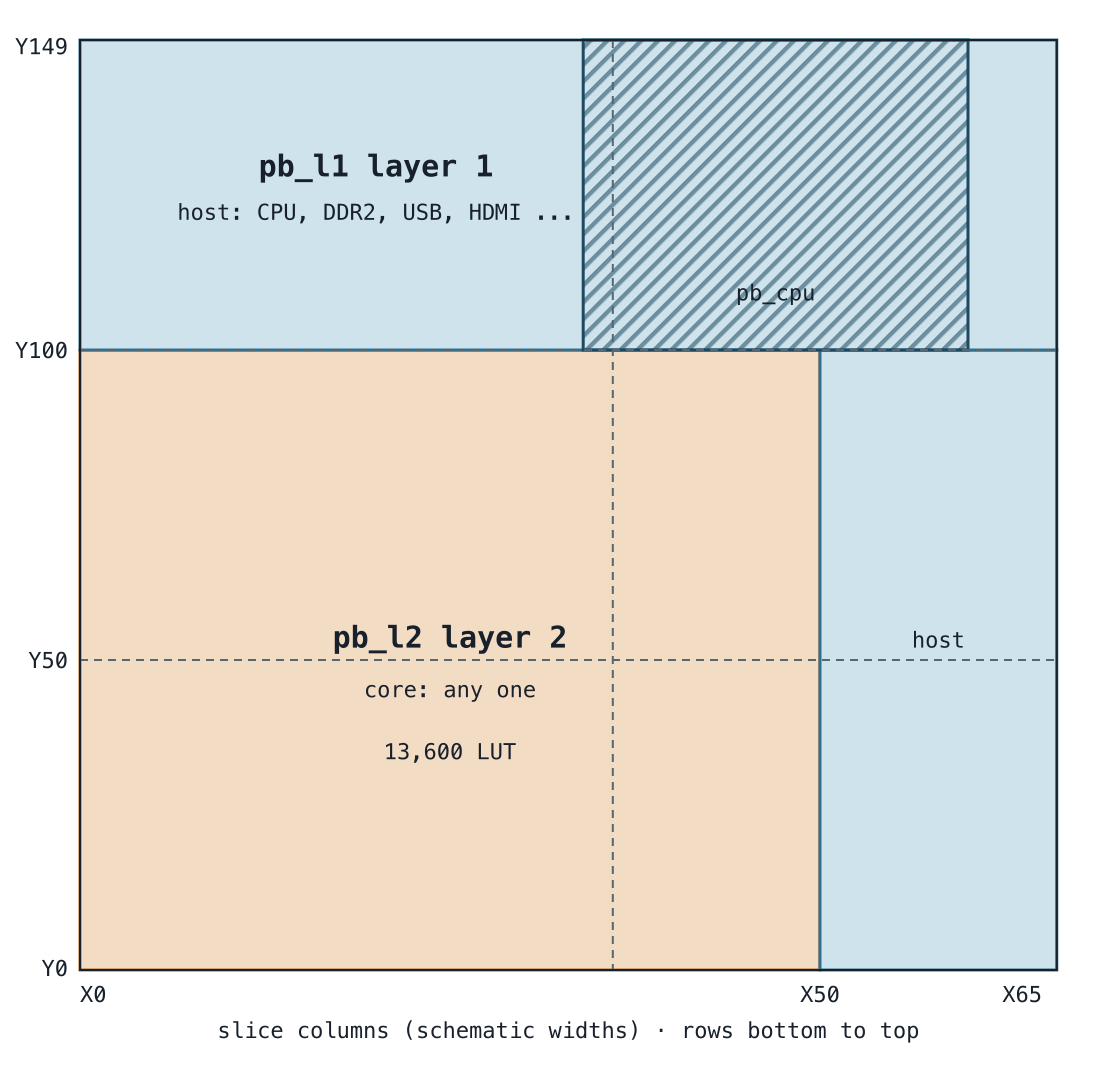
Schematic, not to scale. The die has 2 x 3 clock regions; layer 2 lies in the lower two rows, left of column 50.
| Region | Slices and sites | Budget |
|---|---|---|
| pb_l2, layer 2 (core) | SLICE_X0Y0:X49Y99 (one rectangle); RAMB36 X0Y0-19, X1Y0-19; DSP X0Y0-39 | 13,600 LUT, 40 BRAM tiles, 40 DSP |
| pb_l1, layer 1 (host), an L | SLICE_X50Y0:X65Y99 + X0Y100:X65Y149; RAMB36 X2Y0-19, X1Y25-29, X0Y20-29; RAMB18 X0Y40-59; DSP X1Y0-59, X0Y40-59 | 17,400 LUT, 35 BRAM tiles, 80 DSP |
| pb_cpu, inside the host | SLICE_X34Y100:X59Y149 | the RISC-V and its caches |
The I/O pads are at the edges of the chip. The pads at the edge of the layer-2 part belong to the host (decoupler, pins). Host nets run from those pads along the edge of the layer-2 rectangle.
Note: The slice ranges are the constraints of
host/build.tcl; the LUT limits come from the implementation reports for the two regions. Pin cells, clock buffers, MMCM, PLL and ICAP are removed frompb_l2and stay static.host/trx_constraints.tclstops the build beforeopt_designwhen a constraint resolved to no object (the build would otherwise route for an hour with the crossings untimed).
The host gained the HDMI modes, the scaler, the volume, the case lamp and the port clock, and no longer fitted its old region. Final cut: pb_l2 is one rectangle; the host is one connected L. Host: 12,802 LUT = 73.6 % of 17,400, WNS +0.138 ns, about 12.5 min to build. c64ref: 9,212 LUT = 67.7 % of pb_l2.
| Run | Cut | Result |
|---|---|---|
| 1117 | edge X55 to X50 in the lower rows (pb_l1 15,400) | placement failed, 83.1 %, 10-36 slices short |
| 1119 | plus a host island at X0-5 (17,800) | WNS -6.155 ns: the clock groups of pins.xdc were dropped (matched nothing); host nets crossed the core region |
| 1121 | top-left strip to the host, pb_l2 one rectangle, clock groups fixed | WNS -0.149 ns on the encoder preamble |
| 1122 | same, encoder windows registered | WNS +0.138 ns; host and c64ref route |
| 1128 | same, with the large cores on their own host copies | green: host and all cores |
Note: A core that no longer fits
pb_l2becomes a large core (a full bitstream, Overview, 3.5). Five cores left in this cut, a sixth (ZX Spectrum Next) before it (section 3).
Caution: Routing against the fixed host is reliable up to about 80 % LUT use of
pb_l2(10,880 LUT). Block RAM is the other limit: 40 tiles. A core above either one is a large core.
Fill of pb_l2 (13,600 LUT, 40 block-RAM tiles). Routing is not reliable above 80 % LUT.
| Core | LUT | LUT of pb_l2
|
Block-RAM tiles | Source |
|---|---|---|---|---|
C64 Reference (c64ref, build only) |
9,212 | 67.7 % | 27 | routed with the host (run 1122) |
| Atari 800 XL | 7,073 | 52.0 % | 29.5 | run 955 |
| VIC-20 | 5,470 | 40.2 % | 18.5 | run 958 |
| DDT Mandelbrot | 4,912 | 36.1 % | not recorded | run 1104, before the cut to 6 engines |
| Apple IIe | 4,684 | 34.4 % | 36 | run 955 |
Host (layer 1), routed with c64ref
|
12,802 of 17,400 | 73.6 % of pb_l1
|
WNS +0.138 ns |
| Core | LUT | BRAM tiles | Why it is a large core |
|---|---|---|---|
Amiga 500 (amiga) |
14,298 | 18 | More LUT than the 13,600 of pb_l2
|
NES (nes) |
13,181 | 11 | 97 % of pb_l2, far above 80 % |
Amstrad CPC (cpc) |
7,032 | 46.5 | More block RAM than the 40 tiles |
C16 / Plus-4 (c264) |
5,292 | 43 | More block RAM than the 40 tiles |
ZX Spectrum (zx) |
5,411 | 42 | More block RAM than the 40 tiles |
ZX Spectrum Next (zxnext) |
11,352 | 30 | Did not route in layer 2 (congestion), large since 2026-10-28 |
The figures are those of the partial builds (runs 955, 958 and 1104).
- Ten large cores:
amiga,amiga1200,c128,c264,cpc,neogeo,nes,snes,zx,zxnext. Each is a full bitstream (budget: the device, 32,600 LUT, 75 RAMB36) started by IPROG. - Each carries its own copy of the host files in
cores/<id>/mono/host/, with aFROMfile naming the host commit. A change inhost/moves no large core; the linttools/check_large_copies.pyguards the copies. - The console builds (
nes,snes,neogeo) are built withNO_NET NO_C64VIDEO: no Ethernet, novic_scaler, noc64_text. The WiFi UART stays for the menu button.
- The partial always covers all of
pb_l2; its size follows the frame compression, not the size of the machine. - The limits are 13,600 LUT, 40 block-RAM tiles and 40 DSP slices.
- The reference core
c64refis routed together with the host and never shipped. Every partial core is routed against the stored result. - The partial cores today:
vc20,atari800,apple2,ddt_mandel,ddt_novic.