StinkOS v0.3.0 — userland, networking, audio, package manager & Doom

StinkOS v0.3.0 — a real 32-bit x86 operating system written from scratch in C and assembly. No libc, no prebuilt kernel, no external runtime dependencies. Boots on QEMU and on real PC hardware (BIOS/legacy boot).
This is the first tagged release, and it's a big one: v0.3 turns StinkOS from a kernel-with-demos into a small but genuine platform — a graphical userland that loads independent ELF apps from its own filesystem, a from-scratch TCP/IP network stack, DMA-driven audio, an in-OS package manager, and a working Doom port riding on top of all of it.
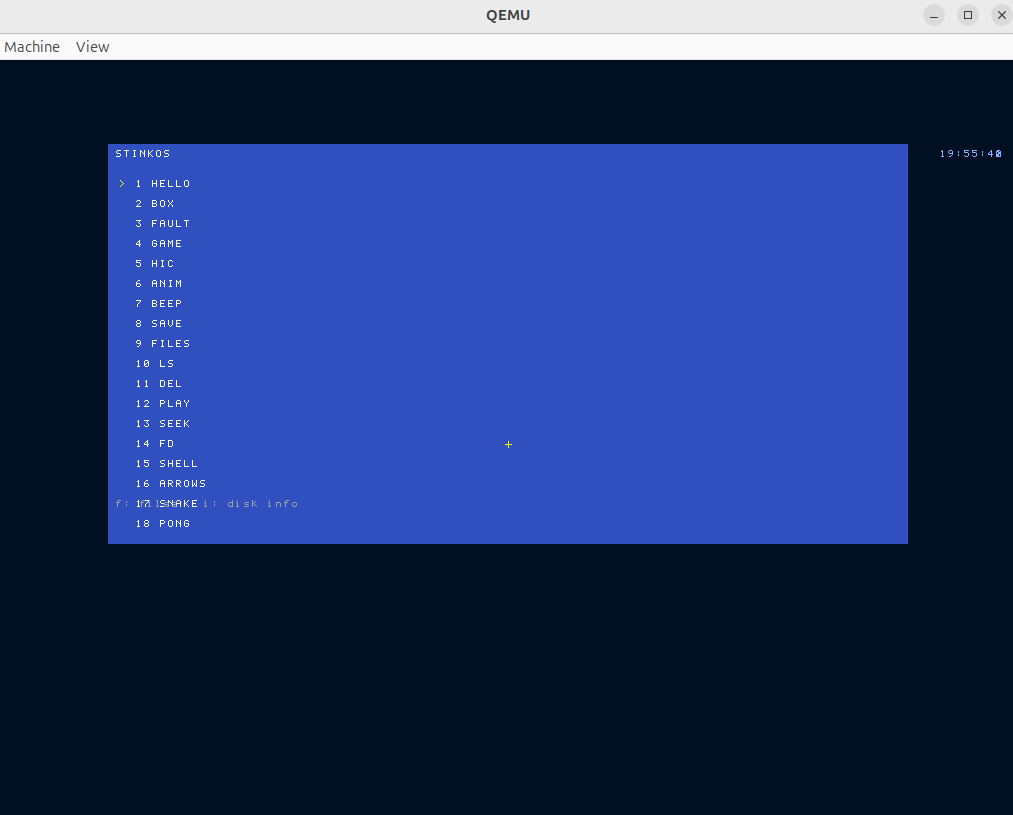
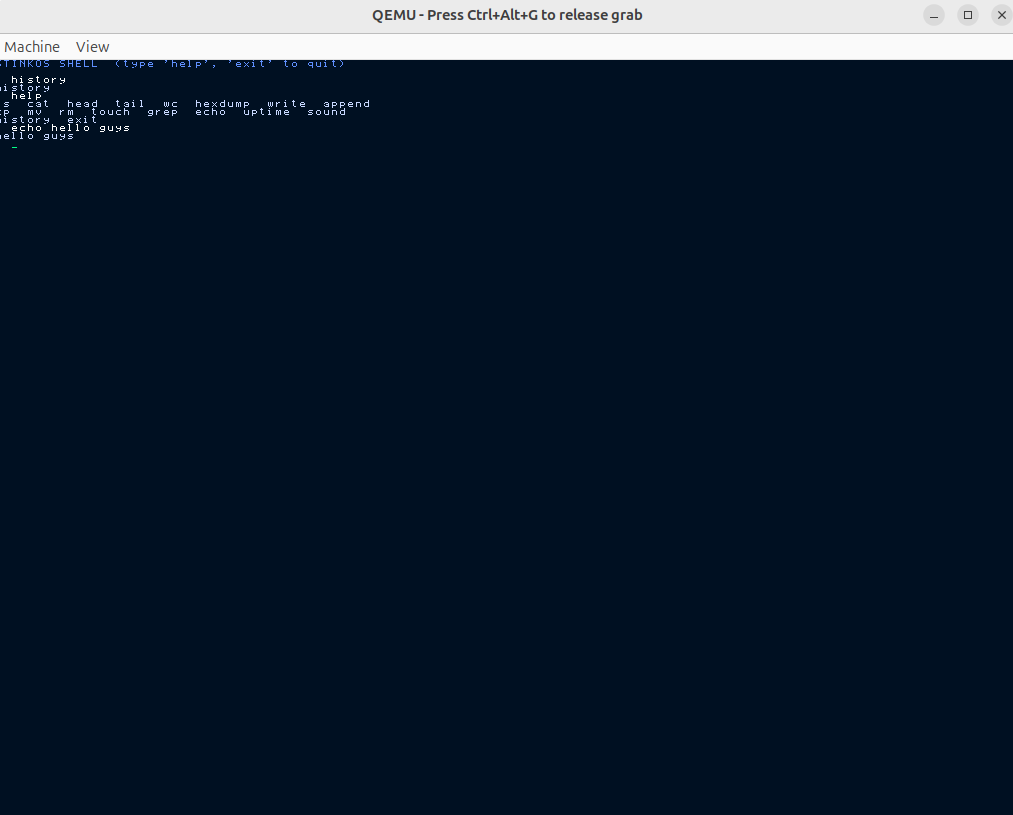
What it is
A real OS, same shape as the big ones — just smaller in every direction. On boot it loads itself from disk via the BIOS, enables A20, builds a GDT, switches the CPU into 32-bit protected mode, sets a VBE linear framebuffer (1024×768×32), wires up interrupts and paging, installs a TSS, and drops into a graphical start menu. From there it loads named ELF binaries off its own filesystem and runs them in Ring 3 with isolated address spaces — a misbehaving app faults and returns to the menu instead of taking down the system. Apps talk to the kernel only through an int 0x80 syscall ABI.
What this release offers
- Userland & graphical shell — an on-screen terminal with ~25 commands (
ls,cat,write,rm,cp,mv,touch,grep,head,tail,wc,hexdump,history,netinfo/ifconfig,ping,run, …) and arrow-key command history; a full-screen text editor; Snake and Pong. - Filesystem (StinkFS + VFS) — flat named files persisted to disk, a file-descriptor layer (open/read/write/seek/close), and an ELF loader that streams app segments straight off disk. Apps live as named files and show up in the menu automatically.
- Networking from scratch — Intel e1000 NIC driver (PCI probe, RX/TX descriptor rings), Ethernet, ARP, IPv4, ICMP, UDP, a TCP state machine with ACK accounting, a DHCP client, and a DNS resolver. Surfaced through the shell's
netinfoandping. - Storage — ATA driver across all four drive slots with Bus Master DMA (PIIX BMIDE), MBR partition read/write, and disk info/copy syscalls. An installer app can clone the boot media onto a target disk.
- Audio — Sound Blaster 16 driver (DSP probe, IRQ 5, ISA 8237 DMA, 22050 Hz auto-init output) plus an 8-channel kernel software mixer, exposed to apps via audio syscalls. PC speaker driver too.
- Package manager (
stink-pkg) — an in-OS package manager with its own HTTP client and a.stinkpkgformat; downloads are verified by SHA-256 against the repo index before install. - Input & misc — PS/2 keyboard (arrows, Caps Lock, Ctrl, Home/End/PgUp/PgDn) and PS/2 mouse with cursor and point-and-click; CMOS RTC with a live clock in the menu.
- Boot diagnostics — a BIOS-style POST screen reporting each subsystem's status as it comes up.
- A ~44-call syscall ABI wrapped as static inlines in
lib/libstink.h, plus a freestanding C library (malloc/free over a growable heap, aFILEstdio layer, printf family, string/ctype/mem helpers,setjmp, SHA-256). - Doom — all of Doom 1 (36 maps), Doom 2 (32 maps), and FreeDM run as Ring 3 apps. Disabled in this image by default (see below).
Requirements
qemu-system-i386to run in a VM, or a BIOS/legacy-boot PC to run on metal.- To build from source: the
i386-elfcross-toolchain andpython3(see the repo README).
Quick start — run the prebuilt image
Download stinkos-v0.3.0.img.gz, then:
gunzip stinkos-v0.3.0.img.gz
qemu-system-i386 -drive format=raw,file=stinkos-v0.3.0.img \
  -netdev user,id=net0 -device e1000,netdev=net0 \
  -audiodev none,id=snd0 -device sb16,audiodev=snd0
The -device e1000 / -device sb16 flags light up the network and audio drivers; drop them for a bare boot. The disk image is ~98 MiB raw because it carries StinkFS's full data region (mostly empty here — it compresses to ~0.6 MiB).
Run on real hardware
Write the raw image to a USB stick or disk and boot it on a BIOS/legacy machine (not UEFI-only):
sudo dd if=stinkos-v0.3.0.img of=/dev/sdX bs=4M conv=fsync # ⚠ /dev/sdX is ERASED — pick the right deviceEnabling Doom
The Doom menu entries (DOOM1 / DOOM2 / FREEDM) are greyed out in this image because no WADs are bundled — game content is not part of the source and isn't redistributed here. To play, build from source with the free Freedoom WADs:
git clone https://github.com/Jovinull/StinkOS && cd StinkOS
bash tools/fetch-wads.sh   # downloads freedoom + freedm (~33 MB) into wads/
make run
Have a commercial doom.wad/doom2.wad? Drop it in wads/ and override: make FREEDOOM1_WAD=path/to/doom.wad.
Build from source
bash tools/build-cross-toolchain.sh   # one-time: builds i386-elf binutils+gcc (~30–60 min)
source ~/.bashrc
make                                   # produces os.bin
make test-headless                     # boots in qemu and asserts subsystem bring-up
make run                               # interactive
Verify your download
sha256sum -c SHA256SUMSSHA256SUMS lists checksums for both the compressed .img.gz and the decompressed .img.
Assets
| File | What it is |
|---|---|
stinkos-v0.3.0.img.gz |
Bootable raw disk image (gzip). gunzip it, then boot in QEMU or dd to a disk. |
SHA256SUMS |
SHA-256 checksums for the image (compressed and decompressed). |
| Source code (zip / tar.gz) | Full source at tag v0.3.0 (auto-attached by GitHub). |
Known limitations
- Single-process: one Ring 3 app runs at a time (returns to the menu on exit/fault). Preemptive multitasking is next.
- Doom runs without music/sound effects and without mouse-aim wired to the engine yet (the SB16 driver and mouse-delta syscall both exist; the glue doesn't).
- BIOS/legacy boot only — no UEFI.
License
GPLv3. The vendored Doom engine under apps/doom/ is also GPL and is attributed in-tree. Everything else is original.