This project is focuses on performing customer segmentation on a group of mall customers. I have used KMeans Unsupervised Learning algorithm to find Univariate and Bivariate clusters. Once these clusters are identified, I have provided observations(Insights) on what the target cluster should be.
- I performed both, Univariate and Bivariate analysis to gain insights on the data.
- The correlation between annual income, age, and spending score was calculated. It is observed that the annual income and age are negatively correlated, and so are spending score and age.
- These observations are important when it comes to the content of the campaigns, the focus areas should be deteremined based on the age, their income and other such factors.
- Algorithm: KMeans Unsupervised Learning algorithm
- First, I have created clusters based on the income.
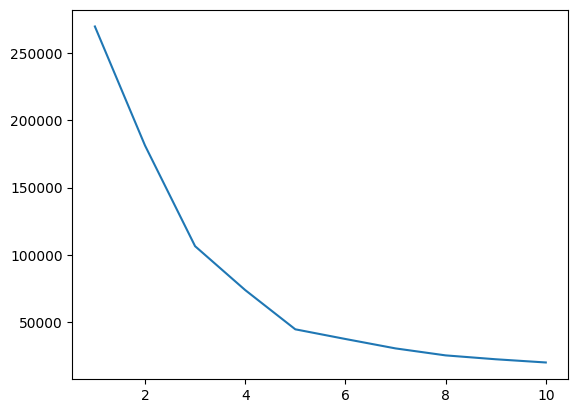
- Used elbow method to find the ideal number of clusters, that's 3 here.

- For using the elbow method, I first calculated the intertia scores, and plotted them.
- For learning more about the relation between age, income and spending score, I calculated the mean age, mean annual income, and mean spending score for each cluster.

- It can be observed that the mean annual income of the first cluster is very high, and high explains the high spending score.
- The second cluster had the highest mean age, and also the lowest average income. This falls in line with the observation from the heatmap.
- For Bivariate clustering, I have created Spending and Income cluster. Like in case of Univariate clustering, I used elbow method to find the number of clusters, 5 here.