Using the DryadLINQ job browser
The DryadLINQ job browser is a graphical user interface which provides a unified view of a large part of the distributed state of a DryadLINQ job. In this document we provide a brief overview of the main capabilities of the DryadLINQ job browser.
DryadLINQ is a compiler and runtime designed to allow users to run .Net programs on large computer clusters. The input language of DryadLINQ is .Net 4.5 or later. DryadLINQ compiles some .Net LINQ constructs into distributed execution plans, and uses the Dryad distributed runtime to execute these plans on a computer cluster reliably. Dryad runs on a variety of environments; in this manual we discuss the version of Dryad that runs on top of HDInsight, which in turns runs on top of Hadoop, which runs on top of Azure. An introduction to Dryad, LINQ, DryadLINQ, Azure and HDInsight is not in the scope of this manual. Some pointers can be found at the MSR SVC big data web page.
LINQ is essentially a language of operators that compute on collections of values, reminiscent of the relational algebra (SQL), and Lisp. A chain of LINQ operators is a LINQ query. Each LINQ query is translated by DryadLINQ into a Dryad job plan, which is then executed by Dryad on the cluster. A Dryad job is always a directed acyclic graph: the nodes of the graph (also called vertices) are processes that run independently on different machines. The edges of the graph (also called channels) are communication channels that move data between the vertices. While conceptually the user writes a single program that operates on collections, at runtime the program is executed using multiple machines, and on collections that are partitioned and stored on multiple machines. While DryadLINQ does a very good job of providing the illusion that the distributed computation occurs on a single machine, under some circumstances the single-machine abstraction breaks down. This happens especially when the application has (correctness or performance) bugs. The user of DryadLINQ is faced with the task of understanding the behavior of an application that spans multiple machines.
To start the job/cluster browser the user has to invoke the provided executable jobBrowser.exe While running the job browser a console window is shows the detailed log messages generated by the job browser.
The cluster browser is used to connect to a cluster and to retrieve the list of running, or recently run jobs.
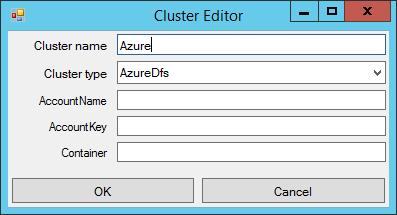
Prior to browsing jobs the cluster browser has to be taught how to connect to a cluster which is running jobs. Click the “Cluster” menu and select , as shown in Figure 1. This will bring a menu like the one in Figure 2. You can give your cluster any name you want; for using a HDInsight cluster choose a type “AzureDfs”.
Clicking on will attempt to add to this menu all clusters for which you have stored HDInsight certificates (if any are found).
Figure 1: Creating a new cluster
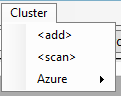
Figure 2: the cluster editor
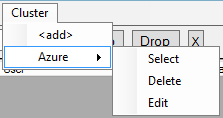
Once you have filled this form, clicking again on the “Cluster” menu will bring up a cluster with the name you have typed, as shown in Figure 3. Choosing “Select” in this menu will enumerate the jobs executed in that cluster.
Figure 3: manipulating a cluster
Once the user has connected to a cluster a display like the one in Figure 4 is shown.
Figure 4: Cluster browser window
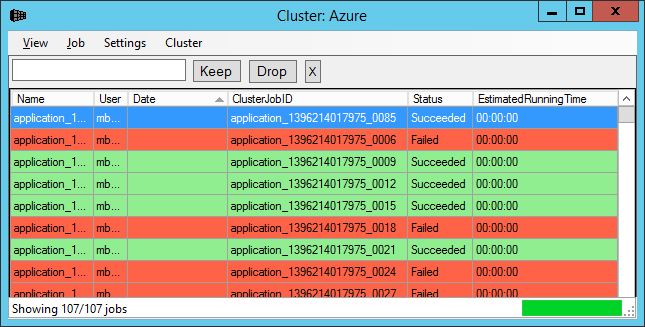
Each job is a displayed on a separate line. The jobs are color coded according to their status: red=failed, green=successful, cyan=running and yellow=cancelled. The cursor points to the currently selected job(s). Several operations can be applied to the selected jobs; some operations can be performed on a single job. The jobs can be sorted on the displayed columns. They can also be filtered using the three buttons shown in Figure 5. The “Keep” button will only show jobs which match the filter, while the “Drop” button will only show jobs which do not match the filter. The “X” button removes all applied filters.