Repository navigation
FP8 and NVFP4
Documentation home · Quickstart · Lifecycle
On this page
GPT-QModel has several distinct floating-point quantization paths. They differ in what is stored in the checkpoint, whether activations are quantized, and which runtime is required. The word “FP8” alone is not enough to choose a configuration or backend.
| Path | Saved weights | Activation contract | Configuration/runtime |
|---|---|---|---|
| FP8 weight-only quantization | FP8 weight plus FP32 inverse scales |
Ordinary floating inputs; an eligible tensorwise CUDA fast path quantizes inputs internally |
FP8Config, METHOD.FP8, FORMAT.FP8, TorchFP8Linear
|
| Native FP8 source checkpoint | Source-format FP8 weights and source scales | Weight-only runtime, or native forward/module-local decoding for a fresh GPTQ/AWQ solve, subject to capability and layout validation | Native floatx source detection and auto-module decoder |
| Native NVFP4 weight checkpoint | Packed E2M1 weights and block scales | Ordinary floating inputs |
TorchFP4Linear / source decoder; not FP8Config(bits=4)
|
| GPTQ W4A-FP8 | Native GPTQ INT4 qweight, qzeros, scales, g_idx
|
E4M3 codes with one FP32 scale per token |
activation="w4afp8", BACKEND.GPTQ_W4AFP8
|
| GPTQ W4A-NVFP4 | Native GPTQ INT4 weights, plus activation-policy metadata/scalars | Packed E2M1 codes, E4M3 block-16 scales, FP32 global scale |
activation="w4a_nvfp4", BACKEND.GPTQ_W4A_NVFP4
|
The W4A paths do not save FP8 or FP4 weight checkpoints. They execute native GPTQ INT4 weights through floating tensor-core operands at runtime. Conversely, FP8Config is not a switch for the GPTQ W4A activation stream.
This page describes source revision 17d4a422a5163608a86c8d62e7b54e1df89b8402. Hardware and optional Torch/Triton APIs are checked at runtime; format recognition is not a promise of native execution on every device.
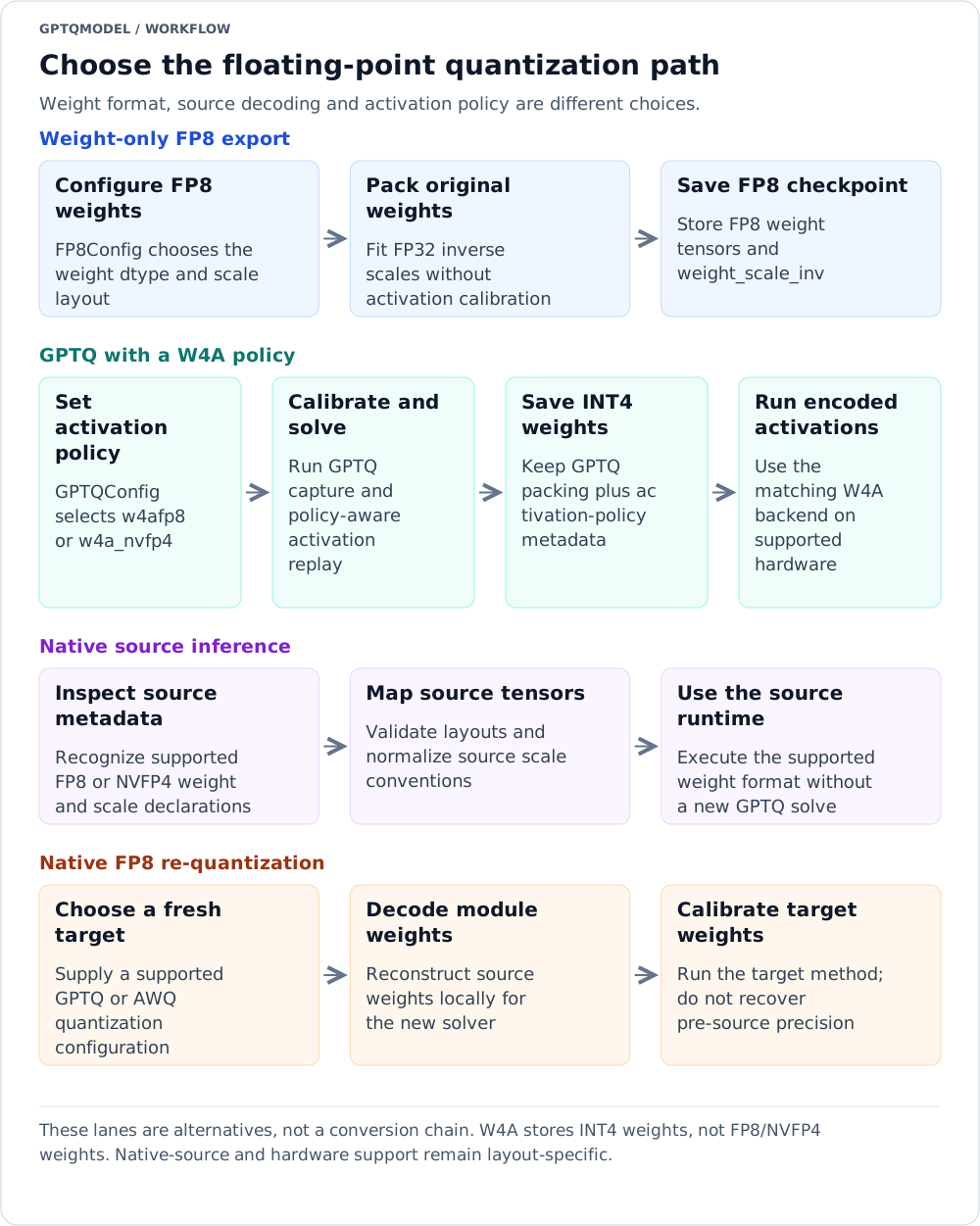
Reading the diagram: These lanes are alternatives, not a conversion chain. W4A stores INT4 weights, not FP8/NVFP4 weights. Native-source and hardware support remain layout-specific.
Text version of the workflow
- Weight-only FP8 export: Configure FP8 weights → Pack original weights → Save FP8 checkpoint.
- GPTQ with a W4A policy: Set activation policy → Calibrate and solve → Save INT4 weights → Run encoded activations.
- Native source inference: Inspect source metadata → Map source tensors → Use the source runtime.
- Native FP8 re-quantization: Choose a fresh target → Decode module weights → Calibrate target weights.
| Identifier | Value | Meaning |
|---|---|---|
METHOD.FP8 |
"fp8" |
Weight-only FP8 quantization method |
FORMAT.FP8 |
"fp8" |
FP8 checkpoint/backend family |
FP8Config.format |
Default "float8_e4m3fn"
|
Actual canonical Torch FP8 dtype name |
BACKEND.FP8_TORCH |
"fp8_torch" |
Torch FP8 weight runtime |
BACKEND.GPTQ_W4AFP8 |
"gptq_w4afp8" |
GPTQ INT4 weights with FP8 activations |
BACKEND.GPTQ_W4A_NVFP4 |
"gptq_w4a_nvfp4" |
GPTQ INT4 weights with NVFP4 activations |
FP8Config._resolve_checkpoint_format() normalizes its dtype-valued format and returns FORMAT.FP8 for backend selection. Thus a serialized format="float8_e5m2" still belongs to the FP8 family; it is not a second quantization method.
GPT-QModel's FP8 weight format supports only weight_scale_semantics="inverse". For a scale region with maximum absolute weight amax and dtype limit fp8_max, the packer computes:
# Conceptual form of the implementation; all scale arithmetic uses FP32.
scale_inv = fp8_max / max(amax, torch.finfo(torch.float32).tiny)
qweight = clamp(weight * scale_inv, -fp8_max, fp8_max).to(fp8_dtype)
weight_reconstructed = qweight.float() / scale_inv
An all-zero region uses inverse scale 1, not an infinite or zero scale. Inverse-scale storage must not be confused with a source checkpoint's direct weight_scale, where reconstruction multiplies by the scale. The native-source loader normalizes recognized direct scales to inverse scales before constructing TorchFP8Linear.
The W4A activation helpers use their own scale conventions: FP8 token scales and NVFP4 local/global scales are multiplicative decoding scales. Do not pass them as weight_scale_inv merely because they are called scales.
For a weight matrix shaped (out_features, in_features):
| Method |
weight_scale_inv shape |
Regions |
|---|---|---|
"tensor" |
Scalar ()
|
One scale for the entire matrix |
"row" |
(out_features,) |
One scale for each output row |
"block" |
(out_features // block_rows, in_features // block_cols) |
One scale for each rectangular weight block |
Block dimensions follow weight storage order, not activation order: [block_rows, block_cols] means [output_rows, input_columns]. Both dimensions of the matrix must divide exactly by the corresponding block size; the Torch FP8 backend does not automatically pad them.
from gptqmodel import GPTQModel
from gptqmodel.quantization import FP8Config

qcfg = FP8Config(
    format="e4m3",
    weight_scale_method="row",
    device="cuda:0",
)
model = GPTQModel.load("/path/to/dense-model", quantize_config=qcfg)
model.quantize()  # No activation calibration dataset is needed for this path.
model.save("/path/to/fp8-model")
FP8 uses the weight-only lifecycle: WeightOnlyLooper and WeightOnlyProcessor directly pack selected original weights. They do not collect activation Hessians or replay calibration forwards. If a calibration dataset is supplied, this path logs that it is ignored. Adapter/EoRA generation, GPTAQ, and FOEM/native activation capture are not supported in this lifecycle.
from gptqmodel.quantization import FP8Config

# Explicit rectangular blocks. All selected matrix dimensions must fit them.
block_qcfg = FP8Config(
    format="e5m2",
    weight_scale_method="block",
    weight_block_size=[128, 128],
    device="cuda:0",
)

# Explicit tensorwise scaling, including eligibility for the CUDA scaled-mm path.
tensor_qcfg = FP8Config(
    format="e4m3",
    weight_scale_method="tensor",
    device="cuda:0",
)
These configurations select different weight-scaling granularity; they do not change the method to GPTQ or enable a W4A stream.
FP8Config subclasses PreProcessorConfig, so shared device, dynamic, smoother, and preprocessing controls remain available. The FP8-specific declared fields are:
| Field | Declared type | Default | Validation/normalization |
|---|---|---|---|
bits |
int |
8 |
Must equal 8 |
method |
METHOD |
METHOD.FP8 |
Must be fp8
|
format |
Optional[str] |
"float8_e4m3fn" |
Normalized to an available Torch dtype name |
group_size |
int |
-1 |
Forced to -1; not used for FP8 weight scaling |
desc_act |
Optional[bool] |
False |
Forced to False
|
sym |
bool |
True |
Forced to True
|
weight_scale_method |
str |
"row" |
tensor, row, or block
|
weight_block_size |
Optional[Union[List[int], Tuple[int, int]]] |
None |
Positive two-item block dimensions; stored as a list in normalized config |
weight_scale_semantics |
str |
"inverse" |
Only inverse supported |
allowed_quant_methods() returns (METHOD.FP8,). quant_linear_init_kwargs() passes format, weight_scale_method, weight_block_size, and weight_scale_semantics to the runtime module. These same normalized settings are added to serialized output. uses_weight_only_lifecycle() returns True.
The format helper has this signature:
def _normalize_fp8_fmt(value: Optional[str]) -> str:| Accepted aliases | Canonical dtype name |
|---|---|
e4m3, float8_e4m3, float8_e4m3fn
|
float8_e4m3fn |
e5m2, float8_e5m2
|
float8_e5m2 |
e4m3fnuz, float8_e4m3fnuz
|
float8_e4m3fnuz |
e5m2fnuz, float8_e5m2fnuz
|
float8_e5m2fnuz |
e8m0, e8m0fnu, float8_e8m0, float8_e8m0fnu
|
float8_e8m0fnu |
None, empty string, "fp8", or FORMAT.FP8
|
float8_e4m3fn |
Strings are stripped and lowercased. Other FORMAT enum members, unknown aliases, and canonical dtypes missing from the installed PyTorch build raise ValueError.
Configuration recognition is broader than weight packing. float8_e8m0fnu is accepted for dequantization of existing checkpoints, but quantize_fp8_weight() explicitly rejects creating dense-weight E8M0 checkpoints. The native MLX weight encoder supports only the four E4M3/E5M2 variants in the table, not E8M0.
def _normalize_fp8_weight_block_size(value: Optional[Union[List[int], Tuple[int, int]]]) -> Optional[Tuple[int, int]]:This helper accepts None or a two-item list/tuple, converts each entry with int(), requires both results to be positive, and returns a tuple. It validates the block specification, not divisibility of a particular matrix; divisibility is checked by the runtime/packer.
def _normalize_fp8_weight_scale_method(
    value: Optional[str],
    *,
    weight_block_size: Optional[Tuple[int, int]],
) -> str:

def _normalize_fp8_scale_semantics(value: Optional[str]) -> str:| Helper/input | Result |
|---|---|
Scale method None with a block size |
"block" |
Scale method None without a block size |
"row" |
Explicit tensor, row, block
|
Stripped/lowercased and checked |
block without a block size |
Error |
| Non-block method with a block size | Error |
| Unknown method | Error |
Scale semantics None
|
"inverse" |
| Explicit semantics string | Stripped/lowercased; anything except inverse is an error |
Be careful with the distinction between helper defaults and constructor defaults: FP8Config.weight_scale_method defaults to the explicit string "row". Supplying only weight_block_size=[128, 128] to the constructor therefore conflicts with row scaling. Set weight_scale_method="block" explicitly, as in the example. A normalized dictionary whose method is omitted can infer block scaling from a block size.
_normalize_fp8_kwargs(payload) handles dictionary/legacy inputs: it recognizes legacy fmt, normalizes the canonical format, block size, and scale method, and extracts legacy weight-only smoothing settings when no modern smoother/smooth field was supplied. Use format=... in new Python calls rather than assuming the dataclass has a fmt constructor parameter.
def _normalize_fp8_kwargs(payload: Dict[str, Any]) -> Dict[str, Any]:from gptqmodel.quantization import FP8Config
qcfg = FP8Config(
format="e4m3",
weight_scale_method="row",
dynamic={
r".*\.mlp\.down_proj$": {"format": "e5m2"},
r".*\.self_attn\.q_proj$": {"weight_scale_method": "tensor"},
},
)Dynamic entries can select per-module format and scale settings. The FP8 dynamic normalizer requires any bits override to represent 8 and any group_size override to be -1 or None. It canonicalizes a dynamic fmt alias into format, validates local block/method combinations and scale semantics, and serializes a provided block size as a list. clone_weight_only_config_for_module() resolves the module-specific configuration before packing; dynamic exclusion can skip modules entirely. Use actual module names from the model definition.
from gptqmodel import GPTQModel, BACKEND

model = GPTQModel.load(
    "/path/to/fp8-model",
    device="cuda:0",
    backend=BACKEND.FP8_TORCH,
)
CPU fallback and Apple Silicon are distinct execution choices:
cpu_model = GPTQModel.load(
    "/path/to/fp8-model", device="cpu", backend=BACKEND.FP8_TORCH,
)
mlx_model = GPTQModel.load(
    "/path/to/fp8-model", device="mps", backend=BACKEND.MLX,
)
These are alternatives; do not keep extra model copies resident unless needed.
The public module-local weight helper is:
def quantize_fp8_weight(
    weight: torch.Tensor,
    *,
    format: str = "float8_e4m3fn",
    weight_scale_method: str = "row",
    weight_block_size: Optional[Tuple[int, int]] = None,
) -> tuple[torch.Tensor, torch.Tensor]:
It requires a rank-2 matrix, normalizes format and scale layout, converts work to contiguous CPU FP32, computes inverse scales by region, clamps to the dtype's finite range, casts to FP8, and returns (qweight, scale_inv). Scales are FP32. A block-size mismatch raises an error rather than truncating or padding the matrix.
TorchFP8Linear.pack_original() flattens convolution weights and transposes Transformers Conv1D weights into the matrix convention. It applies the optional weight smoother before quantization; smooth_block_size() returns the input block width for block scaling and -1 otherwise. It ignores GPTQ-style scales, zeros, and g_idx arguments, because these are not the FP8 scale source. Bias is stored in FP16. pack(), pack_block(), and pack_gpu() delegate to this same original-weight packer; pack_gpu() is not an independent GPU FP8 weight-quantization algorithm.
On Darwin arm64 with MLX available, supported E4M3/E5M2 matrices containing at least 60 * 1024 * 1024 elements are routed to the native MLX encoder by pack_original(). Smaller matrices use the Torch helper. The bridge returns contiguous CPU Torch FP8 weights and FP32 inverse scales.
The constructor in gptqmodel/nn_modules/qlinear/fp8.py is:
def __init__(
    self,
    bits: int,
    group_size: int,
    sym: bool,
    desc_act: bool,
    in_features: int,
    out_features: int,
    bias: bool = False,
    pack_dtype: torch.dtype = torch.int32,
    adapter: Adapter = None,
    register_buffers: bool = True,
    format: str = "float8_e4m3fn",
    weight_scale_method: str = "row",
    weight_block_size: Optional[Tuple[int, int]] = None,
    weight_scale_semantics: str = "inverse",
    **kwargs,
):| Capability | Source declaration |
|---|---|
| Backends/methods/formats |
FP8_TORCH; METHOD.FP8; FORMAT.FP8
|
| Bits | 8 |
| Devices | CPU, CUDA, ROCm, XPU, MPS |
| Platforms | All |
| Activation/model dtypes | FP16, BF16, FP32 |
| Feature divisibility | 1 in general; block and fast-path restrictions apply separately |
| Automatic padding | Disabled |
| Shards | Supported |
| Training declaration | SUPPORTS_TRAINING=True |
| Adapters | LoRA |
| Pack dtype declarations |
int8, int16, int32, int64; these do not change FP8 weight storage |
The backend deliberately excludes NPU: the source notes that exposing FP8 dtypes on CPU through torch-npu does not establish CANN support for device FP8 tensors. validate_once() requires a PyTorch build exposing FP8 dtypes.
Persistent buffers are FP8 weight, FP32 weight_scale_inv, and optional bias. dequantize_weight(*, device=None, dtype=None) defaults to FP32 and returns the transposed contiguous matrix (in_features, out_features) for multiplication by flattened inputs.
| Forward route | Eligibility and behavior |
|---|---|
torch._scaled_mm |
CUDA device; tensorwise scales only; _scaled_mm present; FP16/BF16 input; matching width; input/output dimensions divisible by 16; not E8M0; not previously disabled |
| Dequantize + matmul | General fallback; reconstructs for the current multiplication rather than retaining a dense weight cache |
| Compiled CPU fallback | Explicit optimize(backend="inductor", mode=None, fullgraph=False) on CPU when Torch compilation is available |
The _scaled_mm implementation dynamically quantizes the input using the weight's FP8 dtype and converts inverse weight scales to direct scales for the Torch call. Although scale helpers contain rowwise logic, _can_use_scaled_mm() currently permits only tensorwise weight scales. Do not advertise rowwise/blockwise native scaled-mm execution based on the helpers alone.
If _scaled_mm raises, the module disables that route for subsequent forwards and uses dequantize + matmul. Packing resets that disable flag. Compiled CPU errors log a warning, invalidate compilation, and fall back to eager execution. Device/dtype application and state loading invalidate compiled state. After the product, bias and any adapter are applied and the original leading input dimensions are restored.
For older CUDA devices without native FP8 support, dequantization happens on CPU before transferring the target FP16/BF16/FP32 weight for the operation. E8M0 also forces the validated CPU lookup-table path because the source documents problematic CUDA casting for that format. Being able to store FP8 bytes on a GPU does not prove that its FP8 arithmetic is supported or faster.
The encoder in gptqmodel/quantization/mlx_fp8.py has this signature:
def quantize_fp8_weight_mlx(
    weight,
    *,
    format="float8_e4m3fn",
    weight_scale_method="row",
    weight_block_size=None,
):
It accepts nonempty rank-2 finite MLX FP16/BF16/FP32 weights, validates the same scale layout, and returns FP8 storage bytes (mx.uint8) plus inverse scales. Its Metal encoder implements finite saturation, nearest-even rounding, signed-zero behavior for the appropriate formats, and special handling of source FP32 subnormals. It does not return an MLX array with a Torch FP8 dtype.
| MLX component | Purpose and restrictions |
|---|---|
FP8MlxQuantLinear in qlinear/mlx.py
|
Torch-side checkpoint holder and transfer contract; Darwin/MPS, no adapters/training, holder dtype declaration FP16 |
MlxFP8Linear in qlinear/mlx_fp8.py
|
Native MLX QuantizedLinear(group_size=32, bits=8, mode="mxfp8") plus checkpoint output scale |
MlxFP8PackedLinear in the same file |
General packed-byte Metal runtime using a 256-value decode table and the original inverse-scale layout |
Exact native MXFP8 transfer requires E4M3FN, tensorwise or rowwise scales, input width divisible by 32, positive finite inverse scales with finite reciprocals, and no E4M3 NaN codes. The transfer preserves E4M3 bytes, supplies unit MX block scales, and applies the checkpoint reciprocal scale afterward. The unscaled dot product is computed with FP32 inputs so an intermediate FP16 overflow does not corrupt an otherwise finite scaled result.
Other source-compatible FP8 modules use MlxFP8PackedLinear: tensor, row, and block scales are applied in FP32 while decoding bytes for the current multiplication. Its general Metal route accepts FP16/BF16/FP32 activations and returns their dtype. An optimized prefill route is selected for multiple rows, input width at most 8192 and divisible by 64, and output width at least 8192 and divisible by 32. It uses 16-row tiles; the general route handles the other cases. These are execution choices, not checkpoint conversions to dense weights.
The repository's MLX extra currently declares mlx>=0.32.4 and MLX-LM minima selected by Python version (>=0.31.3 below Python 3.11, >=0.32.2 at Python 3.11+). Use the supported Apple Silicon installation described in MLX / Apple Silicon.
native_floatx_source_format(config, *, model_local_path=None) in models/loader.py inspects source metadata rather than a model-name suffix:
| Source metadata | Detection behavior |
|---|---|
config.quantization_config |
Inspect a dictionary when present |
Optional hf_quant_config.json
|
Read its quantization object, or the sidecar itself; supports older ModelOpt exports lacking model-config metadata |
quant_algo, quant_format, format, quant_method
|
Collect string algorithm identifiers, lowercased |
config_groups[*].format and Quark floatx metadata |
Include format declarations from those layouts |
| Qwen native FP8 exports | Recognize quant_method: "fp8" rather than requiring ModelOpt's quant_algo key |
Detected families include fp8, nvfp4, mxfp8, mxfp4, nvfp8, and mixed-mx; MiMo mixed sources have a separate detector and mimo_mixed label. Detection precedence distinguishes mixed MX from single-format sources. These are source labels, not additional FP8Config formats that can all use one ordinary FP8 GEMM.
For a fresh METHOD.GPTQ or METHOD.AWQ quantization, configure_native_floatx_source_quantization() enables module-local decoding:
- Validate the decode dtype on the target device. Ordinary sources use BF16; MiMo's special path follows its supported FP16/BF16 model dtype and rejects AWQ.
- Keep GPTQ Hessian staging in FP32, overriding a lower staging dtype if necessary.
- Probe validated native E4M3 or packed-FP4 linear support for eligible source families.
- Add
AutoModuleDecoderConfigwhen one is not already present. - Enable checkpoint-backed
offload_to_diskloading so LazyTurtle preserves original source bytes/scales rather than coercing them into the shell model's floating dtype.
The shell stays on meta; one selected module at a time is decoded for its weight solve. A transient _native_floatx_forward_plan records whether Hessian forwards can use native operands or must decode. This plan is not part of the exported GPTQ/AWQ config. MX and other special layouts can use format-specific decoding even when the ordinary FP8 forward wrapper is inapplicable.
import torch
from gptqmodel import GPTQModel
from gptqmodel.quantization import GPTQConfig

# This is a fresh INT4 GPTQ solve from a native FP8 source checkpoint.
target = GPTQConfig(bits=4, group_size=128, device="cuda:0")
model = GPTQModel.load(
    "/path/to/native-fp8-source",
    quantize_config=target,
    dtype=torch.bfloat16,
)
model.quantize([
    "This example document contains several complete sentences about the kinds "
    "of questions and explanations that the model will encounter during deployment.",
    "Use many real documents from the intended domain for an actual run, keeping "
    "the calibration corpus separate from the data used to evaluate quality.",
])
model.save("/path/to/new-gptq-model")
This does not recover the original pre-FP8 weights. The quantizer receives the source checkpoint's reconstructed weights. Requantization and direct inference of that source are different operations. These strings illustrate the API, not a sufficient calibration corpus; dataset preparation removes samples with at most calibration_data_min_length tokens (default 10).
BaseQModel._build_fp8_forward_module() handles compatible linear source modules. It prefers weight_scale_inv; otherwise it reads direct weight_scale or scale and takes reciprocals. For a zero direct scale it uses 1 / torch.finfo(torch.float32).tiny as the inverse-scale substitute. It infers tensorwise, rowwise, or blockwise layout from the normalized scale shape and constructs TorchFP8Linear without repacking the source weights.
It returns no ordinary FP8 wrapper for declared MXFP8/NVFP8 formats, non-linear targets, missing scale metadata, or incompatible layouts. Padded/special source layouts can therefore fall back to module-local dense decoding even when the GPU supports FP8. The per-module checks are necessary in addition to the device probe.
gptqmodel/nn_modules/qlinear/fp4.py defines:
def __init__(
    self,
    *,
    in_features: int,
    out_features: int,
    weight: torch.Tensor,
    weight_scale: torch.Tensor,
    weight_block_size: int,
    orig_dtype: torch.dtype,
    bias: Optional[torch.Tensor] = None,
) -> None:
TorchFP4Linear registers packed weight, weight_scale, and optional bias. On CPU with CPU weights, it decodes the live E2M1 buffers through dequantize_f4_e2m1() for the current F.linear() call without retaining a dense weight. On other devices it constructs a TorchAO NVFP4Tensor view and calls F.linear(). That route requires importable TorchAO NVFP4 support and compatible device/runtime APIs; the source path is torchao.prototype.mx_formats.nvfp4_tensor.
This class is a forward wrapper for already-packed weights, not a generic FP4Config quantizer and not the W4A-NVFP4 INT4-weight backend. BitsAndBytes' fp4 format is another distinct representation; see BitsAndBytes.
Direct loading of a ModelOpt checkpoint with activation quantization metadata is rejected by _configure_modelopt_runtime(). The error explicitly distinguishes supported dense-activation weight-only variants such as W8A16/FP8 and W4A16/FP4 from unsupported ModelOpt activation-quantized runtime execution.
A ModelOpt FP8/NVFP4 checkpoint can still be a source for fresh weight-only GPTQ/AWQ quantization when the auto-module decoder is active; its original activation metadata is not used as the runtime policy. This exception does not mean ModelOpt activation quantization and GPT-QModel's own activation stream are interchangeable.
from gptqmodel import GPTQModel
from gptqmodel.quantization import GPTQConfig

qcfg = GPTQConfig(
    bits=4,
    group_size=128,
    sym=True,
    desc_act=False,
    lm_head=False,
    activation="w4afp8",
    device="cuda:0",
)
model = GPTQModel.load("/path/to/supported-llama-model", quantize_config=qcfg)
model.quantize([
    "This example document contains several complete sentences about the kinds "
    "of questions and explanations that the model will encounter during deployment.",
    "Use many real documents from the intended domain for an actual run, keeping "
    "the calibration corpus separate from the data used to evaluate quality.",
])
model.save("/path/to/gptq-w4afp8-model")
Unlike FP8 weight-only packing, this is a calibrated GPTQ solve with activation policy replay and a saved encoded-stream contract. Replace the illustrative strings with a representative corpus whose tokenized samples survive the minimum-length filter. Loading the saved model with AUTO binds the matching W4A backend through backend_for_activation(). Explicitly requesting a different backend raises an error rather than silently discarding the activation policy. An ordinary GPTQ checkpoint without this policy is not automatically assigned W4A execution merely because the backend supports GPTQ packing.
For an explicit FP8-attention / NVFP4-MLP split:
from gptqmodel.quantization import GPTQConfig

qcfg = GPTQConfig(
    bits=4,
    group_size=128,
    sym=True,
    desc_act=False,
    lm_head=False,
    device="cuda:0",
    activation={
        "mode": "w4a_nvfp4",
        "recipe": "least_squares",
        "attention": {"mode": "w4afp8"},
        # Optional promotion of selected MLP layers to FP8:
        "mlp": {"mode": "w4afp8", "layers": [0, 1]},
    },
)
Use layer indices that exist in the target model. The example promotes the first two MLP layers; it is not a universal accuracy prescription. Without an attention override, the installer uses the stream mode for attention too. The default ActivationAttentionConfig.mode="w4afp8" does not imply that the optional object is automatically created for every NVFP4 stream.
| Constraint | Required value/behavior |
|---|---|
| Method and checkpoint family | GPTQ; FORMAT.GPTQ or FORMAT.GPTQ_V2
|
| Runtime zero-point convention |
REQUIRES_FORMAT_V2=True; GPTQ-v1 serialized zero points are converted by the loader before post-initialization |
| Weight layout | 4-bit, symmetric, group size 128, desc_act=False
|
| Packing | torch.int32 |
| Head | lm_head=False |
| Dynamic weight-layout overrides | Overrides of bits, sym, group_size, or desc_act are rejected; exclusion remains possible subject to stream completeness |
| Stream model support | Current installer requires a Llama decoder (LlamaDecoderLayer), not every model with similarly named projections |
| Selected decoder layer | All seven attention/MLP projections must be W4A modules |
| Projection outputs for stream transport | Width divisible by 128; stricter than the individual linear class's divisor 32 |
| Reinstallation | A different policy cannot silently replace an installed stream |
The seven projections are self_attn.q_proj, k_proj, v_proj, o_proj, and mlp.gate_proj, up_proj, down_proj. Partial conversion of these within a selected layer is rejected. Shared encoded operands must carry consistent scale and rotation contracts. See Model Definitions and Module Tree and Rotation, Smoothing, and Norm Tuning.
| Requirement | W4A-FP8 | W4A-NVFP4 |
|---|---|---|
| Backend | GPTQ_W4AFP8 |
GPTQ_W4A_NVFP4 |
| Class | W4AFP8Linear |
W4ANVFP4Linear |
| Minimum compute capability checked |
(8, 9) — Ada or newer FP8 tensor cores |
(12, 1) — GB10 / SM12.1 floor in this release |
| Device/platform declaration | CUDA / Linux | CUDA / Linux |
| Input/model dtypes | FP16, BF16 | FP16, BF16 |
| Matrix divisors in class | Input 128, output 32 | Input 128, output 32 |
| Optional APIs | Triton; the grouped FP8 GEMM needs the Gluon mma_v2 import (first shipped in Triton 3.6.0) |
Triton (the packer is a plain tl.jit kernel — no Gluon); torch.float4_e2m1fn_x2; F.scaled_mm, F.ScalingType, F.SwizzleType
|
| Training/adapters/auto-padding | Not supported | Not supported |
| Checkpoint shards | Supported | Supported |
Do not summarize NVFP4 eligibility as “all Blackwell” or “all SM12x.” The implementation's minimum is 12.1, and API/driver validation still applies. The FP8 lane of a mixed recipe being Ada-compatible does not make its NVFP4 lane Ada-compatible. Older comments in generic backend declarations are less specific than the executable class validation.
The repository currently requires torch>=2.14.1 and torchao>=0.18.0. The W4A Triton helpers import on any Triton build: w4a_triton imports the Gluon pieces lazily, and only the grouped FP8 GEMM is written in Gluon — the token quantizer and the NVFP4 packer are plain tl.jit kernels. On a Triton without mma_v2 (the API first appears in Triton 3.6.0), activation packing still works, but fp8_linear_prepacked raises native_fp8_gemm_error(), which names the required and installed versions. A mixed NVFP4 recipe that steps the attention lane down to FP8 reports the same floor when it runs; pure NVFP4 does not need Gluon. Successful installation of the base package does not replace the per-backend API and capability checks.
ActivationConfig.from_value(value) returns None for None, returns an existing ActivationConfig unchanged, and constructs an ActivationConfig from a mode string or dictionary. "w4a_nvfp4" supplies recipe="least_squares". The enclosing quantization config stores the validated policy as a canonical dictionary using to_dict().
| Field | Default | Meaning |
|---|---|---|
mode |
"w4afp8" on the dataclass |
w4afp8 or w4a_nvfp4; required in a dictionary |
recipe |
None; resolves to least_squares for NVFP4 |
NVFP4 block-scale recipe; forbidden for FP8 |
attention |
None |
Optional attention-group policy; only refines an NVFP4 stream |
mlp |
None |
Optional per-layer FP8 MLP promotion; only refines an NVFP4 stream |
global_scales |
None |
Calibrated producer-to-FP32-scale mapping for NVFP4 |
An attention dictionary permits only mode and recipe. FP8 attention forbids an NVFP4 recipe; NVFP4 attention inherits the stream recipe when omitted. An MLP dictionary requires mode="w4afp8" and a nonempty list/tuple of unique, nonnegative integer layer indices; booleans and duplicates are rejected and indices are sorted. The stream installer separately checks decoder depth. Unknown fields are rejected instead of being ignored.
global_scales requires an NVFP4 stream and cannot be combined with the legacy headroom recipes. It must be a nonempty dictionary with string keys starting with model.layers. and positive finite numeric values; booleans are rejected. Each value is rounded through FP32 and must remain positive and finite after that conversion. The stream installer checks exact producer coverage against the active attention/MLP policy, so an arbitrary label with the right prefix is not sufficient.
The stream installer signature is:
def install_w4a_llama_stream(model: torch.nn.Module, mode: str,
                             recipe: str | None = None,
                             global_scales: dict[str, float] | None = None,
                             attention_mode: str | None = None,
                             attention_recipe: str | None = None,
                             mlp_fp8_layers: tuple[int, ...] | None = None,
                             fused_norms: bool = False) -> None:
This is an internal installation entry point in w4a_llama_stream.py, not a replacement for the saved GPTQConfig.activation policy. Its default attention_mode=None resolves to the stream mode; a mixed policy must request FP8 attention explicitly. fused_norms defaults to False.
activation_floatx.py defines FP8_E4M3_MAX = 448.0 and:
def fp8_token_qdq(x: torch.Tensor) -> torch.Tensor:For each last-axis input row it computes amax, uses direct scale amax / 448 (or 1 for an all-zero row), rounds/clamps to torch.float8_e4m3fn, and decodes back to the original dtype. Empty inputs return unchanged; non-finite input values raise an error. This is the Torch quantize/dequantize policy used for replay/reference behavior, not the persistent encoded carrier itself.
w4a_triton.py supplies fp8_pack(), fp8_linear(), and fp8_linear_prepacked(). Packing produces E4M3 codes and one FP32 direct scale per token. The grouped MMA kernel multiplies E4M3 input codes by centered INT4 weight codes represented exactly in E4M3, accumulates each 128-input group in FP32, applies GPTQ group scales, then token scales and bias.
_to_e4m3_rn() emits direct nearest-even cvt.rn.satfinite.e4m3x2.f32 conversion. The source explains that a plain Triton cast on SM8.9 can double-round through truncated FP16; the explicit conversion avoids architecture-dependent code/scale bytes. The launch-device guard selects the operands' CUDA device rather than assuming the process's current device matches a sharded layer.
E2M1 magnitudes are 0, 0.5, 1, 1.5, 2, 3, 4, 6, with a sign bit. The reference uses nearest-even rounding and finite saturation. Each 16-element activation block has an E4M3 local scale; one FP32 global scale is shared by the operand tensor:
decoded_block = e2m1_values * local_e4m3_scale.float() * global_scaleThe two principal reference signatures are:
def nvfp4_global_scale(amax: torch.Tensor | float, *, grid_dtype: torch.dtype | None = None,
                       recipe: str = "least_squares") -> torch.Tensor:

def nvfp4_block_qdq(x: torch.Tensor, global_scale: torch.Tensor | float,
                    recipe: str = "least_squares") -> torch.Tensor:
nvfp4_global_scale() requires finite, nonnegative maxima. For a nonzero maximum, it divides by 448 * 6 for NVIDIA/headroom recipes and by 448 * 4 for the other optimized recipes; zero maxima use scale 1. An optional source-dtype grid may be FP16, BF16, or FP32. If rounding to that grid would underflow the scale to zero, the positive FP32 scale is retained.
nvfp4_block_qdq() requires width divisible by 16, finite values, and a positive finite global scale. It returns the original dtype after blockwise rounding. The runtime packer has the stricter width divisor 128 required by GPTQ grouping and scale swizzling.
| Recipe | Local block algorithm | Global/calibration distinction |
|---|---|---|
nvidia |
Max-scaled E2M1 using maximum 6 | Full E2M1 range |
nvidia_headroom |
Same local algorithm as nvidia
|
Legacy calibrated activation-headroom policy |
four_six |
Evaluate candidates using maxima 4 and 6, keep the lower block SSE | Compatibility recipe retained for older checkpoints |
least_squares |
Refine both 4/6 assignments with least-squares scales rounded back to real E4M3, then refine the winning assignment | Default recipe |
least_squares_headroom |
Same local refinement as least_squares
|
Legacy activation-headroom policy |
least_squares_grid |
Least-squares refinement plus bounded E4M3-bit-grid search | Search radius 8 around the selected positive finite E4M3 encoding |
Legacy strings lsq, lsq_headroom, and lsq_grid normalize to their least_squares* names. These are bounded scale-fitting recipes, not learned-scale QAT. The reference clamps positive local scales to the E4M3 hardware range from 2**-9 through 448 and retains refinements only when true block squared error improves.
NVFP4ActivationHeadroom collects a bounded histogram of maxima of 16-value blocks rather than retaining activation tensors. Its defaults are anchor_percentile=1.0, upper_percentile=99.99, rho=16384.0, num_bins=512, log2_min=-40.0, and log2_max=40.0. It validates percentiles in (0,100] and rho in (0,28672). It tracks the running maximum, rejects non-finite input, and requires nonzero observed blocks before computing a calibrated maximum. If requested headroom does not exceed the calibrated upper percentile it warns and uses the upper value.
W4AFP8Linear.post_init() reads native GPTQ packing, checks contiguous g_idx groups and symmetric zero point 8, and stages centered INT4 codes as _weight_e4m3. All centered INT4 integers are exactly representable in this E4M3 operand; GPTQ scales remain separate. pack() records logical zero-point format 2; GPTQ-v1 serialization conversion is handled separately and reversed by the loader.
W4ANVFP4Linear cannot represent every centered INT4 integer with one E2M1 value. It builds two exact integer planes:
high = floor((centered + 2.0) / 4.0)
low = centered - 4.0 * high
centered = low + 4.0 * high
The two planes are E2M1-encoded and packed along K, concatenated into _weight_both, and multiplied with unit E4M3 weight scales. A separate _weight_e4m3 operand supports mixed FP8 attention over those same INT4 weights. These are runtime staging buffers, marked non-persistent; the saved weights remain native GPTQ INT4. Do not equate the 4-bit checkpoint size with resident runtime memory: the inspected implementation keeps these staged operands in addition to GPTQ buffers. They are not an additional serialized weight format.
Here persistent=False only excludes the operands from state_dict(); it does not make them per-forward temporaries. In this revision, _weight_e4m3 retains a full-layer INT4-to-E4M3 expansion between calls. This is an existing runtime-storage limitation, not compliance with the repository's packed-only persistent-weight rule. The two packed E2M1 planes are exact alternate operands, not a lossy replacement of the saved INT4 weights.
activation_global_scale_bits stores the FP32 calibration scalar as exact INT32 bits so generic model-dtype casting cannot change it. The property activation_global_scale views those bits as FP32. Post-initialization requires it to be positive and finite. Device/dtype application preserves staged hardware operand bytes rather than casting FP8/FP4 codes into the model precision; packing/loading invalidate staging and require appropriate post_init() rebuilding.
For each 128-input GPTQ group, NVFP4 forward calls F.scaled_mm() with ScalingType.BlockWise1x16 and SwizzleType.SWIZZLE_32_4_4. The accumulation kernel recombines low/high products, multiplies the GPTQ group scale, accumulates in FP32, and applies the activation global scale, optional token rescaling, and bias before output conversion.
| File/component | Responsibility |
|---|---|
w4a_nvfp4_triton.py |
E2M1 packing, recipe-specific scale search, fused scale swizzling, decode at nonlinear consumers, and low/high-plane accumulation |
nvfp4_pack_and_swizzle(x, global_scale, *, recipe="least_squares") |
CUDA rank-2 input with K divisible by 128; returns packed E2M1 and all per-group swizzled E4M3 scales |
nvfp4_decode(...) |
Validate packed/scales layout and reconstruct an activation at a consumer requiring ordinary arithmetic |
nvfp4_accumulate_group(...) |
Fuse two exact weight-plane products with the group/global/token scales |
W4AActivation in w4a_activation.py
|
Scale-aware carrier for mode, codes, scales, shape, model dtype, optional global scale/recipe and rotation state |
w4a_llama_replay.py |
Calibration replay policy before final encoded-stream installation |
w4a_llama_stream.py, w4a_boundary.py
|
Llama boundary policies and runtime transport through decoder operations |
For an input (rows, K), the NVFP4 packer returns FP4 storage shaped (rows, K // 2) and scales shaped (K // 128, padded_rows * 8), where padded_rows rounds rows up to a multiple of 128. Eight block-16 scales belong to each 128-input group. Scale padding/swizzling is a kernel operand layout, not padding of the logical model width.
For rows=0, it returns shapes (0, K // 2) and (K // 128, 0) without a kernel launch. The low-level packer validates rank, CUDA placement, K divisibility, and recipe; unlike the Torch QDQ reference, it does not itself scan the input/global scale for non-finite values. Do not treat successful packing as a finite-value validation step.
An encoded operand is not just a low-precision tensor: losing its token/block/global scales changes the computation. W4A linears validate mode, width, device, and rotation state. Where the installed stream requires encoded input, a plain tensor raises TypeError. Rotated operands cannot be reused across incompatible linear contracts; the runtime may decode, rotate, and repack when needed. Mixed W4A-NVFP4 linears can consume FP8 carriers for the attention lane without changing the checkpoint weights.
The model wrapper exposes:
def calibrate_activations(self, samples: List[torch.Tensor], *, progress=None) -> Dict[str, Any]:This is a separate calibration operation for an already-quantized, installed NVFP4 stream, not another GPTQ weight solve. The model must be in evaluation mode. Samples are unpadded, nonempty one-dimensional token-ID tensors; capture must run without KV cache. Calibration data must be disjoint from downstream evaluation data. The implementation updates runtime producer scales and the configuration subsequently used by save().
Producer calibration rejects legacy headroom recipes and requires the installed policy and saved quantization config to match. Shared boundaries and all required NVFP4 producers must be valid; arbitrary partial producer maps are not a substitute for this procedure. See Evaluation for keeping calibration and evaluation separate.
# `model` is an already-quantized model loaded with an NVFP4 activation policy.
# Use unpadded token-ID vectors from a calibration-only corpus.
model.model.eval()
report = model.calibrate_activations(calibration_token_vectors)
model.save("/path/to/calibrated-gptq-nvfp4-model")
The returned dictionary contains:
| Report field | Value/meaning |
|---|---|
algorithm |
"producer_maximum" |
recipe |
Stream-level NVFP4 recipe |
global_scales |
Producer-to-scale mapping |
boundaries |
Per-producer measurements listed below |
upstream_activations |
"calibrated_encoded_carriers" |
weight_updates |
0 |
Each entry in boundaries contains:
| Producer report field | Meaning |
|---|---|
recipe |
Effective attention/MLP recipe for that producer |
amax |
Maximum observed absolute producer value |
global_scale |
Frozen positive FP32 global decoding scale |
tokens |
Number of observed token rows |
samples |
Number of observations at that producer |
The implementation calibrates producers in topological order using maximum calibration and each producer's runtime block-scale recipe. It caches one layer's sample state on CPU, then propagates calibrated carriers into the next layer. On failure it restores prior producer scales and policy/config metadata; the procedure does not update GPTQ weights.
FP8Config.gsq refines FP8 weight export on finite E4M3/E5M2 storage — float8_e8m0fnu is rejected — with fixed inverse scales, so learn_scales is unsupported. The default mode is weight-only; gsq_calibration=True instead collects calibration statistics through a dedicated looper processor and requires weight_scale_method "row" or "block" plus calibration data. See GSQ.
| Symptom or assumption | Explanation/action |
|---|---|
FP8Config(bits=4) |
Invalid; FP8 weight config requires 8. Use the appropriate native FP4 source or GPTQ activation policy |
FP8 format accepts E8M0, but packing rejects it |
Recognition/dequantization support is broader than dense-weight quantization support |
| Block size supplied with default row scaling | Set weight_scale_method="block" explicitly |
| FP8 block dimensions do not divide a selected matrix | No automatic padding; choose compatible blocks or module-specific settings |
Native tensor-core throughput expected from all FP8_TORCH loads |
The scaled-mm gate is tensorwise CUDA only; fallback may decode and matmul |
| Inverse and direct scales mixed | FP8 weight decoding divides by inverse scales; source direct scales and activation scales multiply |
| FP8 bytes on an old GPU | Storage support is not native arithmetic support; CPU decoding can be used |
| W4A-FP8 backend assumed SM12x-only | The executable FP8 gate is SM8.9+; NVFP4 is the stricter SM12.1+ path |
| SM12.0 assumed sufficient for W4A-NVFP4 | The current minimum check is (12,1) plus required Torch FP4 APIs |
| Generic model assumed supported by W4A | Current full stream requires Llama decoder layers and all seven projections |
| Individual linear validates output divisor 32, stream still rejects it | Encoded stream transport requires selected projection output widths divisible by 128 |
Bare w4a_nvfp4 assumed to mean FP8 attention automatically |
Request attention={"mode":"w4afp8"} explicitly for the mixed split |
| W4A checkpoint assumed usable through any GPTQ backend | Saved activation policy binds its matching backend; incompatible explicit backends error |
| ModelOpt activation-quantized artifact treated as the same stream | Direct execution is rejected; fresh source requantization is a different supported path |
| W4A forward says weight cache absent | Load/pack native GPTQ tensors and complete post_init(); do not treat staged operands as serialized tensors |
| Dense CPU FP4 fallback assumed to require TorchAO | CPU decoding uses the local dtype utility; the non-CPU NVFP4Tensor route needs TorchAO |
| Runtime memory estimated only from serialized INT4 size | Account for the W4A staged E4M3/FP4 operands and activation scales/workspaces |
-
gptqmodel/quantization/config.py— FP8 enums/config/normalization; activation schema, validation, and serialization. -
gptqmodel/quantization/dtype.py— FP8/FP4 decoding, block inference, and device/dtype capability maps. -
gptqmodel/looper/weight_only_looper.py,weight_only_processor.py— FP8 weight-only lifecycle. -
gptqmodel/nn_modules/qlinear/fp8.py— Torch FP8 packing, buffers, fast path, fallback, and CPU compilation. -
gptqmodel/nn_modules/qlinear/fp4.py— native packed FP4 forward wrapper. -
gptqmodel/quantization/mlx_fp8.py— native Metal weight encoder. -
gptqmodel/nn_modules/qlinear/mlx_fp8.py,mlx.py— native/general packed FP8 MLX inference and transfer contract. -
gptqmodel/utils/mlx.py— whole-model MLX conversion. -
gptqmodel/quantization/activation_floatx.py— FP8/NVFP4 QDQ references, recipes, global scales, headroom calibration. -
gptqmodel/nn_modules/qlinear/w4a_floatx.py— GPTQ W4A-FP8 backend, validation, and operand staging. -
gptqmodel/nn_modules/qlinear/w4a_triton.py— token FP8 packing and grouped tensor-core products. -
gptqmodel/nn_modules/qlinear/w4a_nvfp4.py— exact two-plane INT4 staging and native block-scaled FP4 forward. -
gptqmodel/nn_modules/qlinear/w4a_nvfp4_triton.py— NVFP4 pack/swizzle/decode/accumulation. -
gptqmodel/nn_modules/qlinear/w4a_activation.py,w4a_boundary.py,w4a_llama_stream.py,w4a_llama_replay.py— scale-aware carriers, supported-model boundaries, and replay. -
gptqmodel/quantization/activation_calibration.py— loaded-stream producer calibration. -
gptqmodel/models/loader.py,base.py— native-source detection, decoder/native plans, forward wrappers, ModelOpt restrictions, and public entry points. -
gptqmodel/utils/backend.py— backend identifiers and activation-to-backend binding. -
gptqmodel/models/writer.py— checkpoint/config serialization. -
requirements.txt,pyproject.toml— current dependencies and MLX extras.