Safe HID payloads for testing your system’s resistance to keystroke‑injection attacks.
No damage, no persistence — just clear visibility into what a rogue USB device could do.
BUST is a blue‑team‑focused, non‑destructive toolkit for evaluating how a computer responds to BadUSB‑style HID injection.
It provides a structured set of harmless payloads you can run from devices like the Cardputer ADV, Rubber Ducky, or any HID‑emulating microcontroller.
The goal isn’t exploitation — it’s exposure mapping.
BUST helps you understand:
- What an untrusted USB keyboard can do on a given system
- Which shortcuts and shells are allowed
- What the OS blocks or prompts for
- Where hardening is effective
- Where policy gaps exist
All without risking system stability or modifying anything permanently.
BadUSB attacks are often overlooked because HID devices are implicitly trusted.
Most organisations never test:
- Whether shells can be opened
- Whether scripts can run
- Whether browsers can be driven
- Whether files can be written
- Whether persistence is possible
BUST provides a safe, repeatable, auditable way to test these behaviours.
This is not a red‑team exploit pack.
This is a defensive assessment toolkit.
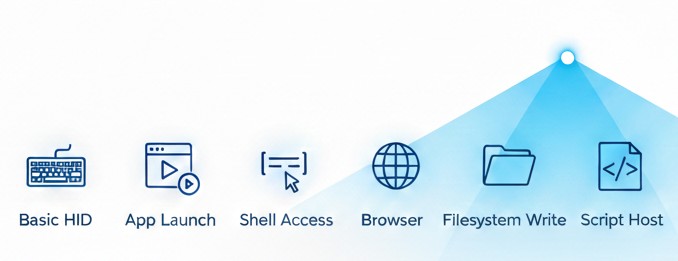
BUST is organised from lowest risk to highest capability, allowing you to stop at any stage depending on your environment.
Tests whether the system recognises the device as a keyboard.
Examples:
- Type a marker string into the focused window
- Send simple keystrokes
Checks whether global shortcuts can open benign applications.
Examples:
- Open Notepad / Terminal
- Type a harmless message
Determines whether a BadUSB can reach a command interpreter.
Examples:
- Run
whoami,hostname,date
Evaluates whether the HID can drive a network‑facing application.
Examples:
- Open the default browser
- Navigate to a safe URL
Checks whether the HID can create or modify files.
Examples:
- Create a temp file
- Write a marker string
Probes whether script engines can be opened with flags.
Examples:
- Launch PowerShell with
-NoProfile - Run a trivial command
Never run on production systems.
Examples:
- Append a harmless line to a profile script
- Create a one‑shot scheduled task
From least intrusive to most revealing:
- Basic HID acceptance
- Application launch
- Shell access
- Browser navigation
- Filesystem write
- Script host access
- Lab‑only persistence
This ordering ensures you can stop early if the system is already hardened.
Each test folder contains:
- A description
- Expected behaviour
- Pass/fail indicators
- A safe payload example
BUST is built on three principles:
- Transparency — every test is visible and understandable.
- Non‑destructiveness — no payload causes harm or disruption.
- Defensive focus — the goal is to reveal what could be done, not to do it.
Contributions are welcome as long as they follow the safety rules:
- No destructive payloads
- No persistence outside the lab‑only folder
- No privilege escalation
- No obfuscation
- No malware or malware‑adjacent behaviour
MIT License — because defensive security research should be open, safe, and accessible.