LangGraph has emerged as the dominant framework for building production-ready AI agent systems, with over 21 major companies across diverse industries adopting it as their primary agent orchestrator. The framework's popularity stems from its unique ability to create stateful, multi-agent applications with sophisticated control flows, human-in-the-loop capabilities, and robust error handling—capabilities that traditional linear frameworks like LangChain cannot match[^1][^2].
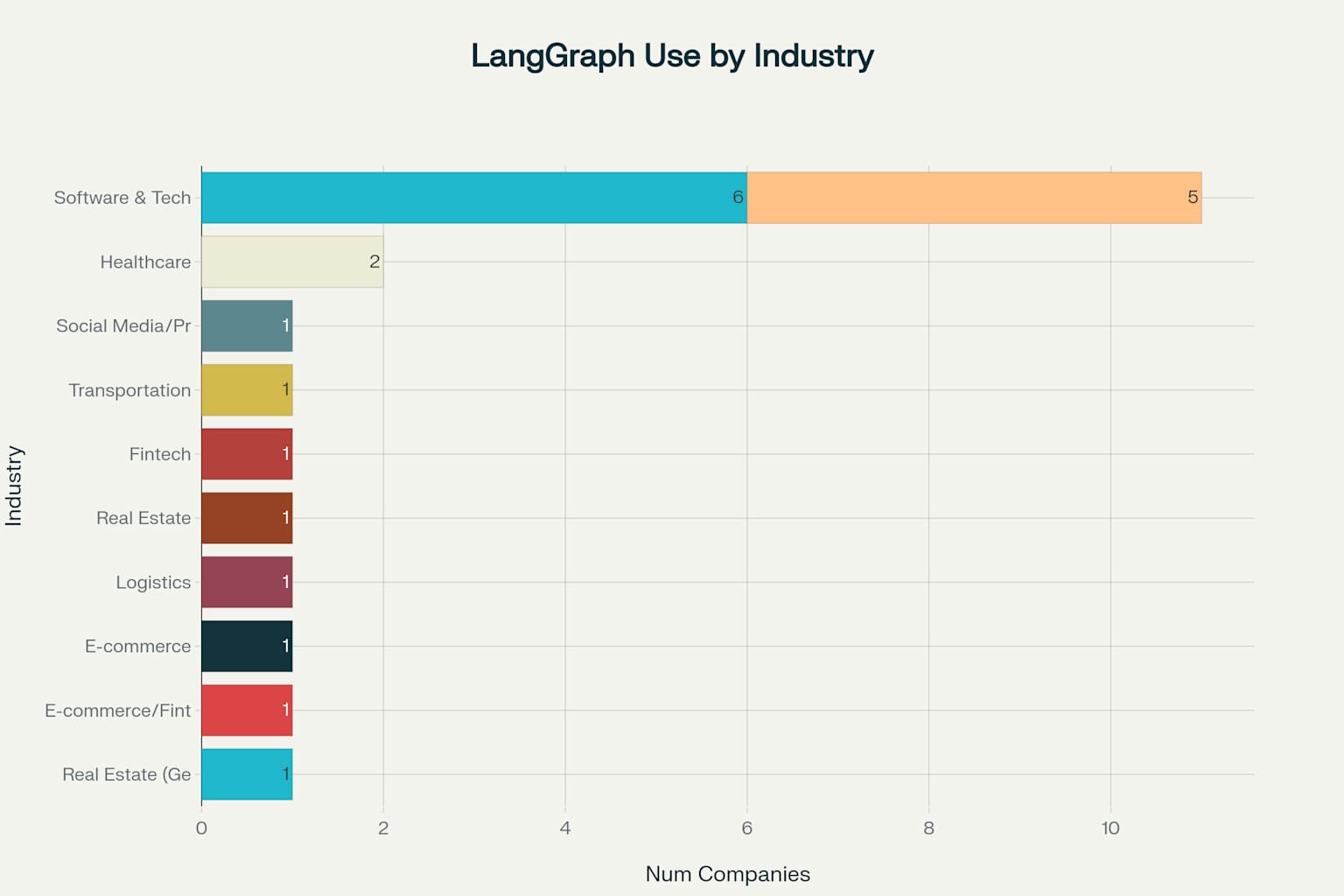
Distribution of Companies Using LangGraph by Industry
The adoption of LangGraph spans multiple industries, with Software & Technology companies leading adoption (6 companies), followed by GenAI Native startups (5 companies)[^7]. This distribution reflects the framework's maturity and versatility in handling diverse use cases.
Replit has built their flagship Replit Agent on LangGraph, serving over 30 million developers with an AI copilot that can build complete applications from natural language prompts[^8]. The multi-agent architecture allows for specialized agents handling different aspects of development—from code generation to environment setup and deployment[^1].
Key Innovation: Replit moved from a single ReAct-style agent to a multi-agent architecture to improve reliability, with each agent performing the smallest possible task to minimize error rates[^8].
Uber's Developer Platform AI team uses LangGraph for large-scale code migrations and unit test generation across their massive codebase[^9]. Their system employs specialized agent networks that handle codebase analysis, dependency mapping, code refactoring, and validation testing[^10].
Enterprise Impact: The system automates complex code migrations that would otherwise require significant manual engineering effort, with iterative reasoning loops that can detect and fix issues automatically[^10].
LinkedIn developed SQL Bot, an AI assistant that translates natural language questions into SQL queries, built on a multi-agent system using LangGraph and LangChain[^11][^12]. The system finds appropriate tables, writes queries, fixes errors, and ensures proper permissions—all while maintaining enterprise security standards[^13].
Business Value: SQL Bot eliminates data access bottlenecks by enabling non-technical employees to independently access data insights without requiring data team intervention[^12].
Elastic leverages LangGraph to orchestrate their network of AI agents for real-time threat detection through their Attack Discovery feature[^14][^15]. The system uses agent orchestration to identify and describe security threats more quickly and effectively than traditional methods[^16].
Security Impact: The multi-agent approach allows for specialized threat analysis while maintaining the speed required for real-time security operations[^15].
Klarna's AI Assistant, built on LangGraph, handles customer support for 85 million active users with 2.5 million conversations to date[^17][^18]. The system performs work equivalent to 700 full-time staff and has reduced average query resolution time by 80%[^18].
Operational Excellence: The controllable agent architecture enables dynamic prompt tailoring and context-aware responses while reducing both token costs and latency[^17].
AppFolio's Realm-X Assistant saves property managers over 10 hours per week through an AI copilot that handles bulk actions, queries, and scheduling tasks[^19][^20]. Moving to LangGraph doubled the accuracy of their system responses[^19].
Industry Transformation: The system demonstrates how specialized copilots can transform traditional industries through intelligent automation and conversational interfaces[^20].
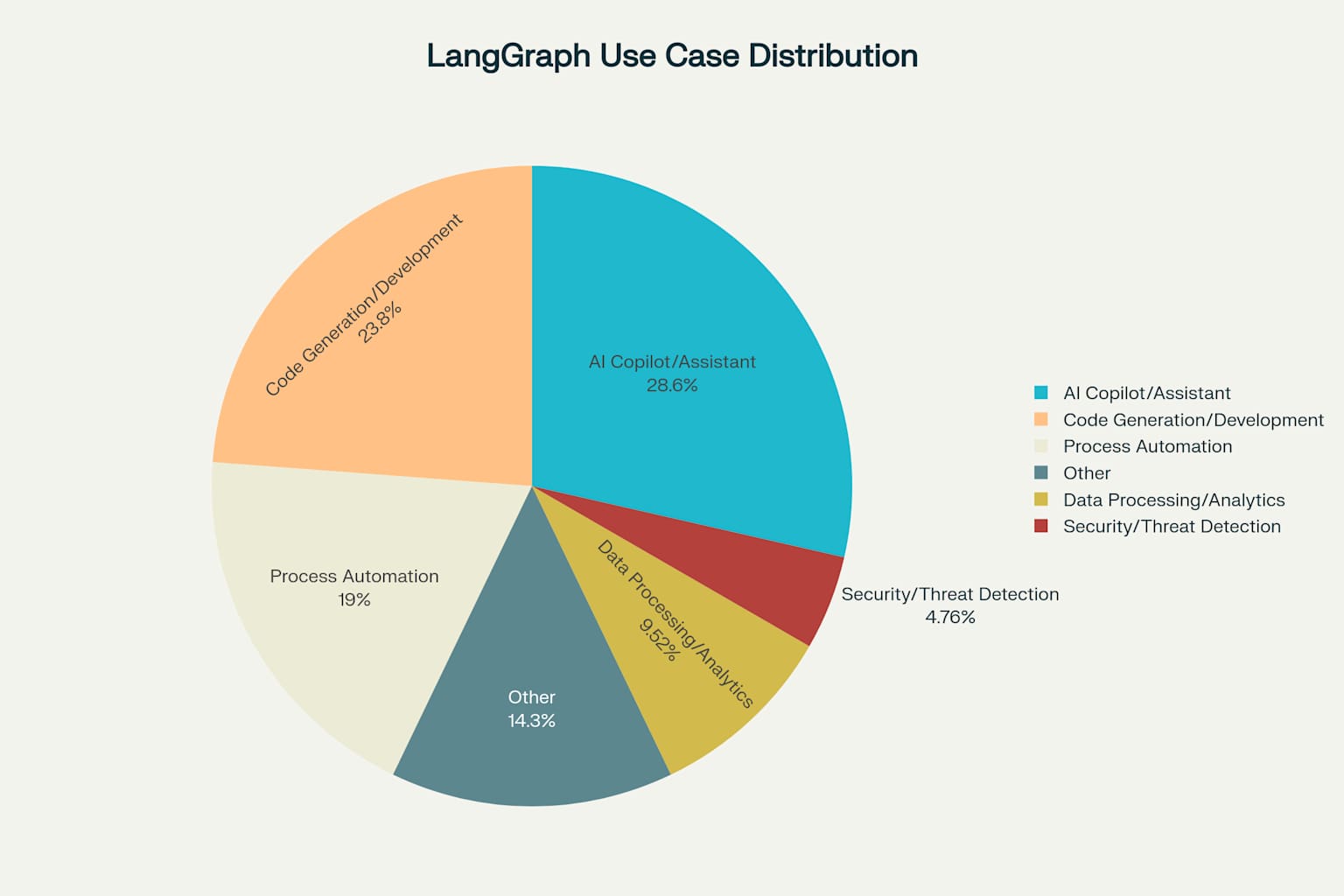
LangGraph Use Cases by Category
The distribution of LangGraph implementations reveals clear patterns in how organizations are leveraging the framework:
AI Copilot/Assistant Applications (28.6%): The largest category includes customer support agents, domain-specific assistants, and workflow copilots[^7]. These applications benefit from LangGraph's ability to maintain context and handle complex, multi-turn conversations.
Code Generation/Development (23.8%): Companies like Replit, GitLab, and Uber use LangGraph for various coding tasks, from complete application generation to specific development workflows[^8]. The framework's ability to handle iterative refinement and error correction is crucial for reliable code generation.
Process Automation (19.0%): Organizations leverage LangGraph to automate complex business processes that require decision-making and multi-step coordination[^7].
LangGraph addresses the key challenges of putting AI agents into production[^16]:
- Reliability: Multi-agent architectures with specialized roles reduce error rates
- Observability: Integration with LangSmith provides comprehensive tracing and debugging
- Control: Human-in-the-loop capabilities allow for guided agent behavior
The framework handles the unique challenges of agent infrastructure[^6]:
- Long-running workflows: Durable execution that survives failures and resumes from checkpoints
- Async collaboration: Support for unpredictable human inputs and multi-agent coordination
- Horizontal scaling: Built-in support for handling bursty, enterprise-scale traffic
LangGraph Platform provides comprehensive tooling[^6]:
- 1-click deployment for rapid production deployment
- LangGraph Studio for visual workflow debugging and development
- 30+ API endpoints for custom user experience integration
LangGraph excels at implementing orchestrator-worker architectures where a central agent dynamically breaks down tasks and delegates them to specialized workers[^3]. This pattern is particularly effective for complex, unpredictable tasks like code generation or research workflows.
The framework enables sophisticated multi-agent designs where independent agents can run in parallel, exchange data, and collectively solve complex problems[^21]. This modularity allows for easier maintenance, debugging, and scaling compared to monolithic agent designs.
LangGraph's graph-based approach naturally implements state machines, allowing for complex conditional logic and workflow orchestration that adapts based on intermediate results[^21].
While frameworks like AutoGen and CrewAI also support multi-agent workflows, LangGraph's integration with the broader LangChain ecosystem, production-ready deployment infrastructure, and extensive enterprise adoption set it apart[^21]. The framework's low-level primitives provide the flexibility needed for custom implementations while offering pre-built components for rapid development[^5].
With nearly 400 companies having used LangGraph Platform since its beta launch[^6], and major enterprises like Uber, LinkedIn, and Replit driving adoption, LangGraph has established itself as the leading framework for production AI agents. The trend toward more specialized, domain-specific agents—rather than general-purpose solutions—plays to LangGraph's strengths in enabling custom, controllable architectures[^16].
The framework's emphasis on reliability, observability, and human-agent collaboration positions it well for the next phase of AI agent adoption, where production deployments require enterprise-grade infrastructure and oversight capabilities.