
At a glance:
- NocoBase open source builder for internal tools, admin panels, and operational systems
- Visual NocoBase no code configuration with flexible NocoBase low code extension paths
- Modular NocoBase plugins, role permissions, workflow automation, and data modeling
- NocoBase self hosted deployment options for teams that need control over infrastructure
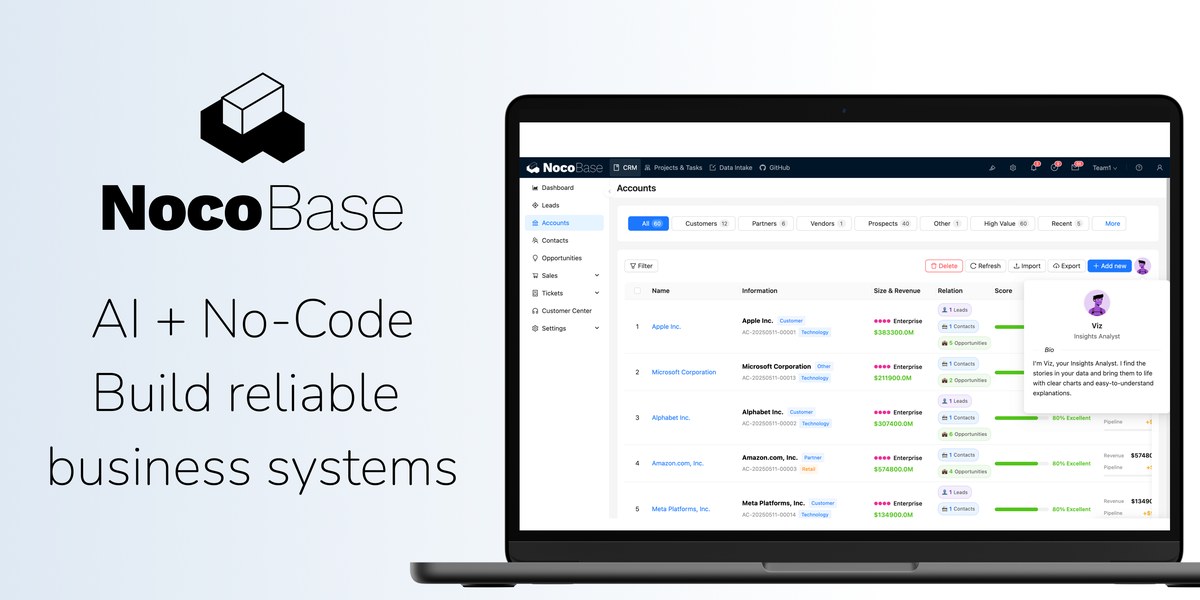
NocoBase is an open-source platform for building custom business apps, managing data, automating workflows, and extending tools with plugins. It is built for teams that need more than a spreadsheet but do not want every internal process locked behind a custom engineering backlog. NocoBase open source design gives product teams, operations teams, and developers a shared space for turning business rules into usable applications.
The platform focuses on configurable data structures, permission-aware interfaces, and repeatable workflow logic. A team can start with a NocoBase demo, read NocoBase documentation, and move toward a NocoBase install when the model fits. For evaluators comparing NocoBase alternatives, the appeal is the balance between NocoBase no code convenience and NocoBase low code extensibility.
NocoBase low code development centers on composing blocks, collections, forms, tables, kanban views, calendars, and action buttons. Instead of beginning with a blank codebase, builders define a NocoBase database model and then arrange interfaces around real operational tasks. This makes NocoBase tutorial material useful for both technical and non-technical users because the core concepts are visible in the interface.
The NocoBase no code layer helps teams prototype approval tools, CRM-like records, inventory dashboards, project trackers, and knowledge systems without writing every screen by hand. When requirements become more complex, NocoBase plugins and server-side customization allow developers to extend the platform. That combination explains why searches like nocobase github and NocoBase open source often appear together during evaluation.
A strong NocoBase database design starts with collections, fields, relationships, and permissions. Teams can model customers, assets, tasks, contracts, employees, orders, or support tickets, then expose only the right views to each role. NocoBase documentation is especially important here because durable applications depend on clean relationships rather than improvised tables.
NocoBase workflow capabilities support automation around approvals, notifications, updates, and business events. A practical NocoBase workflow might route purchase requests, update project status, or trigger follow-up actions after a form submission. Builders who follow a NocoBase tutorial before production usually create cleaner logic, while teams testing a NocoBase demo can confirm whether the workflow engine matches their process style.
NocoBase plugins are a major reason the platform works for longer-term systems rather than only quick prototypes. Plugins can add field types, interfaces, authentication options, integrations, or specialized behavior. Developers reviewing nocobase github can inspect how NocoBase open source components fit together and decide where custom extensions belong.
For organizations choosing between NocoBase alternatives, extensibility matters as much as the first setup screen. NocoBase low code customization keeps engineering involved where it adds value, while NocoBase no code configuration keeps everyday iteration close to business teams. This division helps avoid fragile one-off tools and supports a more maintainable internal application stack.
| Step | Action |
|---|---|
| 1 | Review NocoBase documentation to understand collections, roles, plugins, and deployment choices |
| 2 | Try a NocoBase demo to validate screens, forms, workflow logic, and permission needs |
| 3 | Choose a NocoBase install method, including NocoBase docker for repeatable environments |
| 4 | Configure the first NocoBase database collections, relationships, and user roles |
| 5 | Add NocoBase plugins and test the NocoBase self hosted setup before production rollout |

| Area | Team-facing value |
|---|---|
| App building | NocoBase no code screens and NocoBase low code extension paths for business apps |
| Data structure | Flexible NocoBase database collections, relationships, fields, and permissions |
| Automation | NocoBase workflow tools for approvals, updates, notifications, and repeatable processes |
| Extensibility | NocoBase plugins for custom interfaces, integrations, and platform features |
| Evaluation | NocoBase demo, NocoBase tutorial, and nocobase github resources for careful adoption |
| Component | Minimum | Recommended |
|---|---|---|
| OS | Linux server or container host | Stable Linux server with monitored services |
| RAM | 2 GB for small evaluation | 4 GB or more for team use and plugins |
| Storage | Space for app files and database data | SSD-backed storage with backups |
| Runtime | Node.js-compatible environment or NocoBase docker | NocoBase docker with managed database services |
| Access | Admin account and network access | Reverse proxy, HTTPS, backups, and role planning |
NocoBase self hosted deployments suit teams that need control over data, permissions, and infrastructure. Operations departments can use NocoBase database collections for structured records, while engineering teams can extend NocoBase plugins for integrations and custom behavior. Download NocoBase open source to build custom business apps, automate workflows, and manage data securely on your own infrastructure. Explore a flexible plugin architecture, visual configuration, and role-based access for teams that need a scalable NocoBase self hosted platform.
Teams looking at NocoBase alternatives should consider how often business rules change. If processes evolve weekly, NocoBase no code tools help administrators adjust views and forms quickly. If the organization also needs code-level control, NocoBase low code customization and nocobase github transparency make the platform easier to audit and extend.
Why should I read NocoBase documentation first? It explains collections, permissions, plugins, and workflow patterns before a production NocoBase install.
Is NocoBase docker useful for testing? Yes, NocoBase docker helps create repeatable environments for evaluation, staging, and self-hosted deployment.
Can NocoBase no code builders work without developers? Many interfaces can be built visually, though NocoBase low code support helps with complex integrations.
Where can I inspect the project? Search nocobase github to review the NocoBase open source repository, issues, releases, and extension examples.
How should I compare NocoBase alternatives? Compare data modeling, workflow depth, plugin architecture, hosting control, and long-term maintenance needs.
A realistic NocoBase tutorial should begin with one focused business process, not an entire company operating system. Start with a simple NocoBase database, add forms and table views, then introduce NocoBase workflow steps only when the process is clear. This makes a NocoBase demo more meaningful because stakeholders can judge the platform against real work instead of generic sample screens.
NocoBase install planning should also include security, backups, user roles, and plugin governance. NocoBase self hosted teams need to decide who can create collections, who can change permissions, and how updates are tested. NocoBase docker can simplify this lifecycle, especially when staging and production should stay consistent.
For developers, nocobase github is a useful starting point for understanding release activity, code structure, and extension patterns. For administrators, NocoBase documentation and NocoBase tutorial examples help translate business language into fields, relationships, and automated steps. Together, NocoBase open source access, NocoBase plugins, and NocoBase low code flexibility make the platform practical for internal systems that need room to grow.
When comparing NocoBase alternatives, avoid judging only by the fastest first screen. The better question is whether NocoBase no code configuration, NocoBase workflow automation, and NocoBase database modeling can still support the application after six months of changing requirements. For many teams, that is where NocoBase self hosted control becomes more valuable than a quick prototype.
nocobase github, NocoBase open source, NocoBase low code, NocoBase no code, NocoBase documentation, NocoBase tutorial, NocoBase demo, NocoBase install, NocoBase docker, NocoBase plugins, NocoBase workflow, NocoBase database, NocoBase alternatives, NocoBase self hosted