



Scarf is a Python framework for analysing single-cell RNA, ATAC, protein, and multi-omic data, from a few thousand cells to tens of millions.
| Problem | How Scarf solves it | What you get |
|---|---|---|
| Your dataset is larger than RAM | Out-of-core algorithms , and neighbour search streams from cell-major and gene-major layouts, inside a memory budget you set | No subsampling, so rare populations survive, benchmarked to 10M cells |
| The data is stored remotely and requires downloading | Fetches only the chunks an operation touches, and writes results to a store you own | Start analysing immediately, with one authoritative copy |
| A single parameter change costs hours of computation | Each step is fingerprinted by its settings and inputs, so reuse is by content, not by layer name | Only what changed recomputes, and the old version stays for comparison |
| Sub-population analysis leaves scattered copies that nobody can trace back | Subsets are masks in one file, and every result carries the cells and parameters behind it | A year later, a result still explains itself |
Python 3.12+.
uv venv --python 3.12
uv pip install --python .venv "scarf[extra]"
Detailed installation instructions here
import scarf

reader = scarf.CrH5Reader("filtered_feature_bc_matrix.h5")
scarf.CrToZarr(reader, zarr_loc="data.zarr").dump()

ds = scarf.DataStore("data.zarr", nthreads=4)
ds.pipeline.run()

ds.plots.embedding(
    layout_key="RNA_UMAP",
    color_by="RNA_clusters",
)
Read the scRNA-seq tutorial for granular analysis workflow.
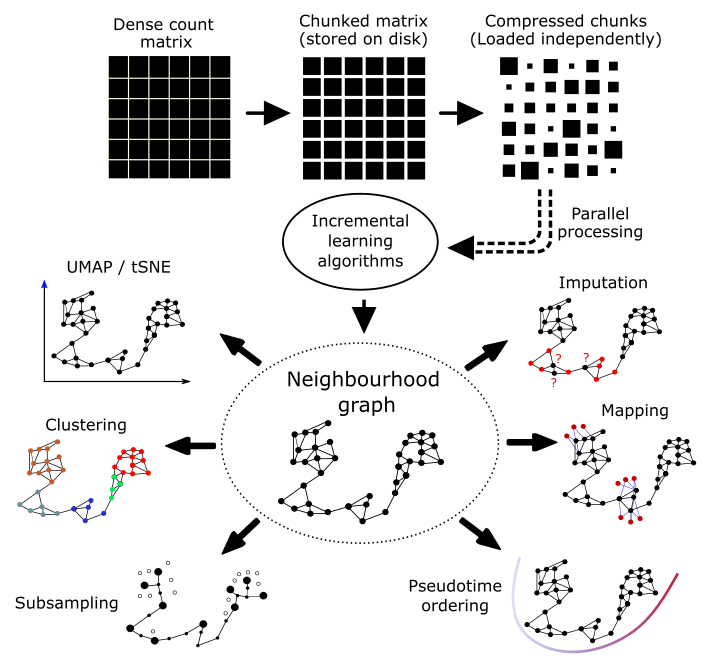
| Area | Methods |
|---|---|
| Modalities | scRNA-seq, scATAC-seq, CITE-seq, matched multi-omics |
| Core workflow | Quality control, feature selection, normalization, PCA and LSI, KNN graph, UMAP, densMAP, t-SNE, Leiden, Paris, marker search |
| Integration | Harmony, partial PCA, shared and weighted nearest neighbours, integration metrics |
| Mapping | Symphony-style reference mapping, label transfer, projection diagnostics |
| Trajectory | Population Balance Analysis pseudotime, expression dynamics and modules, multi-sink fate probabilities |
| Also included | Cell-cycle scoring, gene-set activity, graph-diffusion imputation, doublet scores, HTO demultiplexing, TopACeDo downsampling, pseudobulk export |
Read workflow vignettes and API references on Read The Docs 📖
AI-assisted and autonomous workflows should start with Analysis with AI agents.
Dhapola et al. Scarf enables a highly memory-efficient analysis of large-scale single-cell genomics data. Nature Communications 13, 4616 (2022).
Scarf is open source with BSD 3-Clause License and maintained by Nygen.