


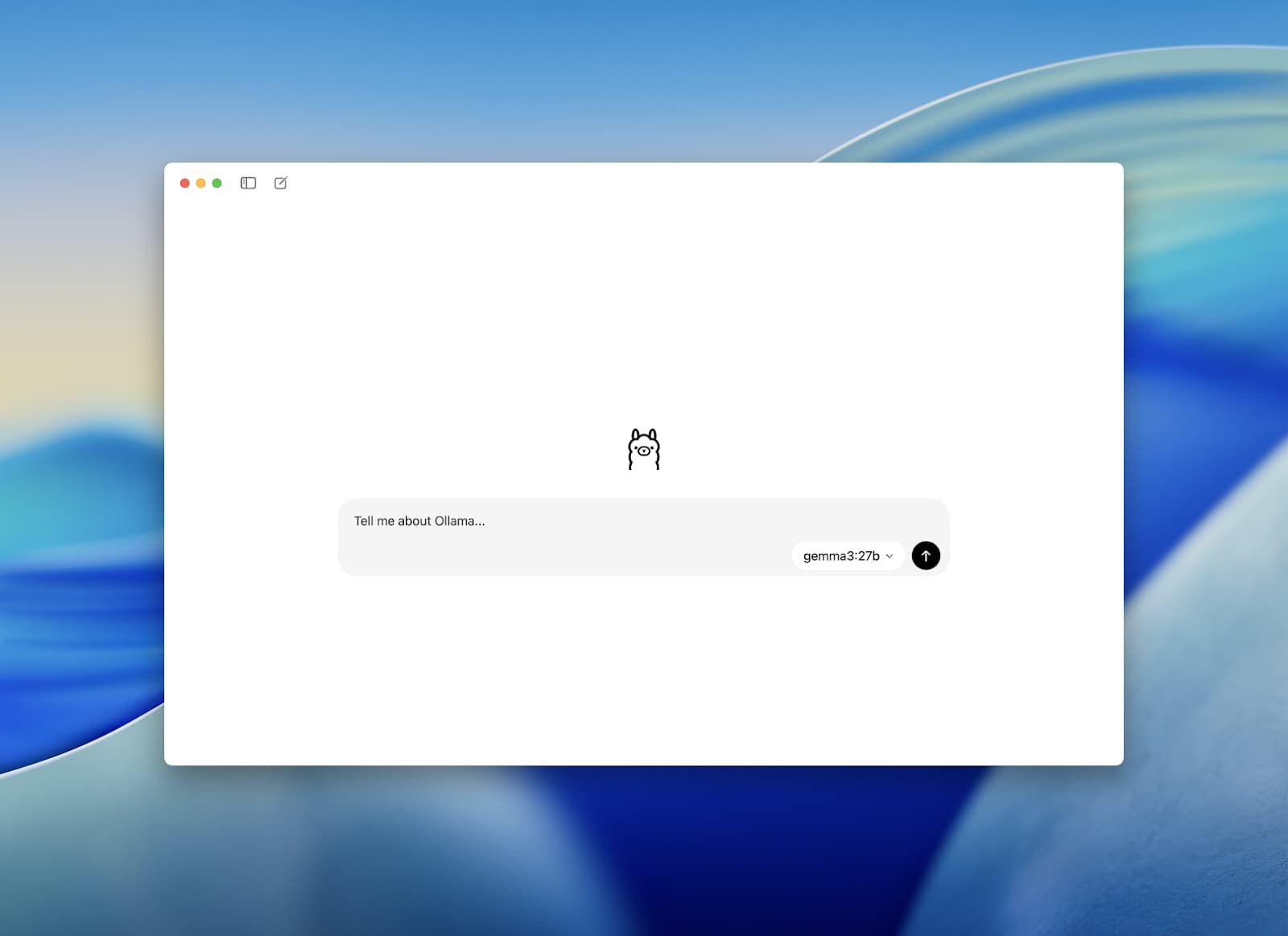
Ollama for Mac is an open-source local inference runtime that makes downloading, running, and managing large language models on macOS as straightforward as installing a command-line tool. Developed to remove the complexity barrier that previously made local LLM deployment the domain of machine learning engineers with specialized hardware knowledge, Ollama handles model quantization, GPU memory management, and inference server configuration automatically — reducing the setup process for a production-quality local AI model to a single terminal command.
The model library available through Ollama covers the full spectrum of current open-source language models. Llama 3, Mistral, Gemma, Phi, DeepSeek, Qwen, Command R, and dozens of additional models and variants are available through the Ollama model registry, installable with ollama pull model-name without downloading raw model weights, configuring quantization formats, or managing GGUF file placement manually. Model variants at different parameter counts and quantization levels allow users to match model size to available hardware — a 7B parameter model at Q4 quantization fits comfortably in 8GB of unified memory on entry-level M-series Macs, while MacBook Pro and Mac Studio configurations with 32GB or more run 70B parameter models at higher quality levels.
Apple Silicon optimization is central to Ollama's Mac performance. The Metal GPU compute framework accelerates matrix operations that dominate LLM inference workloads, and the unified memory architecture of M-series chips eliminates the PCIe bandwidth bottleneck that limits GPU inference on traditional hardware — model weights load from the same memory pool that the GPU reads directly rather than transferring across a bus. Automatic hardware detection configures GPU layer offloading based on available unified memory, maximizing the proportion of model computation that runs on the Neural Engine and GPU rather than falling back to slower CPU inference.
The OpenAI-compatible REST API served by Ollama at localhost:11434 makes local models drop-in compatible with applications built for the OpenAI API — changing the base URL and removing the API key requirement replaces cloud model calls with local inference in any application that uses the OpenAI client library. This compatibility layer enables developers to build applications against the familiar OpenAI interface during development and switch to local Ollama inference for production deployments that require data privacy, offline operation, or predictable inference costs without API rate limits.
- One-command model installation downloads and configures Llama Mistral Gemma DeepSeek and hundreds of models from the Ollama registry
- Apple Silicon Metal GPU acceleration offloads inference computation to the M-chip GPU and Neural Engine for fast local generation
- Unified memory architecture optimization eliminates PCIe bandwidth limits for model weight access on M-series Mac hardware
- OpenAI-compatible REST API at localhost makes local models drop-in replacements for OpenAI API calls in existing applications
- Multi-model management stores and switches between multiple installed models without re-downloading between sessions
- Modelfile customization defines system prompts parameters and base model configurations for persistent custom model variants
- Streaming response output delivers generated tokens to API clients progressively for responsive application integration
- Concurrent request handling serves multiple simultaneous inference requests for multi-user and application pipeline use cases
- macOS menu bar integration provides server status monitoring and quick model management from the system menu bar

Ollama's architecture as a local server rather than a standalone application makes it composable with the Mac software ecosystem in ways that monolithic AI applications cannot match. Any application that can make HTTP requests — Python scripts, Node.js services, shell scripts, GUI frontends, browser extensions — connects to Ollama as a backend. Frontends like Open WebUI, Enchanted, and MacLlama provide graphical chat interfaces built on top of the Ollama API for users who prefer a visual interface to terminal interaction.
The completely offline operation that Ollama enables after initial model download provides a category of privacy guarantee that cloud AI services cannot match through policy alone. Legal documents, medical information, confidential business communications, and proprietary source code processed through Ollama never leave the Mac's hardware, making it appropriate for regulated industries and organizations with strict data residency requirements that prohibit sending sensitive content to external inference servers.