PMComplex miss a signBit method (used in Pharo) Fix #69
Conversation


 SergeStinckwich
changed the title
SergeStinckwich
changed the title

| ] | ||
|
|
||
| { #category : #'*Math-Complex' } | ||
| PMComplex class >> random [ |

There was a problem hiding this comment.
For my own education, what drives the need for this method?
| ] | ||
|
|
||
| { #category : #testing } | ||
| PMComplex >> signBit [ |
There was a problem hiding this comment.
I think, as this is a one line block, we might inline this,
PMComplex >> signBit [ ^ self real signBit ]
unless what you've done is the idiomatic way.
There was a problem hiding this comment.
I don't understand ? This is not a block. You are looking at Tonel files, the real method is :
MComplex >> signBit
^ self real signBit

|
I wonder why we need to define the sign of a complex at all??? |
|
I don't know exactly ... In Pharo 7.0, arcTan: has been redesigned to use signBit instead of sign (in order to detect IEEE-754 negative-zero). PMComplex miss this method and test like |
|
Standards (ANSI Smalltalk?) mandates that 0 sign -> 0, same for +0.0 and -0.0... But that applies to numbers, not complex numbers... Introducing functions/operations that are not natural, but are rather hacks for making some other part of a software work is dangerous. One good example is how Matlab defined relational operators for complex (< <= >= >). For what added value? I know of a single usage for sorting complex values: separate stable poles from unstable poles in some algorithms (for example solving a Riccati). For a discrete or continuous system, that's not necessarily the same sort function... (either real part > 0, or module > 1). That's why I ask for complex sign... |
|
I don't want to add a sign on Complex ... there was already a sign method and there was a failing test : testArcTanDenominator
| c1 c2 |
c1 := 1 i.
c2 := 0.
self assert: (c1 arcTan: c1) equals: Float pi / 4.
self assert: (c2 arcTan: c1) equals: 0.
self assert: (c2 arcTan: c1 * c1) equals: Float piI dunno who wrote this test ? |
|
If I remove
|
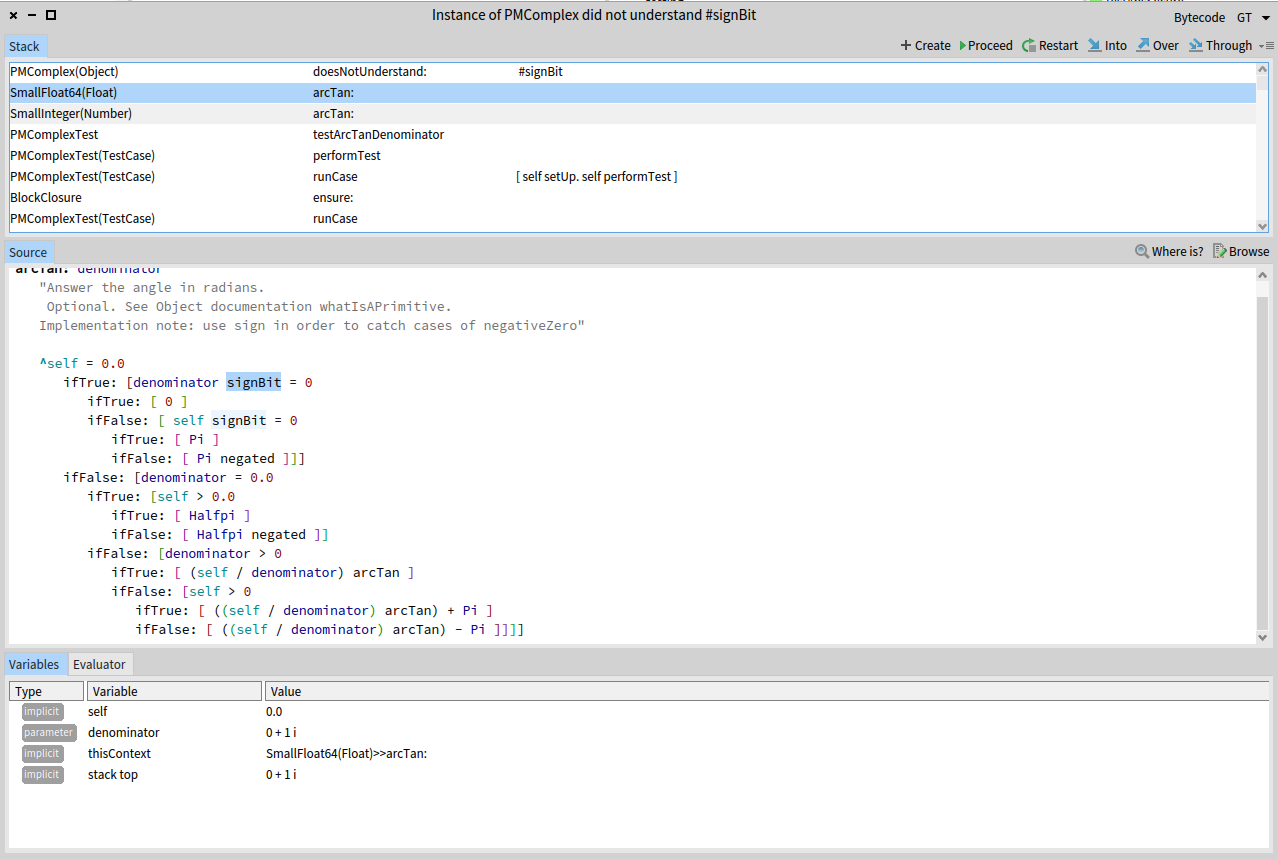
|
Yes, I understand that. But on the other hand, while at fixing it, I'm saying that rather than hacking a sign/signBit that will not be usefull outside of Does complex extension fits real function when imaginary parts are null? What happens when one or both imaginary part is a negativeZero? I might be able to answer to above questions since I probably implemented those... But does the arcTan: implemented in Number works the same as Complex extension when a Complex parameter is provided? Does it use double dispatching for that? Are there tests for all these cases? |
|
I thought |
|
Can you move discussion on a new issue ? |
|
Yes, I once thought this could be discussed in a new issue. But if Number>>arcTan: has not been patched for being compatible with complex extension of arcTan:, as I think then the correct fix is:
|
3 participants


No description provided.