This project is inspired by the 'fantastical' (i.e. not-yet-realized) code described in this video: https://www.youtube.com/watch?v=3s7h2MHQtxc and this project: https://community.wolfram.com/groups/-/m/t/1862464
A Hilbert curve or Hilbert space-filling curve is a family of curves that are infinite lines bend in such a way that they fill all of infinite space. These curves are named after the mathematician who discovered them, David Hilbert, as variants of Peano curves (same mathematical concept).
The use of these curves in general and in this project, is as a mapping of a two-dimensional space to a one-dimensional space, which particularly preserve location of points well. That is, as the order of the curve increases, a point on that curve gets closer and closer to a location. As the limit of the order of the curve goes to infinity, a point on this curve approaches its spot.
This is in contrast to other, more intuitive space filling curves such as the “S-Curve” described in 3Blue1Brown’s video entitled Hilbert's Curve: Is infinite math useful? where said curve does not preserve locality of a point.
In this project, my initial goals are to:
- Program a (scalable) algorithm that parses a square image using a pseudo-Hilbert curve without using outside modules.
- Take that parsed data and transform it into a sound with frequencies mapped to color and brightness mapped to volume.
- Take a sound bit encoded the same as above and decode it back into an image.
- Make this application usable with a passible user interface/GUI.
My stretch goals are to:
- See if I can use a combination of Fourier Transform and machine learning libraries in the SKLearn module to try to classify these ‘images-as-sounds’.
- For example, we can train neural networks to identify things like a bee versus a three. What about when these images are encoded as sounds? Does that make it easier or harder for an ML model to classify?
- Scale the Hilbert Curve tracer to parse non-square image files.
- (Update 26 Mar '23: Fulfilled by compress_image() in imageInterpreter.py)
- Give the program a function to use differently shaped curves; in looking at pictures of Peano’s and Hilbert’s different curves you’ll see what I mean.
- Create a tutorial for the user to try to get a grasp on trying to ‘see’ with sound.
The challenges I foresee in this project are the meat of the issue. Creating a pathfinding Hilbert curve from scratch will be difficult, especially trying to make it iterative and non-exponential as I try to scale curves from one order to the next.
In addition, mapping the colors and brightness to sound in an intuitive manner will be a design challenge as I try to make it as easy as possible for a layman to get the grasp of an image through just a sound bit.
This application may be useful as:
- A tool in research on brain plasticity. Scientists are trying to answer and experiment with ideas and questions on just what auditory and visual cortexes can do, and the limits of how ‘plastic’ our brains are: http://web.mit.edu/surlab/publications/Newton_Sur04.pdf
- A tool in image processing research. If indeed it’s true that ML models can more easily classify images when they’re encoded to sound than as they are as pictures, then it might speed up scientific research that right now has tons of image data that necessitates machine learning. For example the problem as discussed in this video: https://www.youtube.com/watch?v=tSoqJpisKIg
Install requirements via command line with the following command:
pip3 install -r requirements.txt
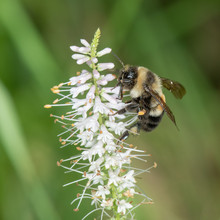
The sample image used is from publicdomainpictures.net and can be found here: https://as2.ftcdn.net/jpg/03/04/58/91/220_F_304589144_Zcp4X2dHDJvSBO6mx98bj1kuLIPY6HwW.jpg
I have overhauled imageInterpreter.py to an initial functional working state, and created a quirky Hilbert-Curve iterative function. There are also auto-genearted test cases from the Pillow (PIL) Image library. What's next is to hook up the image upload to the curve function and generate noise from there. Then, I envision taking the sound signal and trying to decompose it using a Fourier Transform.
I envision experimentation with ML to be as follows:
- Can a basic ML model tell from a given sound byte if the image is 'bee' or 'three'?
- I.E. given just the sound, categorize the image
- Is this easier given a decomposed Fourier Transform?
- Which general model works best (neural net, logistic regression, etc.)
- Can a basic ML model roughly reproduce an image from a sound byte?
- How well is the reproduction compared to the original?
- Again, which model does it best?
- Can this sound to category or sound to image model have a real-world application?
- Is it easier to train on sound-bits from images rather than images themselves?
If you want to see what a curve looks like here is an example for 512 points (order 9 as 2**9 = 512). The colors are of the rainbow to see the curve, and goes from blue to red.

If you follow the colors with your eyes you can actually trace out all the lower orders of pseudo-Hilbert curves (for order 8 will need to probably have eagle eyes!). Here's an example of orders 1 and 2 traced through the colors:


The pixel bumping between colors (red looking slightly higher than blue) is an artifact of compression from the matplotlib library. You can see here that the curve is, in fact, not uneven from left to right:

Sanderson, Grant. “Hilbert's Curve: Is infinite math useful?” YouTube, uploaded by 3Blue1Brown, 21 July 2017, https://www.youtube.com/watch?v=3s7h2MHQtxc.
Rangan, Srinath “Using Pseudo-Hilbert Curves to Assist People Perceive Images via Sound.” Wolfram Community, January 2020, https://community.wolfram.com/groups/-/m/t/1862464.
Newton, Jessica R. and Sur, Mriganka. “REWIRING CORTEX: FUNCTIONAL PLASTICITY OF THE AUDITORY CORTEX DURING DEVELOPMENT.” Department of Brain & Cognitive Sciences, Picower Center for Learning & Memory, Massachusetts Institute of Technology http://web.mit.edu/surlab/publications/Newton_Sur04.pdf. Accessed 28 March 2020.
Yoshida, Kate. “Can AI Help Us Identify Animals?”. YouTube, uploaded by MinuteEarth, 3 December 2019, https://www.youtube.com/watch?v=tSoqJpisKIg.