


-
Authors: Adan Wu, Tao Che*, Chengzhu Ji, Xiaowen Zhu, Jinlei Chen, Qingchao Xu, Qun Gu, Rui Zhang,
Kaihui Zhang, Lei Fu, and Shengpeng Chen -
Key Laboratory of Cryospheric Science and Frozen Soil Engineering,
Heihe Remote Sensing Experimental Research Station, Northwest
Institute of Eco-Environment and Resources, Chinese Academy of
Sciences, Lanzhou 730000, China
The code in this toolbox implements the
"A Hausdorff-Guided Deep Learning Approach for Motion Monitoring of Rotating Arctic Ice Floes".
More specifically, it is detailed as follows.

This repository provides the implementation of our proposed ice floe motion monitoring framework, which integrates geometric selection and intelligent feature matching. The method combines Hausdorff-based geometric selection, SuperPoint feature extraction, and SuperGlue feature matching to address challenges of texture degradation and rotational variations in Arctic ice floe imagery.
The source code is implemented in PyTorch, with training and testing pipelines designed to reproduce the results reported in our submitted manuscript.
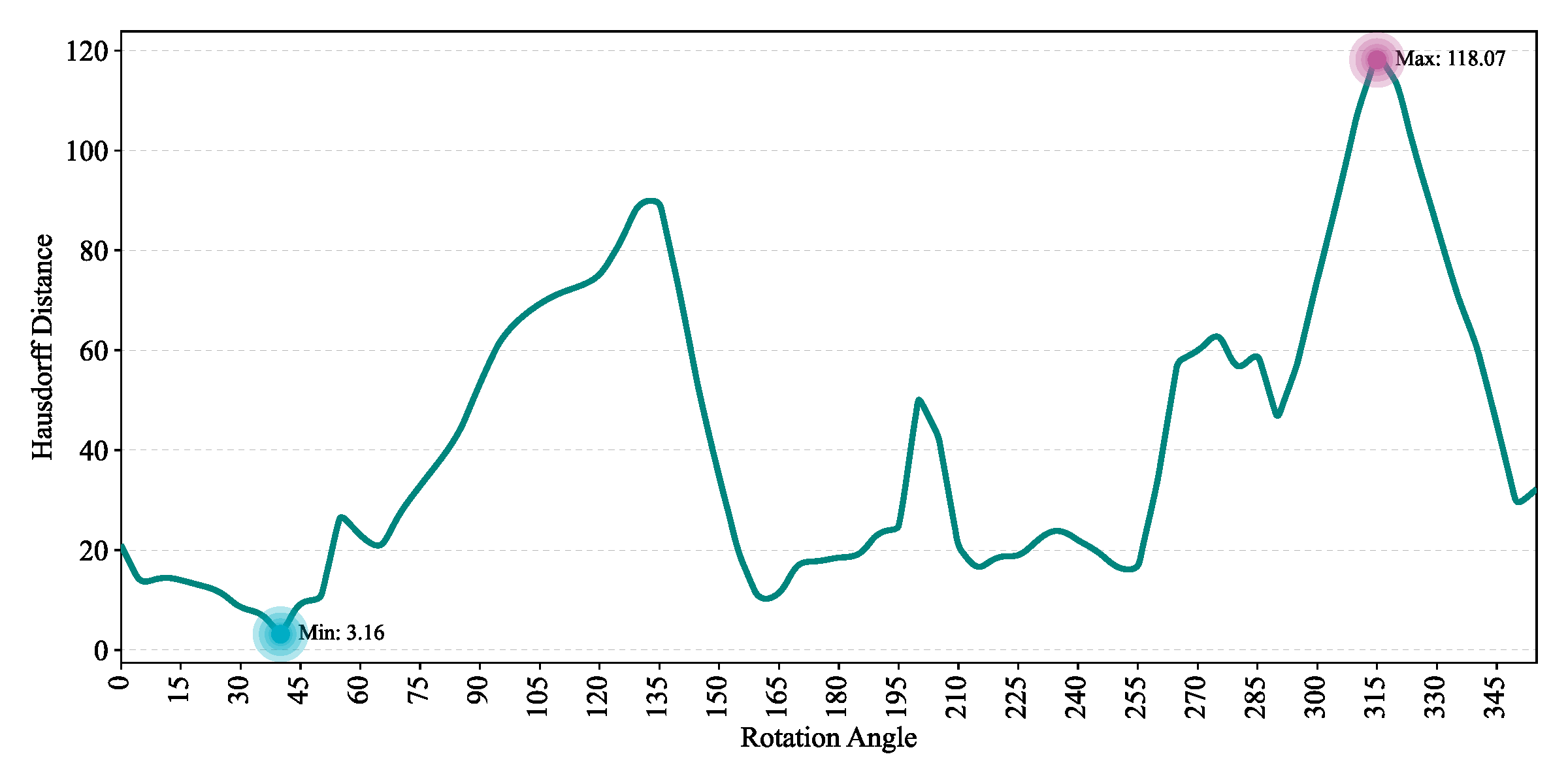
This figure shows the variation of Hausdorff Distance (HD) with respect to rotation angle for ice floe B2.
- Minimum HD (3.16) occurs at approximately 40°, indicating optimal alignment
- Maximum HD (118.07) reflects severe mismatch
- Strong nonlinearity indicates high sensitivity to rotation
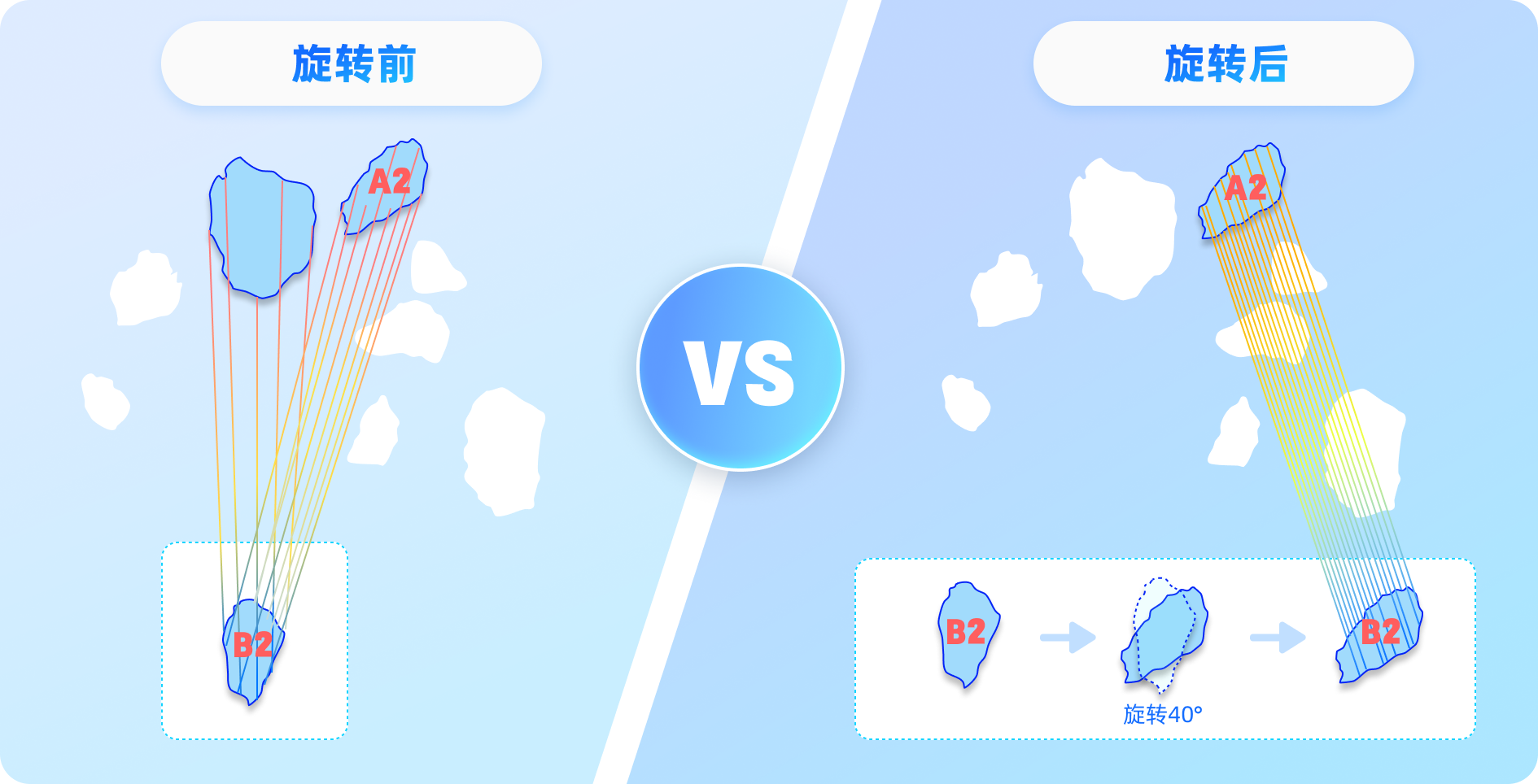
- Feature matches are disordered and inconsistent
- Significant geometric deviation
- High mismatch rate
- Ice floe is well aligned
- Matches become structured and reliable
- Significant improvement in accuracy
Please ensure the following dependencies are installed:
- Python >= 3.11
- PyTorch >= 1.6
- NumPy, SciPy, OpenCV
- Matplotlib (for visualization)
-
The datasets consist of optical imagery acquired from Arctic marginal ice zones.
-
Example data used in the paper (July 6, 2020, B2 floe sample) are provided in the main.
-
Users may organize their own datasets following the structure below
datasets/ ($DATA_DIR)
|-- Dataset
| |-- train2014
| | |-- file1.jpg
| | `-- ...
| `-- val2014
| |-- file1.jpg
| `-- ...
The training procedure is designed for reproducibility and can be customized with different network hyperparameters.
python train4.py train_base configs/magicpoint_shapes_pair.yaml magicpoint_synth --eval
python train4.py train_joint configs/superpoint_dataset_train_heatmap.yaml superpoint_my_data --eval --debug
python train.py --feature_dim 256 --dataset_offline_rebuild 1 --batch_size 32 --debug 0 --eval --viz
Options:
-
--threshold_keypoint: 0.001
-
--threshold_match: 0.1
-
--lr: 1 × 10⁻⁴
-
--epochs: 500
Testing can be performed on the held-out dataset or on provided floe samples.
python test.py --model checkpoints/model_best.pth --data data/test/
This will output matched pairs, matching accuracy, and visualization results under the results/ folder.
Example Experiment (B2 Floe, July 6, 2020)
A demo script is provided to reproduce the B2 floe matching experiment described in the paper.
-
This experiment demonstrates the ability of the proposed framework to achieve robust matching under rotation and texture loss.
-
Please note that results may slightly differ from those reported in the manuscript due to variations in PyTorch and related library versions.
-
Only a subset of the experimental data is provided here; please contact us if you require access to the full dataset.
| Method | Matching Pairs | Matched Accuracy |
|---|---|---|
| Proposed method | 50 | 100% |
| SIFT | 15 | 40% |
| A-KAZE | 19 | 68.42% |
The codes are based on SuperPoint and SuperGlue. Thanks for their awesome work.
If you have any questions or suggestions, feel free to contact me.
Email: wuadan@lzb.ac.cn