Adaptation
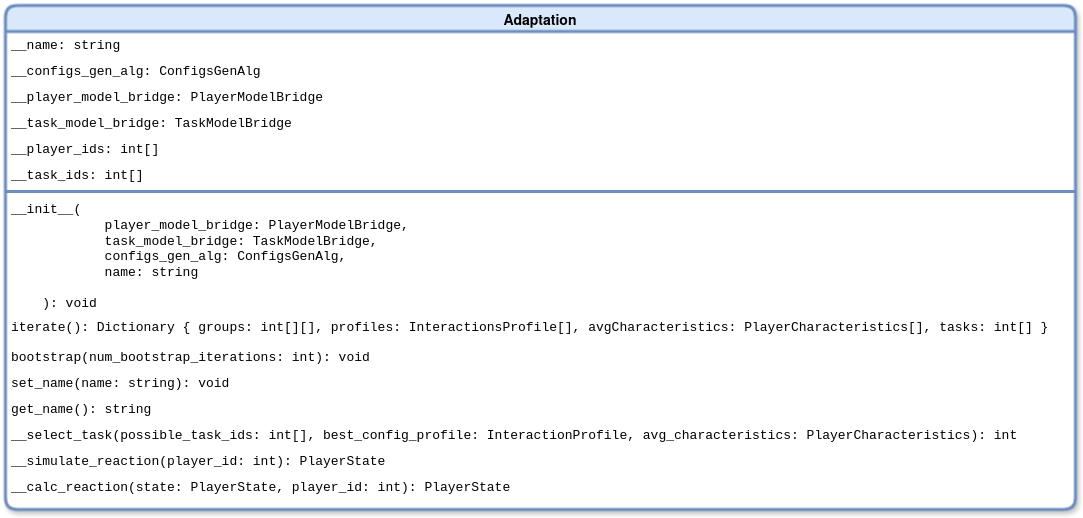
Adaptation encapsulates all the functionalities of GIMME. It is the highest level class, responsible for initializing and executing adaptation iterations.
As instances of Adaptation can be initialized and executed whenever, adaptations can dynamically be reconfigured with different arguments. No direct coupling exists between the player and task models and Adaptation and so, even if, e.g., the number of players or tasks changes, the module can be executed.
+ Adaptation()| Name: expected type | Default value | Description |
|---|---|---|
| playerModelBridge: PlayerModelBridge | - | The connector for the player data models. |
| taskModelBridge: TaskModelBridge | - | The connector for the task data models. |
| configsGenAlg: ConfigsGenAlg | - | The group formation (coalitions structure generation) algorithm to be used. |
| name: string | - | A name for the Adaptation (for debug or if identification is needed). |
+ init(
            playerModelBridge: PlayerModelBridge,
            taskModelBridge: TaskModelBridge,
            configsGenAlg: ConfigsGenAlg,
            name:string

): voidThis method initializes the Adaptation, getting it ready for the execution of iterations.
| Name: expected type | Default value | Description |
|---|---|---|
| playerModelBridge: PlayerModelBridge | - | The connector for the player data models. |
| taskModelBridge: TaskModelBridge | - | The connector for the task data models. |
| configsGenAlg: ConfigsGenAlg | - | The group formation (coalitions structure generation) algorithm to be used. |
| name: string | - | A name for the Adaptation (for debug or if identification is needed). |
+ iterate(): dict { groups: int[][], profiles: InteractionsProfile[], avgCharacteristics: PlayerCharacteristics[], tasks: int[] }This method triggers the beginning of a new iteration using the current Adaptation configuration.
Returns a dictionary with the following entries:
| Name: expected type | Description |
|---|---|
| groups: int[][] | An array of groups, with each group represented as an array of IDs. |
| profiles: InteractionsProfile[] | The profiles for each group, in the order that the groups appear in groups. |
| avgCharacteristics: PlayerCharacteristics[] | The average learning states of each group, in the order that the groups appear in groups. |
| tasks: int[] | The tasks assigned for each group, in the order that the groups appear in groups. |
+ bootstrap(numBootstrapIterations: int): voidThis method performs a bootstrap on the current adaptation process, simulating the learners progression over a number of iterations.
| Name: expected type | Default value | Description |
|---|---|---|
| numBootstrapIterations: int | - | The number of bootstrap iterations. |
- selectTask(possibleTaskIds: int[], bestConfigProfile: InteractionProfile, avgCharacteristics: PlayerCharacteristics): intThis method selects a new task tailored to a group through its profile and average state. It returns the ID of that task in the TaskModelBridge.
| Name: expected type | Default value | Description |
|---|---|---|
| possibleTaskIds: int[] | - | a list of possible tasks to choose |
| bestConfigProfile: InteractionsProfile | - | The profile of the group. |
| avgCharacteristics: PlayerCharacteristics | - | The average characteristics of the group. |
| Expected type | Description |
|---|---|
| int | The chosen task. |
- simulateReaction(playerID: int): PlayerStateThis method simulates the reaction of a given player to the task attributed to their group.
| Name: expected type | Default value | Description |
|---|---|---|
| playerID: int | - | The ID of the player to simulate. |
| Expected type | Description |
|---|---|
| PlayerState | The simulated learning state. |
- calcReaction(state: PlayerState, playerID: int): PlayerStateAn auxiliary method of simulateReaction.
| Name: expected type | Default value | Description |
|---|---|---|
| state: PlayerState | - | The state of the learner before the progression simulation. |
| playerID: int | - | The ID of the player to simulate. |
| Expected type | Description |
|---|---|
| PlayerState | The simulated learning state. |
statisticsCourseAdapt = Adaptation()
statisticsCourseAdapt.init(playerBridge, taskBridge, regAlg = KNNRegression(3), configsGenAlg = GIMMEConfigsGen(numberOfConfigChoices=50, preferredNumberOfPlayersPerGroup = 5, PlayerCharacteristics(ability=0.5, engagement=0.5)), fitAlg = WeightedFitness(), name="Statistics Course Adaptation")

#do 50 iterations of statisticsCourseAdapt and print each chosen configuration
for i in range(50):
    print(statisticsCourseAdapt.iterate()["groups"]) #print chosen configuration