PlayerStatesDataFrame
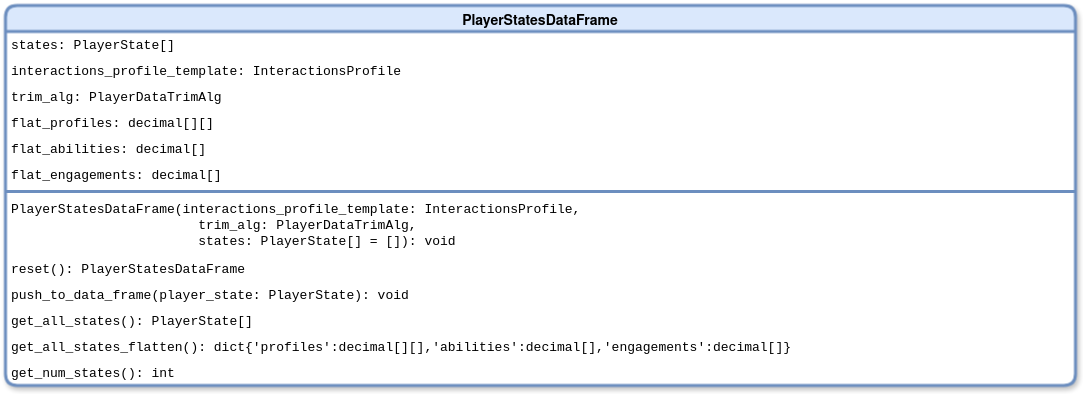
This class stores and manages the learning states of a subject. In particular, it uses a PlayerDataTrimAlg to choose what data to keep/discard when a new state is received.
PlayerStatesDataFrame(interactions_profile_template: InteractionsProfile,
                        trim_alg: PlayerDataTrimAlg,
states: PlayerState[] = []): void| Name: expected type | Default value | Description |
|---|---|---|
| states: PlayerState[] | [] | Data structure that stores the past player states. |
| interactions_profile_template: InteractionsProfile | - | The template for creating interactions profiles. |
| trim_alg: PlayerDataTrimAlg | - | Reference to an algorithm to trim the entries in states. |
| (auto,auxiliary) flat_profiles: decimal[][] | [] | List of all stored profiles after being flattened. |
| (auto,auxiliary) flat_abilities: decimal[] | [] | List of all stored ability values. |
| (auto,auxiliary) flat_engagements: decimal[] | [] | List of all stored engagement values. |
reset(): voidSets all attributes to their default values.
push_to_data_frame(player_state: PlayerState): voidAdds a new playerState datapoint to the states and updates all auxiliary structures. The states are trimmed using trimAlg (see above).
get_all_states(): PlayerState[]Returns all stored datapoints.
get_all_states_flatten(): dict{'profiles':decimal[][],'abilities':decimal[],'engagements':decimal[]}Returns all stored datapoints as a dictionary containing their flat representations.
get_num_states(): intReturns the number of stored datapoints (length of states).