iShap (associated paper, github) is an interaction-aware Shapley value based explanation that partitions the feature set to inform about the most important feature interactions whilst providing the most accurate additive representation. While SHAP [2] explanations are easy to interpret, they often overlook interactions between features, leading to incomplete or misleading insights. On the other hand, interaction-aware methods like nShap [3] provide exhaustive explanations but are often too large and complex to interpret effectively.
iShap bridges this gap by partitioning features into significantly interacting groups, creating succinct, interpretable, and additive explanations. To identify the optimal partitioning from many possibilities, iShap introduces a criterion balancing explanation complexity with representativeness. A statistical pruning method improves runtime and helps avoid spurious interactions.
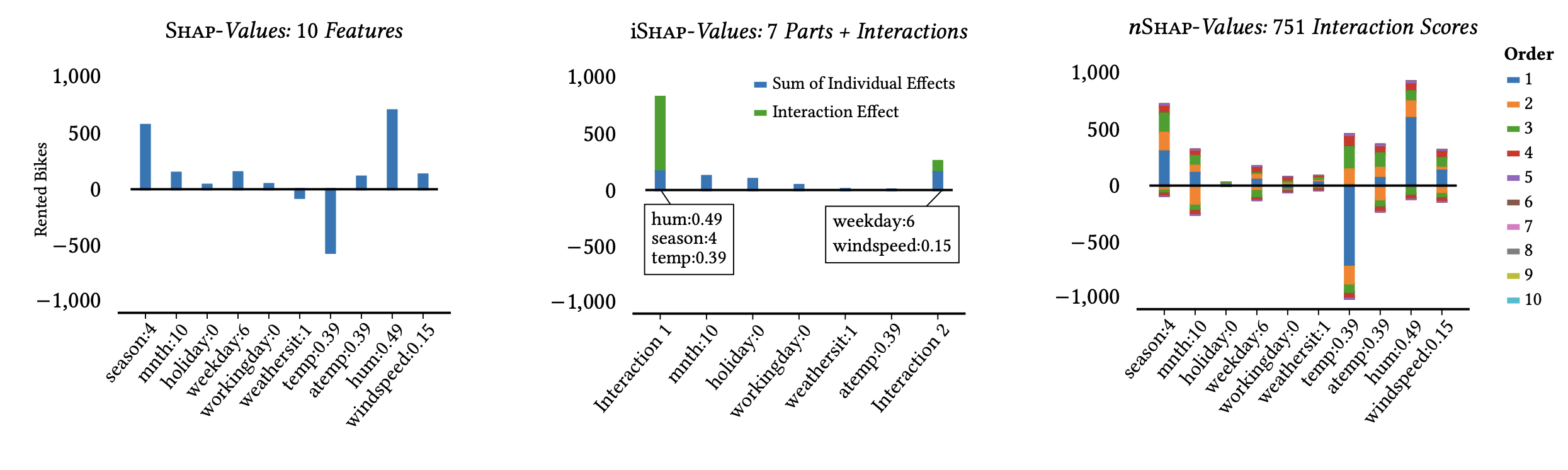 Comparison of Shap (left), our proposal iShap (middle) and 𝑛Shap (right) on the Bike Sharing dataset [4]. Shap
does not reveal interactions, 𝑛Shap returns non-zero scores for 751 out of 1024 feature sets (𝑛 = 𝑑). iShap provides a concise
explanation of 2 interactions for the high predicted demand: its is a dry and relatively warm winter day (Season:4, Hum:0.49
and Temp:0.39) and a Saturday with little wind (Weekday:6 and Windspeed:0.15).
Comparison of Shap (left), our proposal iShap (middle) and 𝑛Shap (right) on the Bike Sharing dataset [4]. Shap
does not reveal interactions, 𝑛Shap returns non-zero scores for 751 out of 1024 feature sets (𝑛 = 𝑑). iShap provides a concise
explanation of 2 interactions for the high predicted demand: its is a dry and relatively warm winter day (Season:4, Hum:0.49
and Temp:0.39) and a Saturday with little wind (Weekday:6 and Windspeed:0.15).
Experiments demonstrate that iShap more accurately reflects underlying model behavior than SHAP and nShap, and user studies indicate it is more interpretable and trustworthy.
- Enhanced Interpretability: Provides more interpretable SHAP values for complex models.
- Synthetic and Real-World Data Support: Includes experiments for both synthetic datasets and real-world scenarios.
- User-Friendly Interface: Designed for ease of use, facilitating quick integration into existing workflows.
To install iSHAP, you can use pip:
pip install ishapor clone the repository and install the requirements:
git clone https://github.com/Schascha1/iSHAP.git
cd iSHAP
pip install -r requirements.txtWe provide a notebook that showcases how to run and visualize iSHAP on a common classification.
To find the reproduction package of the paper, please refer to the Zenodo page.
This project is licensed under the MIT License. See the LICENSE file for details.
If you use iSHAP in your research, please cite the associated paper:
@inproceedings{ishap:xu:25,
  title={Succint Interaction-Aware Explanations},
  author={Xu, Sascha and C{\"u}ppers, Joscha and Vreeken, Jilles},
  booktitle = {Proceedings of the 31st ACM SIGKDD Conference on Knowledge Discovery and Data Mining},
  year={2025},
  url={https://openreview.net/forum?id=uXLXFWTaoT}
}For questions or support, please open an issue in the repository or contact sascha.xu@cispa.de.
[1] Xu, Sascha, Joscha Cüppers, and Jilles Vreeken. "Succint Interaction-Aware Explanations." Proceedings of the 31st ACM SIGKDD Conference on Knowledge Discovery and Data Mining. 2025.
[2] Lundberg, Scott M., and Su-In Lee. "A Unified Approach to Interpreting Model Predictions." Advances in Neural Information Processing Systems 30 (2017).
[3] Bordt, Sebastian, and Ulrike von Luxburg. "From shapley values to generalized additive models and back." International Conference on Artificial Intelligence and Statistics. PMLR, 2023.
[4] Fanaee-T, Hadi, and Joao Gama. "Event labeling combining ensemble detectors and background knowledge." Progress in Artificial Intelligence 2 (2014): 113-127.