Colors & Colorbars
On this page are examples of how QOL.plots can help you deal with colors & colorbars:
- Create a nice colorbar (default)
- Create a well-labeled colorbar for discrete data
- Create a discrete colormap
- Determine the Nth color (e.g. in default plot color cycle)
- Show all available colormap options
Before running any of the following examples, make sure to do:
import matplotlib.pyplot as plt
import numpy as np
import QOL.plots as pqolIn its simplest form, this is accomplished by:
pqol.Nth_color(n) #n should equal a nonnegative integer, e.g. n=0, or n=7.This returns the Nth color in the default color cycle, which is the thing that determines colors when you plot multiple datasets on the same image.
For example, you can use this function to manually choose colors that match the default color cycle, or mix it up however you want:
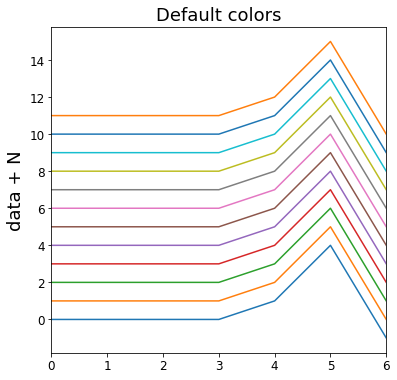
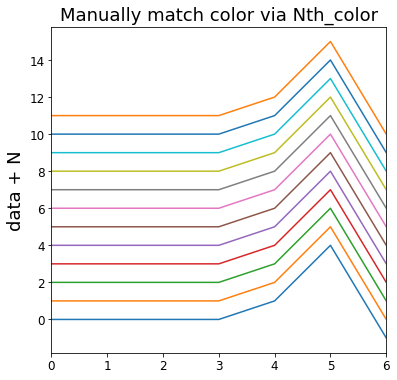
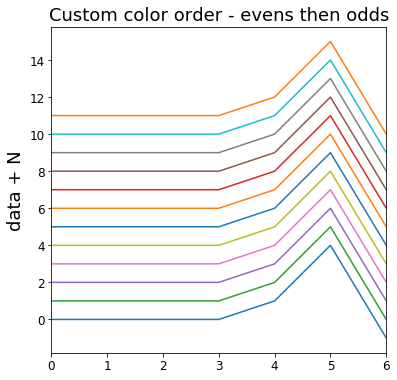
data = np.array([0,0,0,0,1,4,-1]) #make some data

## Default plot ##
title = "Default Colors"
for N in range(12):
    plt.plot(N + data, label=N)
plt.ylabel("data + N")    #formatting/labelling
plt.title(title)          #formatting/labelling
plt.xlim([0,len(data)-1]) #formatting/labelling
plt.show()

## Plot with manually matched colors ##
title = "Manually match color via Nth_color"
for N in range(12):
    plt.plot(N + data, label=N, color=pqol.Nth_color(N)) #this line is different from above.
plt.ylabel("data + N")    #formatting/labelling
plt.title(title)          #formatting/labelling
plt.xlim([0,len(data)-1]) #formatting/labelling
plt.show()

## Plot with selected color order ##
title = "Custom color order - evens then odds"
color_order = [0,2,4,6,8,10, 1,3,5,7,9,11] #this line is new
for N in range(12):
    plt.plot(N + data, label=N, color=pqol.Nth_color(color_order[i])) #this line is different from above.
plt.ylabel("data + N")    #formatting/labelling
plt.title(title)          #formatting/labelling
plt.xlim([0,len(data)-1]) #formatting/labelling
plt.show()In its most basic form, this is accomplished by:
pqol.colorbar()For comparison, below are images showing matplotlib's default colorbar and PlotQOL's default colorbar.
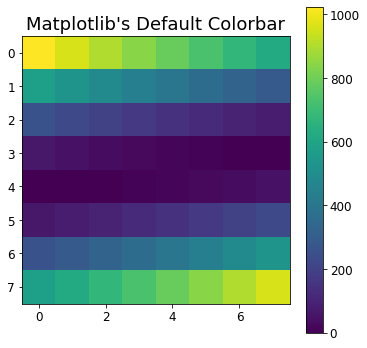
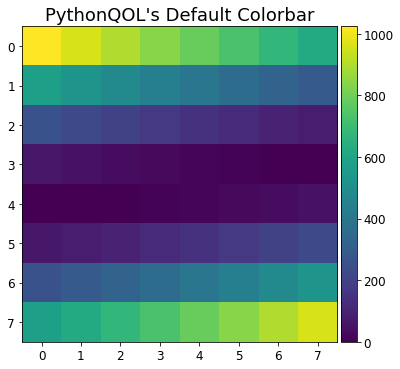
plt.imshow((np.arange(64).reshape(8,8) - 32)**2)
plt.title("Matplotlib's Default Colorbar")
plt.colorbar()
plt.show()

plt.imshow((np.arange(64).reshape(8,8) - 32)**2)
plt.title("PythonQOL's Default Colorbar")
pqol.colorbar() #Note it is pqol.colorbar(), not plt.colorbar().
plt.show()In its most basic form, this is accomplished by:
data = ... #your data goes here
pqol.discrete_imshow(data, colorbar=True)
Below are some examples of using pqol.discrete_imshow, and matplotlib's imshow for comparison.
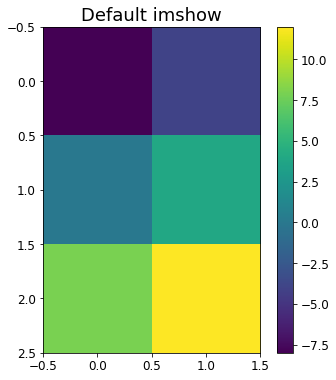
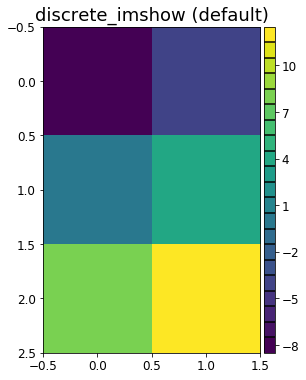
image_data = np.array([[-8,-4],[0,4],[8,12]])

## Default matplotlib imshow ##
plt.imshow(image_data)
plt.title("Default imshow")
plt.colorbar()
plt.show()

## Default PlotQOL discrete_imshow ##
pqol.discrete_imshow(image_data, do_colorbar=True)
plt.title("discrete_imshow (default)")
plt.show()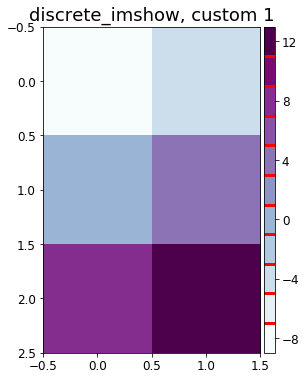
image_data = np.array([[-8,-4],[0,4],[8,12]]) #same data in prior example

## PlotQOL discrete_imshow, custom 1 ##
colormap = 'BuPu'        #colormap. first 2 plots were 'viridis' by default.
cgrid=dict(color='gold', #gridlines of colorbar - color.
           linewidth=3 ) #gridlines of colorbar - linewidth.
stepsize = 2             #discrete step size. == 1 by default.
pqol.discrete_imshow(image_data, base_cmap=colormap, step=stepsize,
                     do_colorbar=True, cgrid_params=cgrid)
plt.title("discrete_imshow, custom 1")
plt.show()

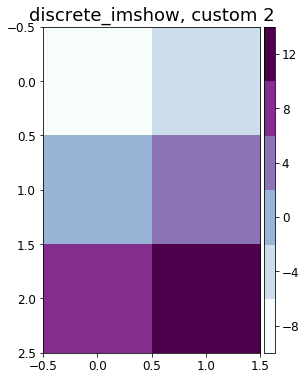
## PlotQOL discrete_imshow, custom 2 ##
colormap = 'BuPu'      #colormap. first 2 plots were 'viridis' by default.
cgrid=dict(grid=False) #gridlines of colorbar - removed.
stepsize = 4           #discrete step size. == 1 by default.
pqol.discrete_imshow(image_data, base_cmap=colormap, step=stepsize,
                     do_colorbar=True, cgrid_params=cgrid)
plt.title("discrete_imshow, custom 2")
plt.show()
For further customization consider combining the pqol.colorbar(discrete=True) and pqol.discrete_cmap() functions.
At the heart of the discrete_imshow and Nth_color examples above is the discrete_cmap function. Most users will not need to use this function direction, but rather may prefer to call the functions from the previous examples.
In its most basic form, creating a discrete colormap is accomplished by:
pqol.discrete_cmap(N, cmap) #N=number of colors, cmap = colormap object, string, or NoneThis will create a discrete colormap with N colors, interpolated based on the colormap represented by cmap:
- If
cmapisNone, uses the default colormap (plt.cm.get_cmap(None), likely'viridis'). - If
cmapis a string, uses matplotlib's colormap represented by that string. * - If
cmapis a colormap, uses cmap itself.
*See the "Show all available colormap options" example, below.
Matplotlib has many default colormap options, but no default way to view all the options available, as far as I know. In the documentation there is a page with an image containing all the default colormaps, but it can get annoying to go to that page every time you want to check the available options. QOL/plots solves this by adapting the example from that page, to let you reproduce the image of all the colormap options.
In its simplest form, showing all available colormap options is accomplished by:
pqol.colormaps()This will print all the default colormaps available, as per the example in matplotlib's online documentation.
For more advanced usage, you may enter any keywords that are accepted by plt.imshow. For example, to see what all the colormaps look like when mostly transparent, you could do pqol.colormaps(alpha=0.3)
##TODO: update page with these examples
- Determine the Nth color (e.g. in default plot color cycle)