Cauli — Forms AI (https://cauliform-ai-293051374734.us-west1.run.app/)
Voice-first assistant that turns a Google Form into a spoken conversation: paste a link, answer by voice (Gemini Live), and submit through the browser agent.
This repo ships a Next.js app and a Jac module under jac/. Form URL checks and parse_google_form live in jac/form_parser.jac (Jac plus a ::py:: block for the HTML / JSON scrape, matching src/lib/form-parser.ts).
Live demo
·
About & links
·
Jac docs
·
Demo video
Built for NEXT GEN PRODUCT LAB (7-day build) and the Gemini Live Agent Challenge.
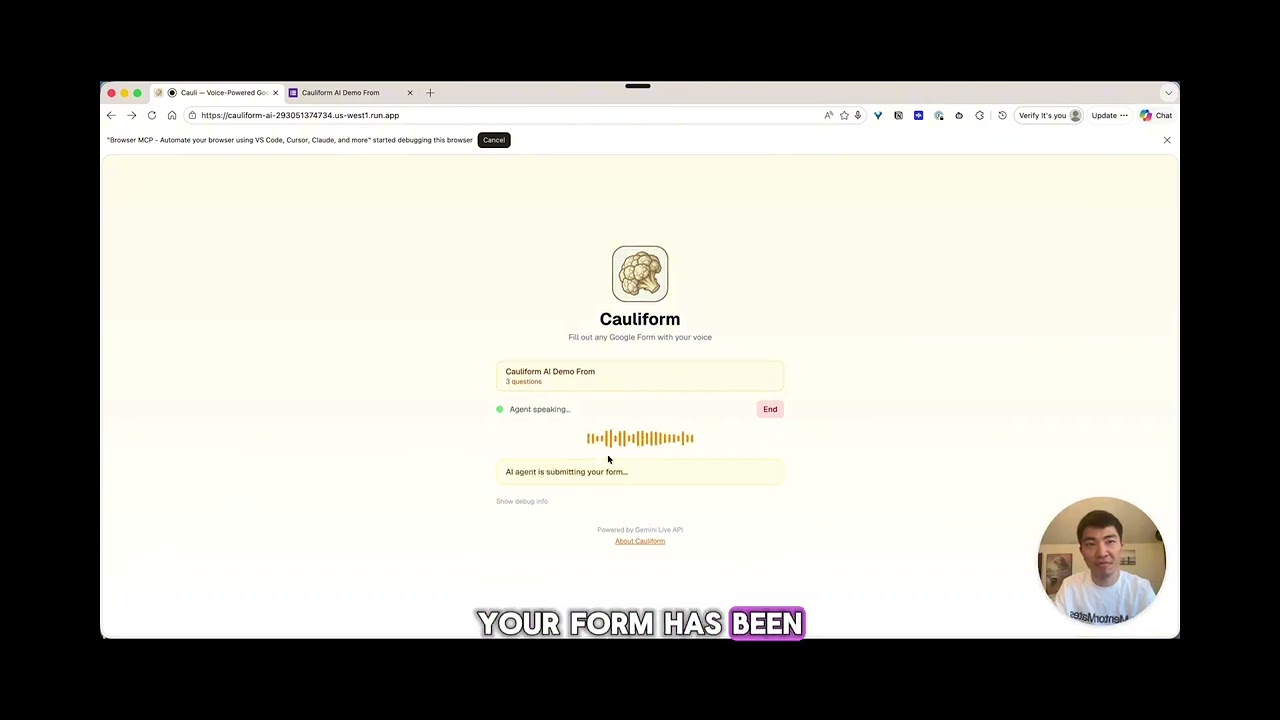


- Parse a public Google Form from its URL
- Voice Q&A via Gemini Live
- Confirm answers, then submit (Tinyfish automation API)
npm installCreate .env.local in the project root (see Environment variables), then:
npm run devOpen http://localhost:3000. For a large-type About page with prominent links, open http://localhost:3000/about.
Jac is the Jaseci-stack language used for jac/form_parser.jac. Use Python 3.12+ (tested with 3.13).
python3.13 -m venv .venv-jac
./.venv-jac/bin/pip install -r requirements-jac.txt
./.venv-jac/bin/jac --version
After the venv exists:
npm run jac:check   # static check jac/form_parser.jac
npm run jac:smoke   # run jac/smoke.jac (no network)
Project layout
jac/form_parser.jac—extract_form_id,is_valid_google_form_url,map_question_type,parse_google_form(heavy scraping in embedded Python).jac/smoke.jac— quick sanity checks for the Jac helpers.scripts/jac_parse_stdio.py— JSON stdin → JSON stdout bridge for Node.src/lib/jac-form-parser.ts— spawns the bridge when Jac parsing is enabled.
By default the API uses TypeScript + fetch (fits serverless). To run the Jac-backed parser locally:
export CAULIFORM_USE_JAC_PARSER=true
export CAULIFORM_JAC_PYTHON="$(pwd)/.venv-jac/bin/python"   # must resolve to an absolute path
npm run dev
Use an absolute path for CAULIFORM_JAC_PYTHON so Next/Turbopack does not traverse .venv-jac symlinks at build time.
npm test              # Vitest — URL helpers aligned with jac/form_parser.jac
npm run jac:smoke # Jac smoke (requires `.venv-jac` + jaclang)Set these in .env.local (or your host’s env).
| Variable | Required | Purpose |
|---|---|---|
GOOGLE_AI_API_KEY |
Yes (voice) | Gemini / token route |
TINYFISH_API_KEY |
Yes (submit) | Form submission automation |
NEXT_PUBLIC_APP_URL |
Recommended | App URL for client config |
NEXT_PUBLIC_FIREBASE_PROJECT_ID |
Optional | Defaults in code if unset |
CAULIFORM_USE_JAC_PARSER |
Optional | true / 1 to parse forms via Jac |
CAULIFORM_JAC_PYTHON |
If Jac parse on | Absolute path to venv python |
Example snippet:
GOOGLE_AI_API_KEY=
TINYFISH_API_KEY=
NEXT_PUBLIC_APP_URL=http://localhost:3000
NEXT_PUBLIC_FIREBASE_PROJECT_ID=
Firebase Admin uses Application Default Credentials (e.g. gcloud auth application-default login locally, or the Cloud Run service account in production).
Optional Jac parsing:
CAULIFORM_USE_JAC_PARSER=true
CAULIFORM_JAC_PYTHON=/absolute/path/to/.venv-jac/bin/python
About Cauli
Forms automation with a conversational layer: Jac sources live in
jac/; the UI and API routes are Next.js and React. For larger headings and link cards, open About on the live demo orhttp://localhost:3000/aboutwhen developing locally.