All Kernel Low Reuse Selector
GraphBrew's validated automatic path is a frozen decision rule for mappings reused once or twice. It chooses between a cost-matched GraphBrew composition and Boost Rabbit.
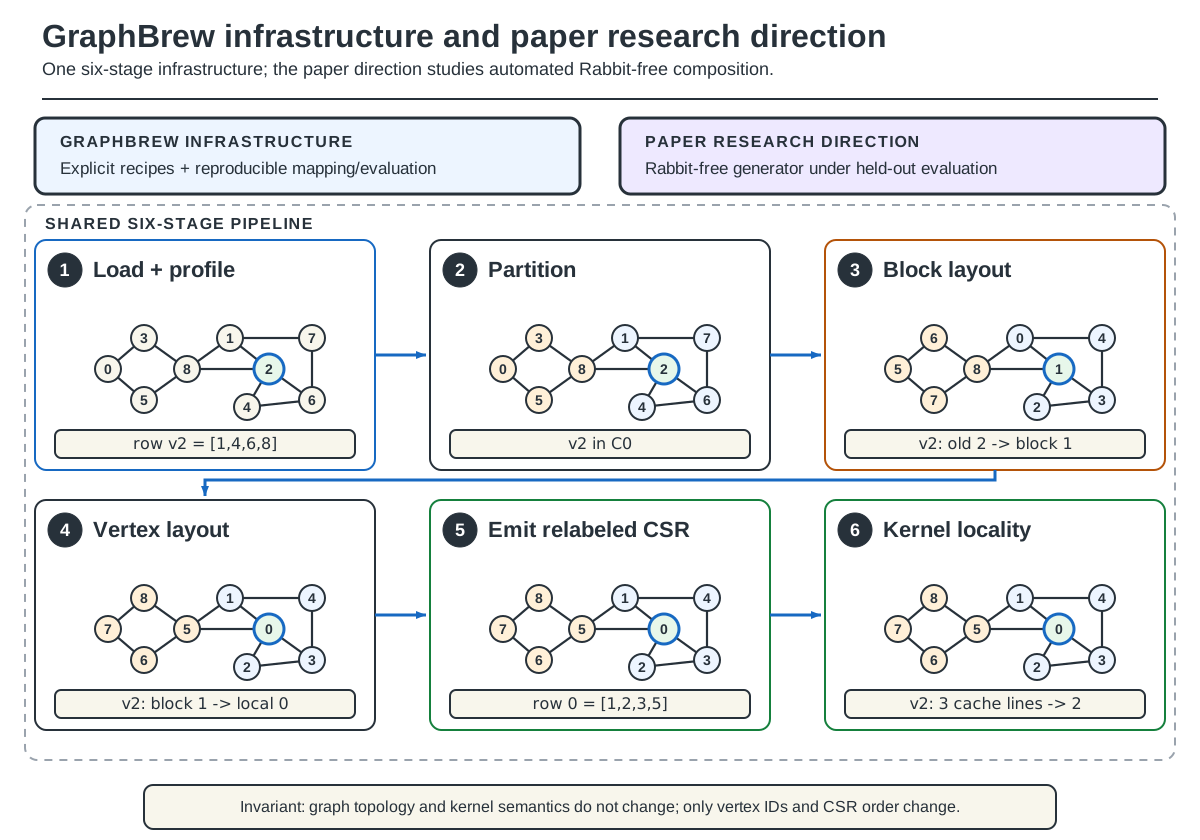
Rabbit is inexpensive to construct, so a more elaborate layout is useful only when its kernel savings recover the extra preprocessing cost. Full Leiden-Gorder composition improved locality but was approximately 17-18 times more expensive to build than Rabbit. The promoted composition removes the dominant cost while preserving the useful layout structure:
- two parallel Leiden iterations and passes;
- ordered super-graph proposal batches of 4096;
- no refinement phase;
- communities placed by descending size;
- Gorder8 inside communities of at most 5000 vertices;
- BFS fallback inside larger communities.
Exact configuration:
12:leiden:compose:sg_none:comm_size_desc:intra_gorder:gw8:
cd_parallel:sgmb4096:gordf5000:norefine:2:2
On the five-graph cost-matched confirmation set, this composition was 10.4% cheaper to construct than CSR Rabbit and 21.1% cheaper than Boost Rabbit while remaining faster across the seven-kernel aggregate.
The composition above is fixed. The runtime does not search the partitioner, block layout, or vertex-layout space. Automation is limited to choosing between that fixed composition and Boost Rabbit.
The deployable interface is:
14:_:_:_:allkernel-lowreuse-rule:best-endtoend:<reuse>
where <reuse> is 1 or 2.
The candidate is eligible only when:
- the graph has at least 1000 vertices;
- reuse is at most 2;
- the kernel is PR, PR-SpMV, BFS, CC, CC-SV, BC, or SSSP; and
- the following predicate is true:
property_wsr_llc <= 3.2 && ((degree_cv <= 2.68 && (avg_degree <= 60 || property_wsr_llc <= 0.82)) || degree_cv > 8)
Otherwise the selector uses Boost Rabbit. Reduced builds without Boost use DBG as an explicit fallback.
property_wsr_llc is the estimated kernel-property working set divided by
machine last-level-cache capacity. The structural statistics come from the
lightweight graph-analysis pass.
This rule is deterministic. It uses no graph names, runtime training, learned weights, nearest-neighbor lookup, or trial reorderings.
The predicate was derived on 18 graphs. It was frozen before 12 additional graphs were opened. Mapping construction and all seven kernels were measured with fixed affinity and repeated trials.
Seven holdouts selected GraphBrew and all seven passed at reuse 1 and 2. Five holdouts used Boost Rabbit fallback.
| Reuse | Selected holdouts: Boost/GraphBrew | Lower 95% | Full selector/always-Boost |
|---|---|---|---|
| 1 | 1.696x | 1.502x | 1.361x |
| 2 | 1.642x | 1.460x | 1.336x |
| Graph | Decision |
|---|---|
| soc-BlogCatalog | GraphBrew; pass |
| soc-LiveMocha | GraphBrew; pass |
| web-Stanford | GraphBrew; pass |
| Amazon0601 | GraphBrew; pass |
| web-Google | GraphBrew; pass |
| web-NotreDame | GraphBrew; pass |
| loc-gowalla_edges | GraphBrew; pass |
| soc-pokec | Boost Rabbit fallback |
| as-skitter | Boost Rabbit fallback |
| cit-Patents | Boost Rabbit fallback |
| citeseer | Boost Rabbit fallback |
| ca-AstroPh | Boost Rabbit fallback |
The full 30-graph derivation and validation rows are in the machine-readable evidence file.
The result is an end-to-end low-reuse result, not a claim that GraphBrew always produces faster kernels. The selector wins by balancing mapping cost against the aggregate kernel savings for the declared reuse.
reuse=2 means two complete kernel invocations share one materialized
mapping. It does not mean two PageRank iterations; one PageRank invocation
still performs its fixed internal iteration count.
- The rule is validated only for reuse 1 and 2.
- It is a fallback policy, not a universal GraphBrew recommendation.
- Road and mesh-like graphs exposed failures of the universal static composition and are intentionally routed away by the rule.
- CC-SV can regress even when the seven-kernel end-to-end aggregate improves.
- Mapping construction and kernel time must remain separate in reported results.
See AdaptiveOrder for the runtime boundary and GraphBrewOrder for explicit composition.