Lexical affixes in polysynthetic languages #703

Description

This issue is related to issue #701. While that issue deals with the question of incorporating a noun into a verb, this issue talks about deriving a verb from a noun by means of a (sometimes formerly verbal) affix. This phenomenon is found in a number of languages, here I will cover three: Chukchi, Yupik and Greenlandic. In Yupik and Greenlandic these are called "postbases" and verbs that are formed from a noun + verbal postbase are called denominal verbs (Malouf, 1999).
In Chukchi a very similar phenomenon exists, from Dunn's grammar (§12.6)
A number of languages have affixes which correspond to incorporating V[erb]’s in other languages. The Chukotko-Kamchatkan languages [...] also have small sets of derivational suffixes which, when added to N[oun]’s, function much like incorporating V’s (Bogoras 1922). They supply meanings such as ‘to fetch’, ‘to take off (clothing)’, ‘to put on (clothing)’, ‘to search for’, and ‘to consume, eat’. Suffixed to N’s, they derive V stems denoting unitary activities (Mithun, 1984)
In the Chukchi corpus I am working on, these appear in 15-20% of the texts I have annotated so far and are more frequent than nominal incorporation. I have come across the following affixes:
- More lexical:
EAT: Transitive, makes an intransitive verb where the object (thing being eaten) is filled.GO.TO: Intransitive, makes an intransitive verb where the direction (place being gone to) is filled.DRAG.OUT: Transitive, makes an intransitive verb when the object (thing being dragged) is filled.MAKE(circumfix): Transitive, makes an intransitive verb where the object (thing being made) is filled.DES(circumfix): Equivalent to "want to"SEARCH: Transitive, makes an intransitive verb where the object (thing being searched for) is filled.CATCH: Transitive, makes an intransitive verb where the object (thing being caught) is filled.
Although there are more described in the glossing manual.
One example (4) from a story about an evil spirit and a bird:

# text = Каԓьайӈын эгэ мынӄымԓёченмэв.
# text[phon] = kaɬʔajŋən eɣe mənqəmɬosenmew
# text[rus] = Злой дух [говорит]: «Ладно, давай есть друг у друга костный мозг».
# text[eng] = The evil spirit says: «Well, let us eat each other’s bone marrow».
1	Каԓьайӈын	Каԓьайӈын	NOUN	_	Case=Abs|Number=Sing	_	_	_	Gloss=злой.дух-AUG-NOM.SG
2	эгэ	_	ADV	_	_	3	advmod	_	Gloss=ладно
3	мынӄымԓёченмэв	_	VERB	_	_	1	parataxis	_	Gloss=1PL.S/A.SUBJ-костный.мозг-EAT-COMB-1PL.S/O.EXCL
4	.	.	PUNCT	_	_	1	punct	_	_
This is an intransitive verb, мынӄымԓёченмэв which translates as "let us eat each other’s bone marrow". The root is ӄымԓ [qəmɬ] "bone marrow", the "let us" is subjunctive SUBJ, while COMB can indicate reciprocity and EAT is a lexical affix that creates an intransitive verb from a noun X meaning to eat X.
And another from this text:

# text = Ӄԓявыԓ мургин гатапачпортӈыԓен.
# text[phon] = qɬawəɬ murɣin ɣatapasportŋəɬen
# text[rus] = DMP: Парень наш (с)делал паспорт.
# text[eng] = DMP: Our lad got a passport (lit. made).
1	Ӄԓявыԓ	Ӄԓявыԓ	NOUN	_	Animacy=Anim|Case=Abs|Number=Sing	3	nsubj	_	Gloss=мужчина-NOM.SG
2	мургин	мури	PRON	_	Possessive=Yes|Number=Plur|Person=1|PronType=Pers	1	nmod:poss	_	Gloss=мы-GEN
3	гатапачпортӈыԓен	_	VERB	_	Aspect=Perf	0	root	_	Gloss=PF-MAKE-паспорт-MAKE-PF.3SG
4	.	.	PUNCT	_	_	3	punct	_	_
Here the verb is an intransitive one "got a passport" formed of the noun пачпорт "passport" and the verbalising circumfix та-STEM-ӈ.
The Inuit languages have a similar structure as this example from Jacobsen's grammar of Yupik:
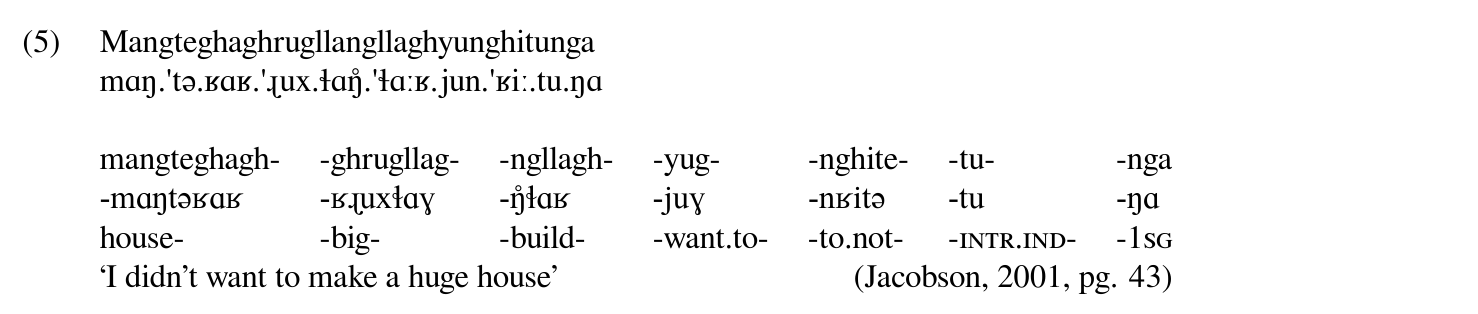
One could imagine an analysis such as:
# text = Mangteghaghrugllangllaghyunghitunga.
1       Mangteghaghrugllangllaghyunghitunga     mangtegha       NOUN    _       _       0       root    _       _
2       .       .       PUNCT   _       _       1       punct   _       _
where the lemma is "house", or
# text = Mangteghaghrugllangllaghyunghitunga.
1       Mangteghaghrugllangllaghyunghitunga     mangteghaghrugllangllaghyu       VERB    _       _       0       root    _       _
2       .       .       PUNCT   _       _       1       punct   _       _
where the lemma is "to want to build a big house". But I wonder if there might be a more adequate way of representing the information.
A similar example is found in this story in Chukchi, although combinations of these affixes are not frequent in the corpus I am annotating:

# text = Гымнин ытԓьаӄай нырэԓгыӄанъявӈытаӈӄэн.
# text[phon] = ɣəmnin ətɬʔaqaj nəreɬɣəqanjawŋətaŋqen
# text[rus] = Моя мамочка хотела поехать на Первый (в Эгвекинот).
# text[eng] = My mum wanted to go to Egvekinot.
1       Гымнин  _       PRON    _       Animacy=Anim|Case=Gen|Number=Sing|Person=1|PronType=Pers        2       nmod:poss       _       Gloss=я-AN.GEN
2       ытԓьаӄай        ытԓьаӄай        NOUN    _       Animacy=Anim|Case=Abs|Deriv=Dim|Number=Sing     3       nsubj   _       Gloss=мать-DIM-NOM.SG
3       нырэԓгыӄанъявӈытаӈӄэн   _       PROPN    _       _       0       root    _       Gloss=ST-DES-белый-ущелье-GO.DO-DES-ST.3SG
4       .       .       PUNCT   _       _       3       punct   _       _
Here Эԓгыӄанъяв is a place name and GO.DO can be used with other placenames such as тынотапынмынтагъак "I went to Nutepelmen" < Нутэпылмын "Nutepelmen".
In his dependency analysis of Greenlandic, principally targetted at Greenlandic→Danish machine translation, Eckhard Bick (2019), these suffixes are split off as separate nodes in the tree. Among the reasons he gives is the fact that subunits can have word-external arguments, although he argues against over-splitting.
While splitting off of incorporated arguments,auxiliaries and light adverbs clearly pushes syntax under the water-line of the word boundary and helps to create a deeper syntax and a more universal dependency tree, there is also the danger of splitting off morphemes that are less syntactic in nature and part of larger semantic lexical units. For instance, in our example, theword for plane can be morphologically deconstructed into the root timmi (plane) and the affixes TAR (uses to) and TUQ (that which), literally meaning something (or somebody) that uses to fly. However, such a deconstruction is only of etymological interest, there are no external syntactic reasons for this (such as the existence of
@i->Varguments), and the lexical minimal unit in terms of object equivalence in the real world is clearly plane. Similarly, the verb root titartaavoq (draw) is originally decomposed by the FST as titartar(paa)+HTR, i.e. with a transitive root and an affix denoting "half-transitivity" (i.e. taking an indefinite object in instrumental case). However, the HTR affix,while leaving morphological traces, does not correspond to a syntactic node, and since the external object is in an oblique case rather than ordinary object case (absolute), it syntactically "prefers" the longer and already half-transitive form titartaavoq as its dependency head (i.e.with HTR included).
As far as UD is concerned, the surface syntax is clear, as with #701, these are largely intransitive verbs. But simply treating them as such belies argument structure relations that are going on underneath. For example, we would be relegated to having a separate verb for every object that can be made, eaten or gone to, and that information would not be available without further processing.
We could produce the missing "predicate" in the enhanced representation, much like we do with predicate ellipsis, e.g.

# text = Ӄԓявыԓ мургин гатапачпортӈыԓен.
# text[phon] = qɬawəɬ murɣin ɣatapasportŋəɬen
# text[rus] = DMP: Парень наш (с)делал паспорт.
# text[eng] = DMP: Our lad got a passport (lit. made).
1       Ӄԓявыԓ  Ӄԓявыԓ  NOUN    _       Animacy=Anim|Case=Abs|Number=Sing       3       nsubj   3.1:nsubj       Gloss=мужчина-NOM.SG
2       мургин  мури    PRON    _       Possessive=Yes|Number=Plur|Person=1|PronType=Pers       1       nmod:poss       _       Gloss=мы-GEN
3       гатапачпортӈыԓен        _       VERB    _       Aspect=Perf|Number[subj]=Sing|Person[subj]=3|Valency=1|VerbForm=Fin     0       root    _       Gloss=PF-MAKE-паспорт-MAKE-PF.3SG
3.1     _       _       VERB    _       Predicate=Make|Valency=2        _       _       0:root  Gloss=MAKE
3.2     пачпорт пачпорт NOUN    _       _       _       _       3.1:obj Gloss=паспорт
4       .       .       PUNCT   _       _       3       punct   _       _
The motivation behind encoding the morpheme as Predicate=Make is that there should be a finite set, and it avoids having "technical" surface forms or lemmas, as make is a circumfix, та-STEM-ӈ.
I think that this phenomenon should be taken into account in the ongoing discussions about enhanced UD and predicate-argument structure. I would welcome any thoughts or comments too.
- Michael Dunn (1999) Grammar of Chukchi. PhD Thesis
- Bick, E. (2019). "Dependency Trees for Greenlandic". Proceedings of the 15th Conference on Natural Language Processing (KONVENS 2019). 140-148
- Robert Malouf (1999) "West Greenlandic noun incorporation in a monohierarchical theory of grammar." In Gert Webelhuth, Andreas Kathol, and Jean-Pierre Koenig (ed.), Lexical and Constructional Aspects of Linguistic Explanation. 47-62.
- Marion Mithun (1984). "The Evolution of Noun Incorporation". Language 60,4: 847-
894 - Steven Jacobson (2001) A Practical Grammar of the St. Lawrence Island / Siberian Yupik Eskimo Language