Repository navigation
White Paper
Portable Project Coordination for AI-Assisted Work is the current
24-page illustrated technical white paper for founders, technical leads,
developers, researchers, and operators. It explains record authority,
coordination, evidence, adoption, and a proposed evaluation of .SYSTEMX.
Edition 2.0 · 20 October 2026 · Lucas (SatoshiUNO)
A product of Wayne Tech Lab LLC
Download the clickable PDF · Read the editable manuscript · Edition metadata and checksums · Local walkthrough report
Published in the immutable v1.11.0-alpha.5 prerelease
on 20 October 2026, 13:01:32 UTC, release 418402174. Reviewed
publication source: 85c9d6b78b9143b7ad928cc2b26050d1194921fa.
The paper examines 1.11.0-alpha.4, source
e086ba15a1e70c6b585b8f12a703defc5c984b2c. Its publication release is
1.11.0-alpha.5. The paper edition, examined software, publication release,
and 1.11.0-alpha.3 four-part 4K media edition are separate identifiers.
The manual is the operational reference; the paper is a pinned
explanation of its baseline. Alpha software is experimental and subject to
change. Use it at your own risk.
Networks.Chat — author portfolio · WayneTechLab.com — business · Repository · Wiki manual
Watch the 1:50 introduction on YouTube for a narrated animated
overview of context, plans, canonical work, Agent 0/X/Y/Z/Alpha, ROOT, AUTOBOT,
DATA, and .SYSTEMXP scopes. The video guide and 4K poster
provide nine YouTube chapters and the original MP4, captions, and transcript.
This overview is separate from a narrated reading of the complete 24-page paper.
The streaming copy is on the Wayne Tech Lab channel.
| Reader or question | Route through edition 2.0 |
|---|---|
| Founder: what problem does this solve? | Abstract; sections 1–3 for purpose, record authority, and flexible plans; section 12 for adoption. |
| Operator: how do agents coordinate? | Sections 4–5 for Agent 0/X/Y/Z/Alpha, ten selected-reference AUTOBOTS, ROOT, and three TODO surfaces. |
| Developer: show an executable example | Section 6 and Appendix B for the bounded walkthrough; section 9 for evidence, concurrency, and security limits. |
| Multi-project or chat workflow | Sections 7–8 for .SYSTEMXP, authorized transport, versioned defaults, installation, and recovery. |
| Evaluate tokens, money, or time | Sections 10–11 for assumptions, complete accounting, existing verification, and a proposed comparative study. |
| Inspect terms and sources | Appendix A for implementation limits; Appendix B for reproducibility; linked Works Cited. |
The twenty-page web application in section 6 is a planning example. The executable trace is a smaller protocol test; it does not claim that the paper or verifier built, deployed, or accepted that application.
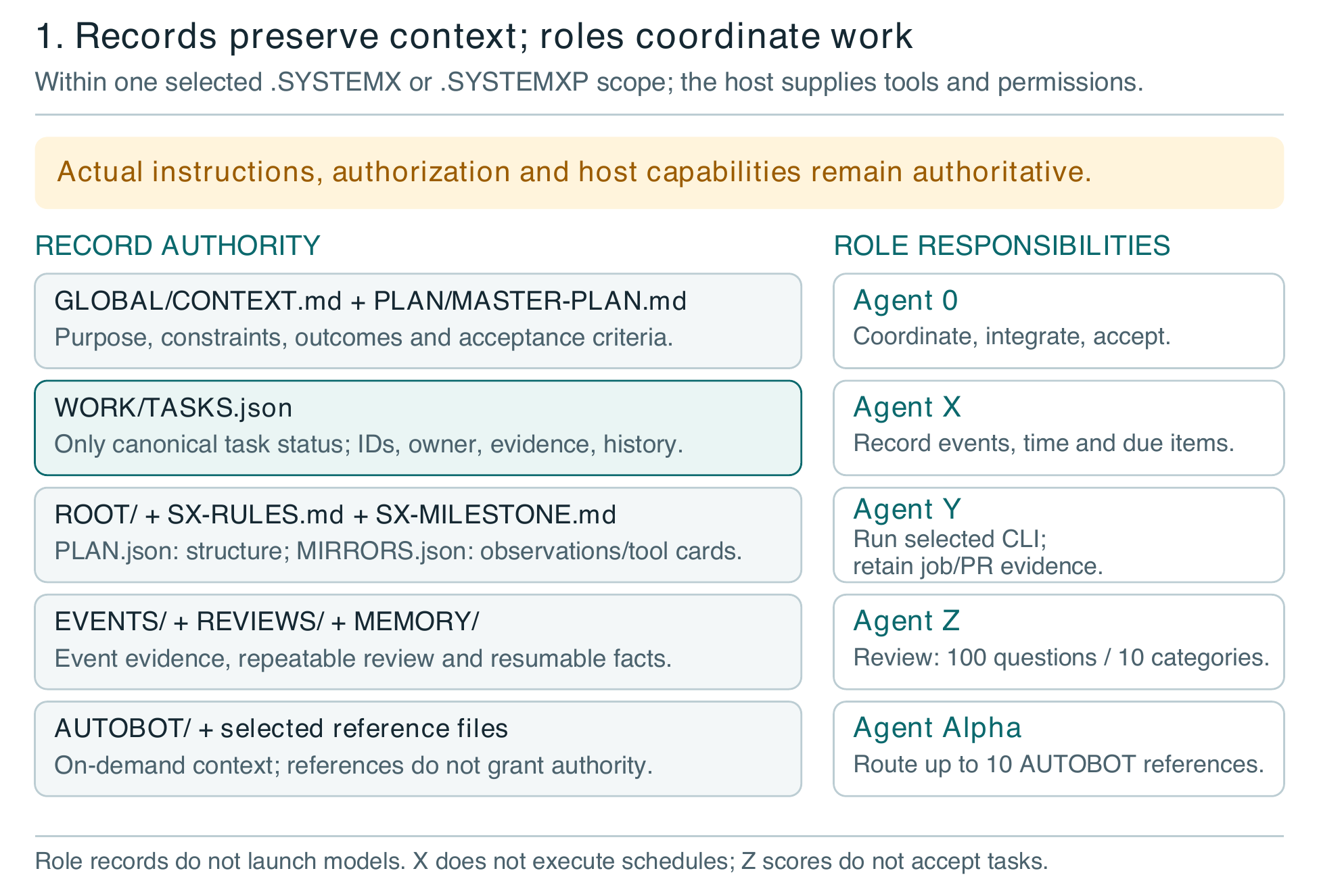
| Figure | What it explains | Editable source |
|---|---|---|
| 1. Record authority and agent responsibilities | Context/plans support one canonical ledger; the host supplies tools and permissions. | SVG |
| 2. Three TODO surfaces and reconciliation | Tasks, observed harness items, and optional bot observations meet through ROOT and authorized reconciliation. | SVG |
| 3. Scope and lifecycle boundaries | Outer tools/defaults, independent .SYSTEMXP records, and owner payloads have different lifecycles. |
SVG |
| 4. Illustrative input accounting | Declared hypothetical assumptions separate selected context and coordination overhead; no measured savings are reported. | SVG |

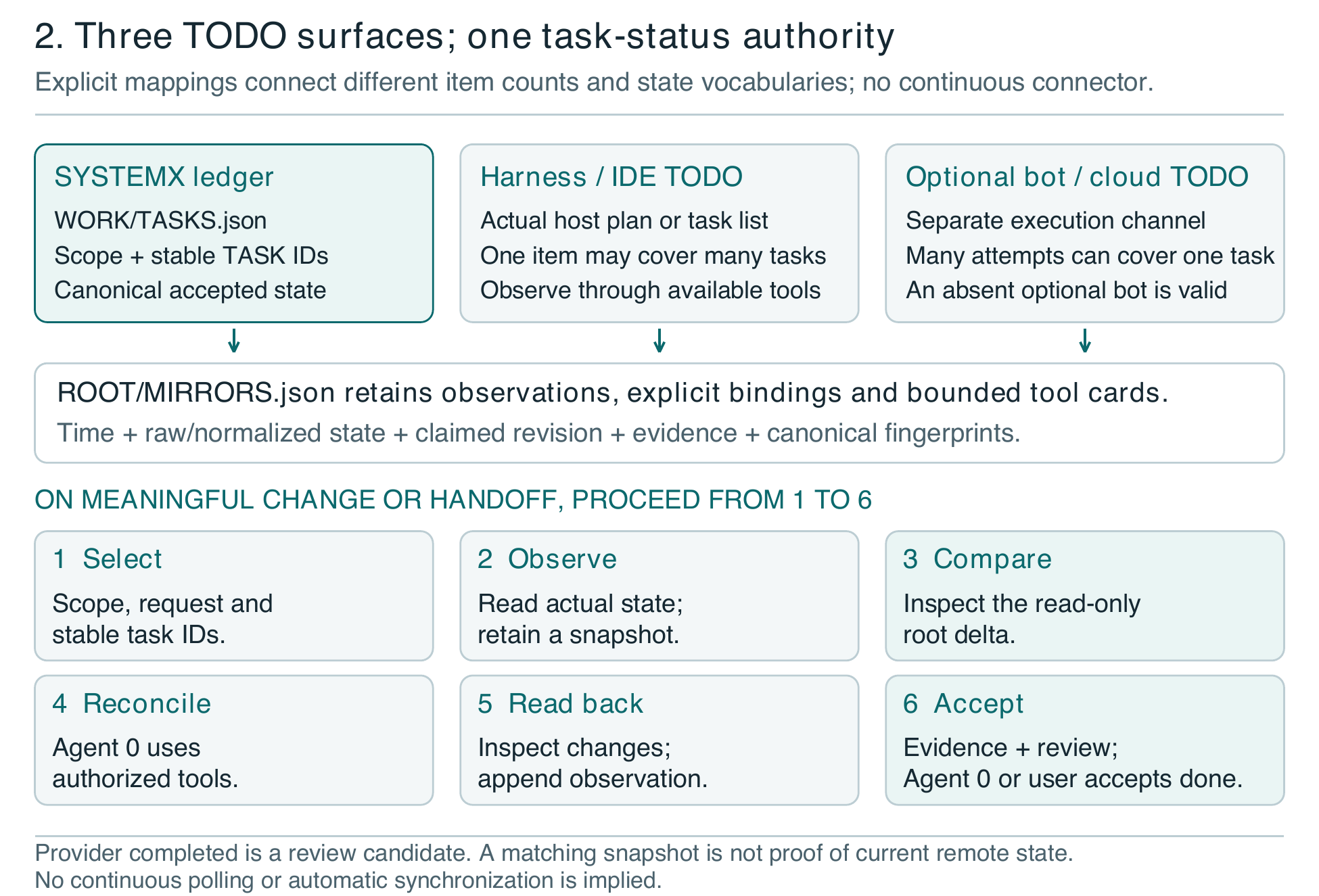

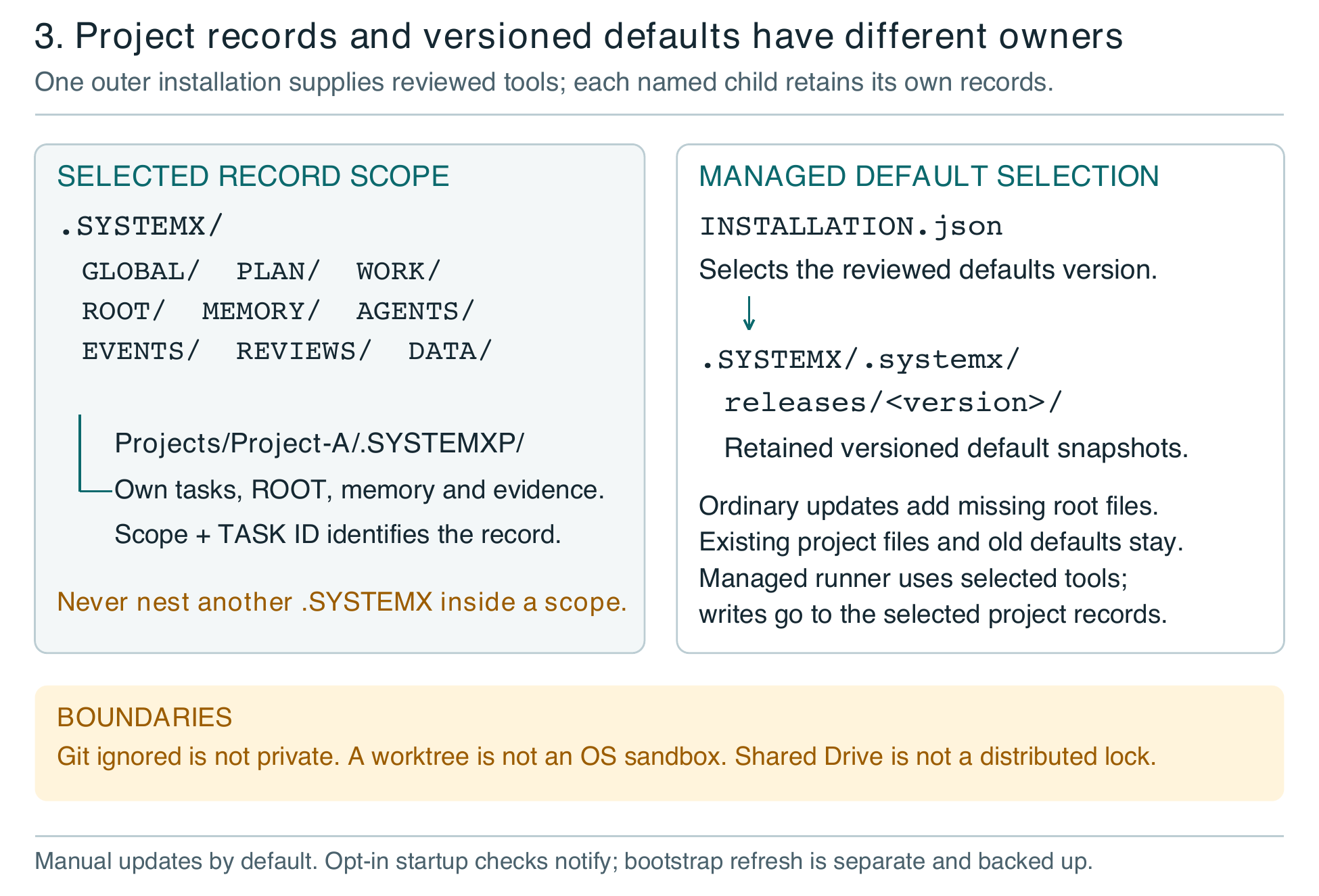

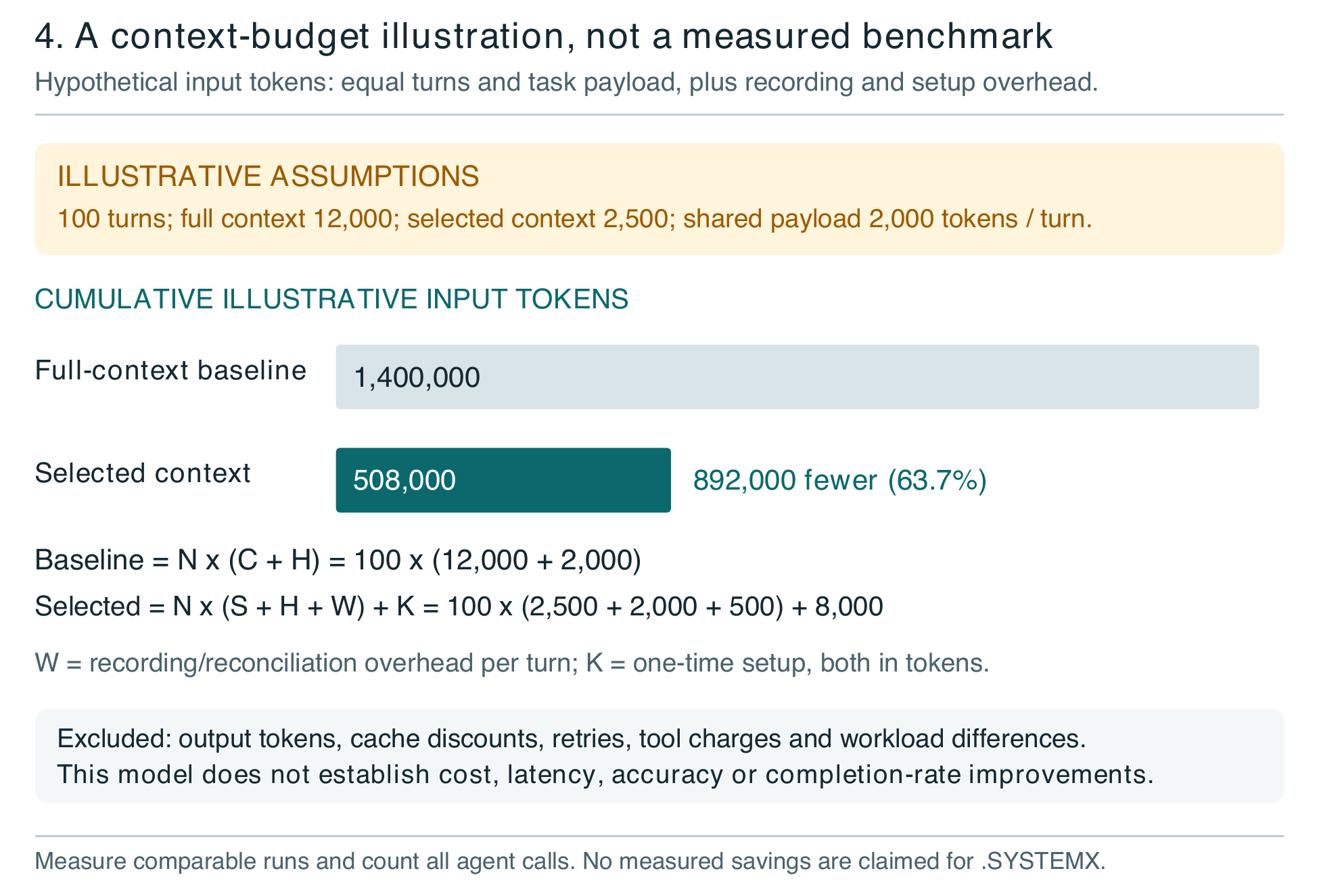

These original publication figures are separate from the raster four-part 4K field guide, which retains its alpha.3 media edition and export provenance. Captions distinguish implementation schematics from mathematical illustration.
WORK/TASKS.json is the canonical task status and acceptance record. Context
and the Master Plan explain why work exists. WORK/FOCUS.json selects the
current objective, task IDs, and checkpoint; TODO/DONE views are generated
projections. ROOT adds request provenance, optional milestone/wave/phase/
group structure, tool cards, and external task-list observations without
creating another status authority. Task identities include their selected
.SYSTEMX or named .SYSTEMXP scope.
Agent 0 routes work, integrates evidence, and retains acceptance with the user. X records events/time; Y carries an optional selected installed CLI and draft-PR handoff; Z applies the fixed advisory review; Alpha selects references from the ten AUTOBOT functions. A role name or file starts no worker and grants no tools, credentials, network access, or authority. Add optional roles when useful.
ROOT compares retained observations with all tasks bound to an external item,
including members outside a selected output slice. It does not fetch an IDE or
provider API. Agent 0 uses actual authorized tools, reads back external changes,
and retains evidence. Provider completed, exit zero, or a review score never
automatically accepts canonical done.
Exact operating contracts: ROOT, Agent 0, Agent X, Agent Y, Agent Z, Alpha/AUTOBOT, and evidence and acceptance.
The edition 2.0 verifier creates a disposable managed project, runs 30 local CLI commands, prints sanitized arguments, return codes, returned IDs, and evidence digests, then removes the project. Python 3.9 and Python 3.14 runs completed its stated positive and refusal checks against the examined alpha.4 implementation.
From a reviewed checkout with Python 3.9 or newer:
python3 -I -B docs/media/verify_white_paper_v2.pyThe example checks a synthetic harness item mapped to two tasks, aggregate running state with one task accepted and another active, and a stale bound member detected when only the other task is selected. External completion leaves canonical acceptance unchanged. Premature or missing-reviewer completion is refused; known-bad evidence fails while its counterpart passes; a future occurred event is refused while a planned event is allowed.
The observations are synthetic fixtures. The verifier starts no model, contacts no provider, creates no PR, and deploys no application. It supports tested local record behavior; it is not actual external readback or a productivity, security, or autonomous-throughput benchmark. Alpha.4 full-suite evidence is cited separately, without relabeling it as a new full-suite run for this publication.
Reduced rediscovery and selected context are a testable proposition. The
input-only example assumes repeated context, common task input, selected
context, per-request record overhead, and setup. Changing its assumptions
changes the arithmetic. It reports no measured .SYSTEMX token or dollar
savings, runtime improvement, cache hit, or quality gain.
A real comparison counts all billed input/output classes, workers, tools, retries, maintenance, quality, and human effort. End-to-end wall time differs from summed parallel worker durations. Section 11 proposes paired tasks, predefined acceptance, versioned tools/models, complete costs, negative checks, and retained failures. See Tokens, cost, and time.
The 24-page PDF contains 4,728 words, four original figures, and 15 references. Its professional MLA-style format uses a branded cover, author/page header, company/edition footer, linked contents/figure list, reading routes, and parenthetical citations. The body uses Times-family twelve-point double-spaced text, one-inch margins, and hanging-indent Works Cited, with compact tables/code and publication adaptations.
All 24 rendered pages passed publication review. Navigation inspection found 119 external HTTPS links, 104 valid internal links, and 15 outline entries. Those counts describe link objects, not a check of every remote site's availability. The PDF is selectable and clickable but is not tagged PDF/UA or a strict classroom submission. Markdown is the editable text alternative.
Exact PDF: 1,130,293 bytes, SHA-256
def4d23341e1aabc6908cb02a330537af549f992b8fbe23151928ea6f8383771.
The metadata
records edition identity and verification; release checksums identify the
separate downloadable package/archive streams.
Research paper format explains draft builds, optional publishing dependencies, and review. Publication does not establish independent peer review, vendor endorsement, AGI, an external standard, or production certification.
Edition 1.2, Portable Project Memory for Agentic Work, remains preserved at v1.11.0-alpha.4: 96-page PDF, manuscript, metadata, and historical citation erratum. It examines 1.8.3-alpha.1, predates Y/Alpha/ROOT, and keeps its original PDF/Markdown bytes. The separate erratum corrects its release-report citation without rewriting the original. Its 29 chapters, six figures, and 32 references describe that older publication only.
The current source and new defaults distribute edition 2.0. Additive updates preserve adopted older local files. Earlier publications remain in immutable tagged history. Edition 1.1 audio keeps its original label and does not narrate 2.0; a new recording requires its own transcript, completeness review, identity, and release evidence.
First-time setup · Setup prompt · Version history · Readiness