[TOC]
Def: 當輸入n筆資料時,此function所需要花費的時間。通常指最差情況複雜度(就是在最衰的情況,同一種輸入所需要花最長的時間)
解釋: T(n)是一個演算法實際隨著n變大而成長的線,f(n)算是一條上界,可以是1、n、n^2、logn...。 只要上下移動這條上界到可以使這條上界永遠大於T(n)這條線,那f(n)就可以是T(n)的upper bound.
在看Worst Case 的時候,就是在看當n到無限大的時候,這個演算法最慢需要多少時間,所以用的是Upper Bound
在討論Best Case的時候,就是在看整條T(n)最小的地方可以到多小
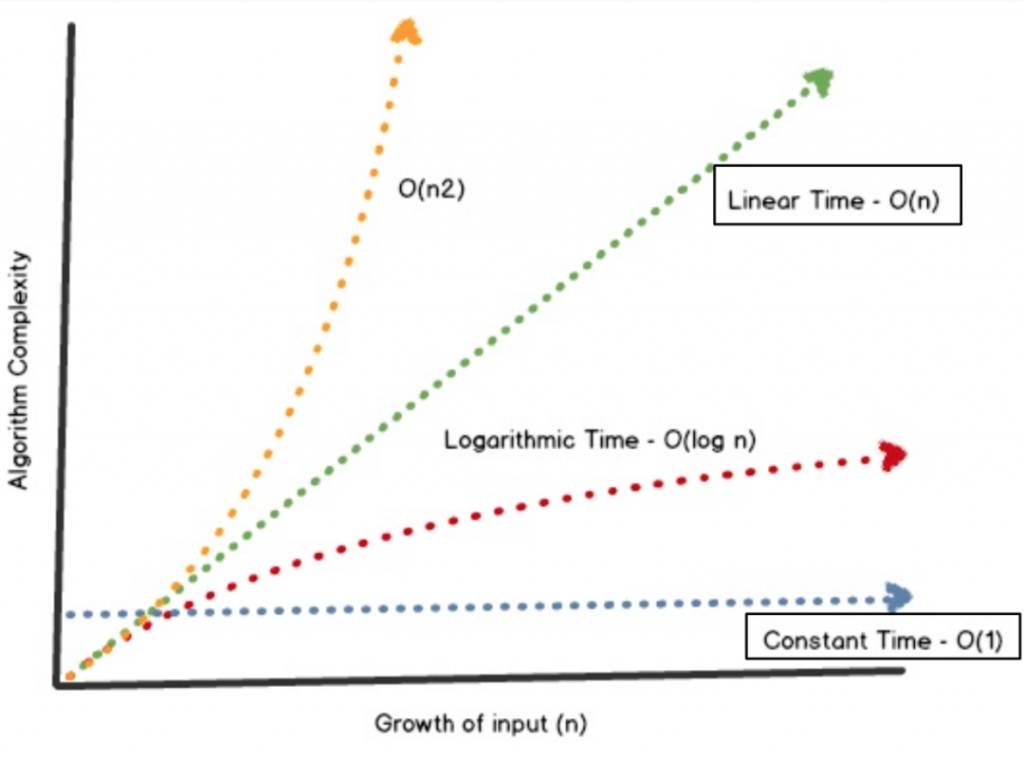
| 執行時間 | 白話文 | 例子 |
|---|---|---|
| 不管輸入多少東西,都不影響求出答案的時間範圍。其中$1$可被替換成任意常數。 | printf("%d",book[237]) | |
| 假設要從$n$個人當中找出拿著筆的人,從第一個人問到第$n$個人,時間複雜度會隨$n$的數目增大而線性增加。 | 簡易搜尋 | |
| 呈上例,在問第一個人時同時叫他也去依序問其他$n-1$個人,這樣執行$n$次。此時時間複雜度會依照$n$增加,以$n^2$圖形增加 | 泡沫排序法 | |
| 以二分搜尋法為例,在執行當中一次過濾掉資料的一半 ,所以當資料數目增加,時間複雜度會以$\log_2n$圖形增加 | 二分搜尋法 |
寫完發現真的不能不放圖

而Tree對於計算時間複雜度的意義在於,Tree的高度就代表這個Leaf所需要compare次數多寡,例如:A[0]<= A[1]<=A[2] 需要作2次Comparison,A[0]<= A[2]<=A[1] 需要作3次comparison。
這裡的Lower Bound是在說Comparison Sort 的演算法可以優化到甚麼程度。因為Comparison的特性,Decision Tree最少會需要$n!$個Leaf才能囊括所有可能性,也就是說Worst Case只能被優化到$2^h$ 最靠近
泡沫排序法是一種簡單的排序法,就是在走訪整個序列時,當遇到兩數的順序不對,就交換順序,直到整個序列排序的位置正確為止。

如圖,第一階從第一個數開始跑,跑到最後,在繼續從第一個數跑,直到整個序列都沒有交換才停止。
當我們分析時間複雜度:
最差的情況(數列是由大排到小,所以總共需要$n-1$次疊代,在疊代過程中需要$n-1-i$次的置換(swap)
所以最差的時間複雜度就是
最好的情況就是已經完全排序好的序列,只需要跑$1$次疊代確認,途中沒有任何swap,只需確認是否排序正確。
所以最好的時間複雜度是$O(n)$。
#include<stdio.h>
#include<stdlib.h>

void bubble_sort(int* array, int n){
    int t = 0;//to avoid the init variable cannot go into the loop
    int swap = 0;
    while(!(swap == 0 && t != 0)){
        swap = 0;
        for(int i = 0; i < n-t-1; ++i){
            //swap
            if(array[i] > array[i+1]){
                int tmp = array[i];
                array[i] = array[i+1];
                array[i+1] = tmp;
                swap += 1;
            }
        }
        t += 1;
    }
}

int main(){
    int array[6] = {5, 1, 4, 2, 8};
    bubble_sort(array, 5);
    for(int i = 0; i < 5; ++i){
        printf("%d%c", array[i], ','*(i != 4) + '\n'*(i == 4));
    }
    return 0;
}
Merge Sort 是一種 divide and conquer 演算法,透過把一個大的array劃分成小的array去做comparison去完成sorting。
Merge Sort 有分成幾個部分:
- 分割
- 比較
- 合併

Quick Sort 是一種分治法,
分治法(分而治之)是一種把一個大問題拆成二或多個相同或類似的小問題,直到小問題可以直接求解的方法。
首先Quick Sort當中會需要一個pivot(基準數),依照這個基準將整個數列分成兩區,一區裡的數均小於pivot,另一區則需均大於pivot。
如下圖,我們選定序列的第一個數作為pivot,i控制序列前端的數並和pivot做比較(必須要小於pivot),j控制序列後端的數並和pivot做比較(必須要大於pivot),當i遇到比pivot大的數且j遇到比pivot小的數,則兩數對調。
直到j > i, j 和 pivot 交換位置,則完成一次。
之後以pivot為基準分成兩邊繼續做partition(),直到兩邊都排序好即完成。

#include<stdio.h>
#include<stdlib.h>
void swap(int* arr, int i, int j);
int partition(int* arr, int i, int j);

void swap(int* arr, int i, int j){
    int tmp = arr[i];
    arr[i] = arr[j];
    arr[j] = tmp;
}
int partition(int* arr, int i, int j){
    /*set the first index of the arr as the pivot*/
    int pivot_index = i;
    int pivot = arr[i];

    while(i <= j){
        while(arr[i] <= pivot && i <= j) ++i;
        while(arr[j] >= pivot && i <= j) --j;
        if(i < j) swap(arr, i, j);
        //we are sure the i num is bigger than j num
        //and make sure the index i is not bigger than index j
    }
    swap(arr, pivot_index, j);
    return j;
}

void quicksort(int* arr, int i, int j){
    int pi;
    if(i >= j) return;//when the array only have 1 num
    if(i < j){
        pi = partition(arr, i, j);
    }
    quicksort(arr, i, pi-1);//divide and conquer
    quicksort(arr, pi+1, j);
}

int main(){
    int arr[] = {16, 20, 1, 26, 14, 7, 9, 4, 8, 18, 11, 17};
    quicksort(arr, 0, 11);
    printf("arr ={");
    for(int i = 0; i < 12; ++i){
        printf(" %d%c", arr[i], ','*(i != 11)+'}'*(i == 11));
    }
    printf("\n");
}
還有另外一種方法(可惡寫到這裡才發現剛剛寫的方法linkedlist實現有難度,只好再把另外一種方法寫好)。因為找不到照片,我自己畫表格:
| 16 | 20 | 1 | 26 | 14 | 7 | 9 | 4 | 8 | 18 | 11 | 17 |
|---|
這次我們多加兩個變數
我們一樣以序列第一的數為 pivot ,不過這次 i (控制數字小於pivot)要先等於low(因為可能整個序列都沒有小於pivot的數)。令 j = low+1(移動範圍到high)
| 16 | 20 | 1 | 26 | 14 | 7 | 9 | 4 | 8 | 18 | 11 | 17 |
|---|
當 j > pivot,不用任何動作,繼續下去。
| 16 | 20 | 1 | 26 | 14 | 7 | 9 | 4 | 8 | 18 | 11 | 17 |
|---|
當 j < pivot,i 加一(紀錄小於pivot的陣列的最尾端,就是最後要跟pivot交換位置的地方),並將 j 和 i 的數值交換位置。 如下表:
| 16 | 1 | 20 | 26 | 14 | 7 | 9 | 4 | 8 | 18 | 11 | 17 |
|---|
然後就依此類推,一直做下去:
| 16 | 1 | 20 | 26 | 14 | 7 | 9 | 4 | 8 | 18 | 11 | 17 |
|---|
| 16 | 1 | 20 | 26 | 14 | 7 | 9 | 4 | 8 | 18 | 11 | 17 |
|---|
| 16 | 1 | 14 | 26 | 20 | 7 | 9 | 4 | 8 | 18 | 11 | 17 |
|---|
| 16 | 1 | 14 | 26 | 20 | 7 | 9 | 4 | 8 | 18 | 11 | 17 |
|---|
| 16 | 1 | 14 | 7 | 20 | 26 | 9 | 4 | 8 | 18 | 11 | 17 |
|---|
| 16 | 1 | 14 | 7 | 20 | 26 | 9 | 4 | 8 | 18 | 11 | 17 |
|---|
| 16 | 1 | 14 | 7 | 9 | 26 | 20 | 4 | 8 | 18 | 11 | 17 |
|---|
快轉一下
| 16 | 1 | 14 | 7 | 9 | 4 | 20 | 26 | 8 | 18 | 11 | 17 |
|---|
| 16 | 1 | 14 | 7 | 9 | 4 | 8 | 26 | 20 | 18 | 11 | 17 |
|---|
| 16 | 1 | 14 | 7 | 9 | 4 | 8 | 26 | 20 | 18 | 11 | 17 |
|---|
| 16 | 1 | 14 | 7 | 9 | 4 | 8 | 11 | 20 | 18 | 26 | 17 |
|---|
| 16 | 1 | 14 | 7 | 9 | 4 | 8 | 11 | 20 | 18 | 26 | 17 |
|---|
這時候 i 和 pivot 換位置,就完成一次partition()。
| 11 | 1 | 14 | 7 | 9 | 4 | 8 | 16 | 20 | 18 | 26 | 17 |
|---|
#include<stdio.h>
#include<stdlib.h>
void swap(int* arr, int i, int j);
int partition(int* arr, int i, int j);

void swap(int* arr, int i, int j){
    int tmp = arr[i];
    arr[i] = arr[j];
    arr[j] = tmp;
}

int partition(int* arr, int low, int high){
    int pivot_index = low;
    int pivot = arr[low];
    int i = low;
    int j = low+1;
    while( j <= high){
        if(arr[j] >= pivot){
            ++j;
            continue;
        }
        if(arr[j] < pivot){
            ++i;
            swap(arr, i, j);
            ++j;
        }
    }
    swap(arr, pivot_index, i);
    return i;

}

void quicksort(int* arr, int i, int j){
    int pi;
    if(i >= j) return;
    if(i < j){
        pi = partition(arr, i, j);
    }
    quicksort(arr, i, pi-1);
    quicksort(arr, pi+1, j);
}

int main(){
    int arr[] = {16, 20, 1, 26, 14, 7, 9, 4, 8, 18, 11, 17};
    quicksort(arr, 0, 11);
    printf("arr ={");
    for(int i = 0; i < 12; ++i){
        printf(" %d%c", arr[i], ','*(i != 11)+'}'*(i == 11));
    }
    printf("\n");
}