Repository navigation
Frontend Architecture
The frontend source lives in ydl-front and uses the original Vue 2 / Webpack 3 stack. It is used both with Django locally and with a browser mock adapter in the public Pages demo.
📦 ydl-front/
┣ 📂 build/                   # Webpack build pipeline
┣ 📂 config/                  # Development and production asset paths
┣ 📂 src/
┃ ┣ 📄 App.vue                # App shell and session initialization
┃ ┣ 📄 main.js                # Vue bootstrap
┃ ┣ 📂 router/
┃ ┃ ┗ 📄 index.js             # Hash-based routes
┃ ┣ 📂 store/
┃ ┃ ┣ 📄 api.js               # Axios client and demo adapter switch
┃ ┃ ┗ 📄 store.js             # Vuex data/actions
┃ ┣ 📂 demo/
┃ ┃ ┣ 📄 data.js              # Fictional sample data
┃ ┃ ┣ 📄 mockApi.js           # Simulated REST endpoints
┃ ┃ ┣ 📄 session.js           # Demo role/session behavior
┃ ┃ ┣ 📄 announcements.js
┃ ┃ ┗ 📄 resources.js
┃ ┗ 📂 components/
┃   ┣ 📂 Authorization/      # Login and signup views
┃   ┣ 📂 Course/             # Browse, create, edit, enroll
┃   ┣ 📂 Forum/              # Discussion and replies
┃   ┣ 📂 Quiz/               # Questions, answer components, quiz editing
┃   ┣ 📂 Calendar/           # Monthly calendar and timetable
┃   ┣ 📂 Profile/            # Dashboard and user settings
┃   ┣ 📂 Resources/          # Course resource list and upload form
┃   ┣ 📂 LandingPage/        # Branding and announcements
┃   ┣ 📂 Demo/               # Demo toolbar and teacher quiz editor
┃   ┗ 📂 Navigation/         # Navbar and sidebar
┣ 📂 static/demo-resources/   # Downloadable fictional learning files
┗ 📂 docs/                    # Generated static build output
Only the important directories are shown. Older experimental prototypes and test scaffolding also exist in the historical repository.
flowchart TD
  Router["Vue Router (hash mode)"] --> Shell["App.vue / ProfilePage.vue"]
  Shell --> Course["Course components"]
  Shell --> Forum["Forum components"]
  Shell --> Quiz["Quiz components"]
  Shell --> Calendar["Calendar / events"]
  Course --> Vuex["Vuex store"]
  Forum --> Vuex
  Calendar --> Vuex
  Vuex --> Axios["src/store/api.js — Axios"]
  Axios -->|"Local full-stack"| DRF["/api/ → Django"]
  Axios -->|"Pages build"| Mock["src/demo/mockApi.js"]
The components primarily interact with existing store actions and Axios APIs; the public demo swaps the transport behavior rather than rebuilding all screens.
Examples from the restored Vue hash router:
| View | Example fragment |
|---|---|
| Landing page | /#/ |
| Student dashboard | /#/profile/2/courses/ |
| Course catalog | /#/profile/2/allcourses |
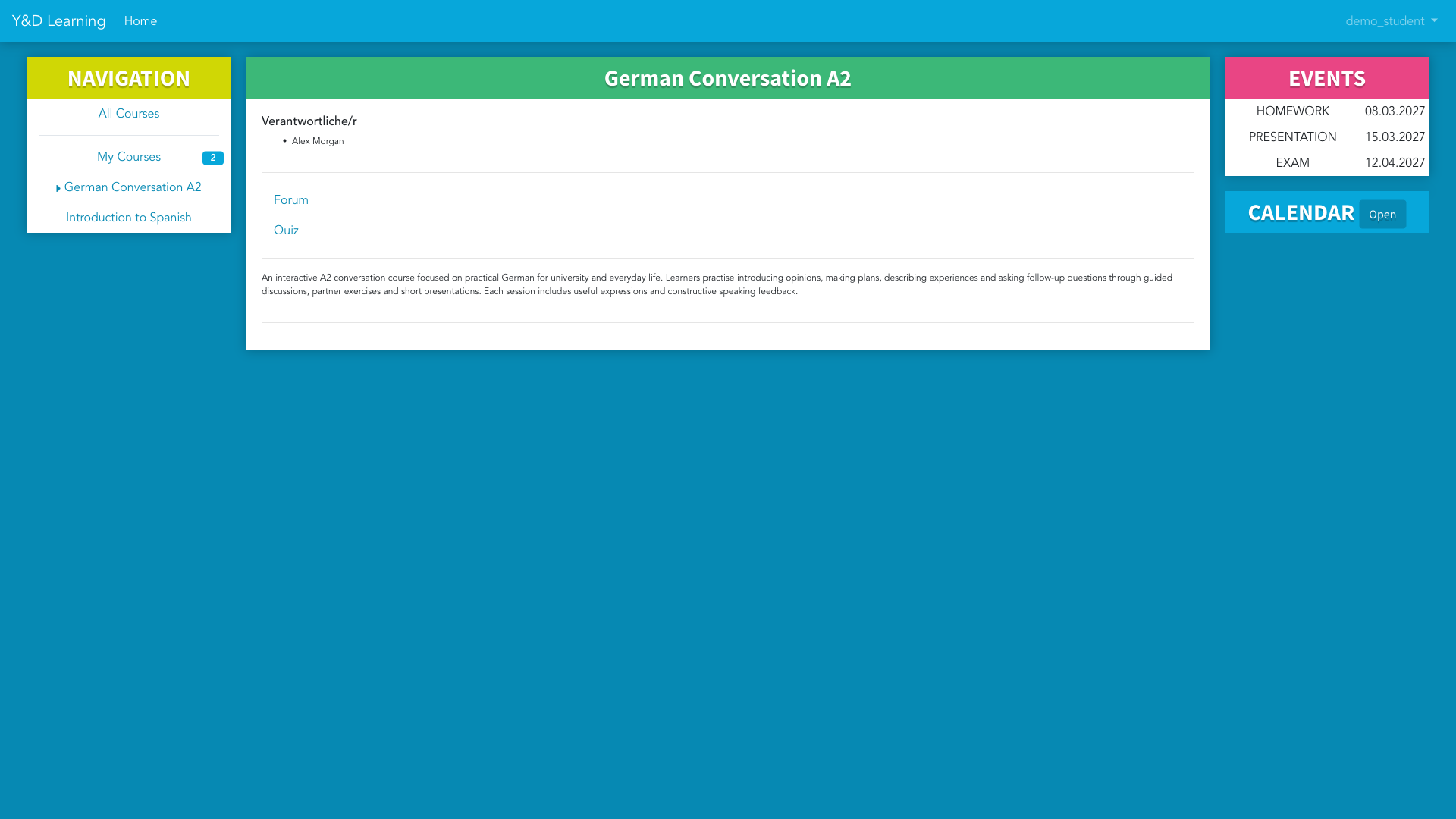
| German Conversation A2 | /#/profile/2/courses/1 |
| Quiz | /#/profile/2/courses/1/quiz |
| Forum | /#/profile/2/courses/forum |
| Calendar | /#/profile/2/calendar/ |
| Teacher course editor | /#/profile/1/courses/1/edit |
| Teacher quiz editor | /#/profile/1/courses/1/quiz/edit |
User IDs here are fictional demo identities, not universal URL contracts. GitHub Pages is particularly suited to hash routing, because fragment routes do not require server-side rewrite rules.
- Course descriptions may contain rich text; rendering and editing need consistent treatment of paragraphs and line breaks.
- Interactive quizzes provide immediate local feedback in the demo; no Django attempt history is published.
- Vue components are subject to the project's historical ESLint/Standard rules (for example no semicolons and no trailing commas).
- The Pages-specific Webpack build uses
YDL_BUILD_TARGET=pagesand an asset base path/.
Next: Public demo mode · Feature showcase