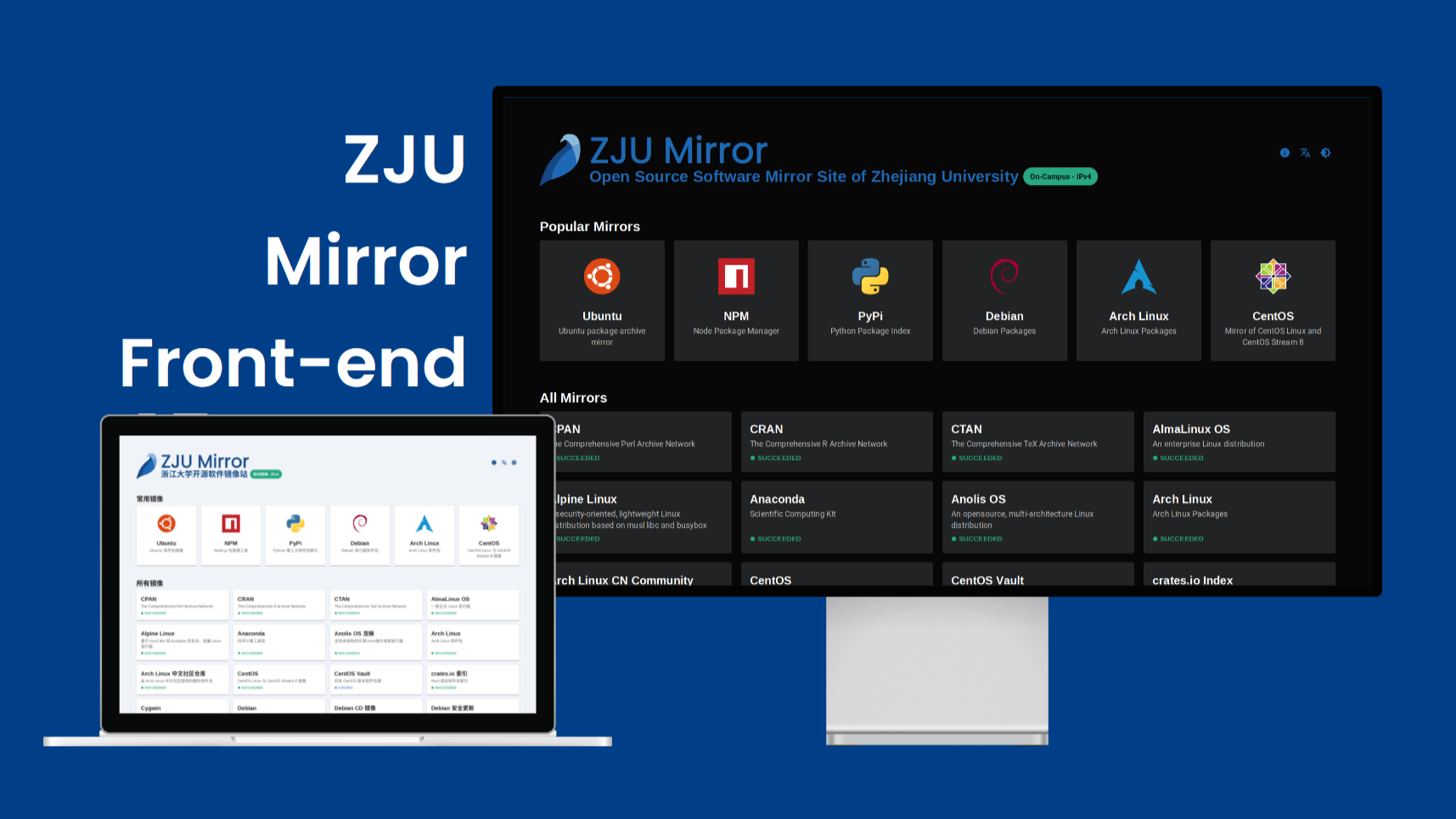
The ZJU Mirror portal is a statically generated Astro site with small React islands for live mirror status, search, and interactive MirrorZ guides. Back-end JSON format: mirrorz-json
Development runs entirely in Docker with Node.js 22 and pnpm 10.15.1. Generated files and dependencies stay in Docker volumes and images.
export DEV_UID="$(id -u)" DEV_GID="$(id -g)"
docker compose build dev
docker compose run --rm dev git submodule update --init --recursive
docker compose run --rm dev pnpm install --frozen-lockfile
docker compose run --rm --service-ports dev
The development server listens on 0.0.0.0:4321. Type checking and optional
formatting can also be run locally with the same image:
docker compose run --rm dev pnpm check
docker compose run --rm dev pnpm format
For local UI review without live back-end endpoints, run:
docker compose run --rm --service-ports dev pnpm dev:reviewIt serves the populated dev/fixtures/mirrorz.json catalog and reports an
on-campus IPv4 connection so campus-only UI can be inspected.
The deployment marker is configured at build time. Production defaults to
DEPLOYMENT_ENV=production; set it to staging to add a fixed strip to every
page:
docker compose run --rm -e DEPLOYMENT_ENV=staging dev pnpm buildThe production Dockerfile accepts the same name as a build argument, so the
equivalent image build uses --build-arg DEPLOYMENT_ENV=staging.
Build the unprivileged production image, or start its production-style preview
on 0.0.0.0:8080:
docker build --tag mirror-front .
docker compose up --detach --build preview
Cluster-specific NGINX configuration can be mounted under
/etc/nginx/mirror-front/http.d and /etc/nginx/mirror-front/server.d for the
HTTP and server contexts, respectively. Run docker compose down when the
preview is no longer needed; named development caches are retained.
CI builds both images. The frontend build runs Astro/TypeScript checks, and
the exporter build runs its two focused tests. Pushes to main also
publish both GHCR images as latest and their seven-character commit
abbreviation. Registry cleanup retains the ten newest commit-tagged images
and removes unneeded untagged images.
A separate workflow lints and packages changes under charts/mirror-front/,
and publishes the OCI chart on pushes to main. It uses the version in
Chart.yaml; no Git release tags are needed. Chart-only changes skip image
builds.
The Helm chart manages the frontend, optional standalone statistics exporter (single-replica Deployment and Service), their configuration, Services, and an optional Gateway API HTTPRoute. Configuration is in values.yaml.
- ZJU announcements remain under
news/. - Generic interface glyphs primarily use Google Material Icons' baseline
family; brand marks use Iconify Logos or Simple Icons, while institutional
artwork remains in the local
resource/icons/collection. - The About, History, FAQ, Container Images, and Statistics pages live in
src/content/special-pages/, with one MDX file per page and locale. Their frontmatter supplies the page title and lead; the shared layout and presentation remain insrc/components/static/SpecialPage.astro. Keep matchingzh/anden/files when adding or renaming a page. - The Statistics page reads
/statistics-data/manifest.jsonand static PNGs generated hourly by the standalone statistics exporter and proxied by an NGINX snippet the chart injects when statistics are enabled. Its source, image build, configuration example, and deployment contract live understatistics-exporter/. Grafana panel selection is runtime configuration; changing it does not require rebuilding the frontend. - Shared mirror guides come from the pinned
vendor/mirrorz-docssubmodule. The parent repository's gitlink is the authoritative content pin;mirrorz-docs.lock.jsonrepeats the commit and license as build-time provenance because Docker builds do not receive Git metadata. Update the gitlink and manifest commit together when updating the guides. Every guide in the submodule is rendered unconditionally: route generation never consults the livemirrorz.jsoncatalog, so a mirror that is temporarily absent from it (for example mid-migration while its publish deployment is not Ready) keeps its guide page, and a guide without a hosted mirror still gets one. The mirror status island links to a guide only when one exists. - The browser consumes the same-origin
/mirrorz.jsonendpoint directly as MirrorZ Data Format v1.7. MirrorZ governs this public data contract. - Mirror file links are resolved from
site.urland each nativemirrors.urlvalue in that document. autoindex/index.htmlis the single first-class build product: a self-contained directory-listing shell. The bundled NGINX configuration serves normal Astroindex.htmlpages first, then internally redirects HTML requests for other directories to that shell (URL unchanged). The shell's same-originfetch(location.pathname)explicitly requestsapplication/json, which NGINX answers usingautoindex on;andautoindex_format json;before the page safely renders and sorts the entries.
-
A directory request whose
Acceptheader containstext/htmlreceives the shell.Accept: application/json, curl's default*/*, and requests without anAcceptheader receive NGINX's JSON array. Responses includeVary: Acceptso shared caches keep the representations separate. -
Scripted consumers can request a listing directly, for example:
curl -H 'Accept: application/json' https://mirrors.zju.edu.cn/debian/ -
NGINX's built-in autoindex intentionally omits entries whose names start with a dot. This differs from the previous directory-listing behavior and is part of the new public contract.
-
For a local production-style demo, mount a readable sample tree at a path below
/usr/share/nginx/htmlthat does not contain anindex.html, for example/usr/share/nginx/html/sample. The bundled configuration then serves/sample/through the same HTML/JSON negotiation. A fixturemirrorz.jsoncan be mounted at/usr/share/nginx/html/mirrorz.jsonso the shell can display status metadata for the sample's first path segment. -
A standalone publish origin should use the same
map $http_acceptcontract andindexvariable, enableautoindex_format json, and serve or proxy the shell at the exact internal redirect target/autoindex/index.html. Its mirror data root normally has no content pages, so it can omit the leadingindex.htmlfallback used by the combined portal image.
UI Designer: Rynco Maekawa