This repository contains links and example models used in the Book Chapter pertaining to Urban Simulation.
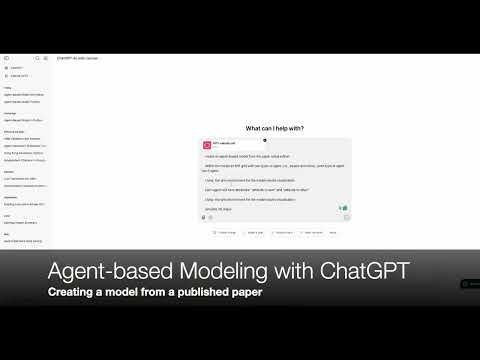
Example of Using ChatGPT 4o with Canvas to create an agent-based model: https://youtu.be/GBeyOhBQWAU.
- Anylogic
- MESA
- Repast
- NetLogo
- GAMA
- MATSim
- TRANSIMS
- SLEUTH
- MASON
- DINAMICA
- Metronamica
- UrbanSim
- UrbanSim
- PTV Visum
- TransModeler
- Paramics
- Legion
- Steps
- EXODUS
A sample (and definitely not an exhaustive list) of agent-based modeling applications and references are provided below for interested readers:
- Southwest Airlines used an agent-based model to improve how it handled cargo (Seibel and Thomas, 2000).
- Eli Lilly used an agent-based model for drug development (Bonabeau, 2003a).
- Pacific Gas and Electric: Used an agent based model to see how energy flows through the power grid (Bonabeau, 2003a).
- Procter and Gamble used an agent-based model to understand its consumer markets (North et al., 2010) while Hewlett-Packard used an agent-based model to understand how hiring strategies effect corporate culture (Bonabeau, 2003b).
- Macy’s have used agent-based models for store design (Bonabeau, 2003b).
- NASDAQ used and agent based model to explore changes to Stock Market's decimalization (Bonabeau, 2003b; Darley and Outkin, 2007).
- Using a agent-based model to explore capacity and demand in theme parks (Bonabeau, 2000).
- Traffic and pedestrian modeling (Helbing and Balietti, 2011).
- Disease dynamics (e.g. Eubank et al., 2004).
- Agent-based modeling has also been used for wild fire training, incident command and community outreach (Guerin and Carrera, 2010). For example SimTable was used in the 2016 Sand Fire in California.
- InSTREAM: Explores how river salmon populations react to changes (Railsback and Harvey, 2002).
Bonabeau, E. (2000), 'Business Applications of Social Agent-Based Simulation', Advances in Complex Systems, 3(1-4): 451-461.
Bonabeau, E. (2003a), 'Don’t Trust Your Gut', Harvard Business Review, 81(5): 116-123.
Bonabeau, E. (2003b), 'Predicting the Unpredictable', Harvard Business Review, 80(3): 109-116.
Darley, V. and Outkin, A.V. (2007), NASDAQ Market Simulation: Insights on a Major Market from the Science of Complex Adaptive Systems, World Scientific Publishing, River Edge, NJ.
Eubank, S., Guclu, H., Kumar, A.V.S., Marathe, M.V., Srinivasan, A., Toroczkai, Z. and Wang, N. (2004), 'Modelling Disease Outbreaks in Realistic Urban Social Networks', Nature, 429: 180-184.
Guerin, S. and Carrera, F. (2010), 'Sand on Fire: An Interactive Tangible 3D Platform for the Modeling and Management of Wildfires.' WIT Transactions on Ecology and the Environment, 137: 57-68.
Helbing, D. and Balietti, S. (2011), How to do Agent-based Simulations in the Future: From Modeling Social Mechanisms to Emergent Phenomena and Interactive Systems Design, Santa Fe Institute, Working Paper 11-06-024, Santa Fe, NM.
North, M.J., Macal, C.M., Aubin, J.S., Thimmapuram, P., Bragen, M., Hahn, J., J., K., Brigham, N., Lacy, M.E. and Hampton, D. (2010), 'Multiscale Agent-based Consumer Market Modeling', Complexity, 15(5): 37-47.
Railsback, S.F. and Harvey, B.C. (2002), 'Analysis of Habitat Selection Rules using an Individual-based Model', Ecology, 83(7): 1817-1830.
Seibel, F. and Thomas, C. (2000), 'Manifest Destiny: Adaptive Cargo Routing at Southwest Airlines', Perspectives on Business Innovation, 4: 27-33.
To compare differnet modeling approaches to the same issue, in subfolder SIR_Models folder you will find 4 models:
- Cellular Automata (SIR_CA.nlogo)
- Discreet Event Simulation (SIR_DES.nlogo)
- System Dynamics Model (SIR_SD.nlogo)
- Agent-based Model (SIR_ABM.nlogo)
Each explores the spread of a disease using a a Susceptible-Infected-Recovered (SIR) epidemic model. For more details about SIR models see: https://en.wikipedia.org/wiki/Compartmental_models_in_epidemiology
To see an example of an CA Urban Growth model go to subfolder UrbanGrowth

To see an example of an Agent-based model desinged to simuatiae people exiting a building go to subfolder PedestrianModel
