Repository navigation
Phone numbers #6023

Replies: 39 comments

|
Hey @edwardhorsford. I'm developing this pattern (above) for telephone numbers. It's based on the guidance we have drafted in Dropbox Paper. There's nothing about validation yet though - is this anything you have knowledge of? |

|
My sense is that validation depends on whether you accept international numbers or ones with area codes. If you don't, then it's easier to detect the right number of digits (after stripping formatting characters). If you do, you have to allow a pretty large range of digits. In the UK I think you can reasonably easily detect mobile vs landline numbers - I don't think the same holds true for international numbers though (it definitely doesn't in the UK). Extensions also complicate the matter. If helpful, here's a gist (I found on a blogpost somewhere) of various UK telephone formats - could be useful for unit testing. |
|
@timpaul has asked for more comments. TypeSuggest the input type should be tel - it's a perfect use case. Scope of patternIs this about collecting phone numbers, display of phone numbers or both? If it's both, can examples of both be at the top? Displaying the user's number as writtenI'm unconvinced on the guidance to retain formatting - do we have evidence that this is important? I don't particularly mind it, but it may be quite a bit of extra work for teams to implement (storing one value but validating against another) - and it's ultimately not what's going to get stored in the database. Services will be sanitising this data (removing whitespace / brackets, etc) - is it useful to display this sanitised value to the user? Formatting other numbersThis is content in the content style guide - can we link out to that? Can we show some examples as well as describing it? OtherIt may be useful to call out some of the more challenging areas to think about - that we don't currently have patterns for. These include: country codes / internationalisation, extensions, weird numbers (sms shortcodes, etc). Input maskingRather than retaining the user's formatting, an alternative (would need to be tested) would be to swallow whitespace and special characters as they're typed and mask the input live to an agreed format. Done well, this can look really good (Stripe / Apple come to mind). |
|
Thanks for the comments above @edwardhorsford - I've updated the draft version accordingly. We've also piloting hypothes.is as a way of capturing feedback about draft guidance - feel free to use it (it's over on the right hand side of the draft). Our content designer Amy will start writing up the finished guidance now. Would you like to review it once it's done? |
|
@quis from the GOV.UK Notify team has added extra spacing between numbers in telephone number fields, to help users read them: alphagov/notifications-admin#1545 |

|
@edwardhorsford couple of points: Displaying the user's number as writtenThis is a good idea. On Notify we store the number in the database as the user gives it to us. We normalise it before we use it to send a text message, but on the frontend we play it back in the format it was provided. We’ve seen problems with people not recognising numbers played back in a different format. Input maskingThis is a bad idea, and I haven’t seen a need for it, even if it can be an ooh that’s nice moment. It makes things harder for people typing a number in a certain way, eg typing spaces to help them keep track of their position. It makes it harder to transcribe or copy the number from another place and check that you’ve got it right. |
Displaying as writtenInteresting - we didn't observe that on passports. I think we stripped whitespace / brackets though, so perhaps they were still recognisable to users. Input maskingI defer to your research here. Really interesting to hear. |
|
Yes, thanks @quis and @edwardhorsford. Here's a question - assuming we distill the above conversation into the published guidance, how would either of you feel about the comments above then being deleted? We're trying to decide how aggressively we should maintain the backlog. Eg. is it a verbose record of every conversation ever had, or a succinct summary of the outstanding issues? |
|
Undecided! I like the idea of comments / discussion living on, but right now these comments will be the first thing people read. Might a system similar to wikipedia work? where comments get archived, and only the newest are shown? In this case these particular comments probably aren't so valuable that they need keeping, but later other discussions might well be valuable to be kept. |
|
Loosely held opinion: I would scope this discussion to being about adding the pattern for phone numbers. Once the pattern is published this discussion should be closed (but not deleted). Then future revisions start as new backlog items. For example, someone could add ‘dealing with country codes’ as a new thing in the backlog. It might result in updates to the same pattern, but it’s a new discussion. |
|
Sounds good, and close to what we'd discussed as a team. The only variation was that we keep this issue in the backlog project as an index for all issues relating to this pattern - so we'd link to them all from the top comment. It's a bit manual, but it means we'd get a kind of threaded discussion out of it. We'll try a few approaches and see what works. |

Design reviewThis proposal was reviewed by a panel of designers from GDS, HMRC, DWP and Home Office on 22 March 2018. The panel agreed that the pattern should not be published in the GOV.UK Design System until the following changes have been made. Recommendations
|
|
In order to create an example of an international telephone number input we are likely to need to be able to add prefixes to form inputs. For example: |

|
OK, I've updated the pattern and examples and hopefully addressed the issues raised by the working group.
The international telephone number example doesn't rely on the prefix component, so is no longer dependant on this being approved. For validation we now reference Google's libphonenumber library rather than the GOV.UK Notify code, as this is a fully supported open source project that handles international numbers. The only issue not addressed is 'Provide a list of safe example international telephone numbers'. As every country has it's own rules around telephone number formats there is no single example of an international telephone number. Desk research failed to find a reliable list of safe numbers for different countries. |

|
This proposal was reviewed by a panel of designers and frontend developers from GDS, HMRC, DWP, EA and Home Office on the 26 of April, 2018. It was reviewed against the criteria for implementation Thanks to the contributor @timpaul with the support of @edwardhorsford and @quis Design reviewThe panel agreed that the pattern should be published in the GOV.UK Design System after implementing the following recommendations. Recommendations
|

Cheers Joe - hadn't thought about trying GT. Maybe worth considering changing the content for the (tele)phone pattern? |


|
It'd probably make sense to keep this in sync with the content style guide which currently uses 'telephone number'? |
Interesting that a quick search on GOV.UK shows nearly 13k references to 'telephone' but still a considerable 9k+ references to 'phone'. |

|
Google ngram viewer searches books. It shows 'phone' dominant in US books but subdominant in UK books (although reaching parity). I'm glad this topic came up here because we use both terms and I'd like guidance on which one to choose (my vote would be for 'phone'). |

My preference too. We're trying 'phone' in UR sessions and will examine what users think. |
|
Searching 'phone' v 'telephone' but looking beyond 2000 (2008 seems to be as far as it will go), Google Books Ngram Viewer shows a big divergence from 2001 or so onwards, with the preference being 'phone'. |
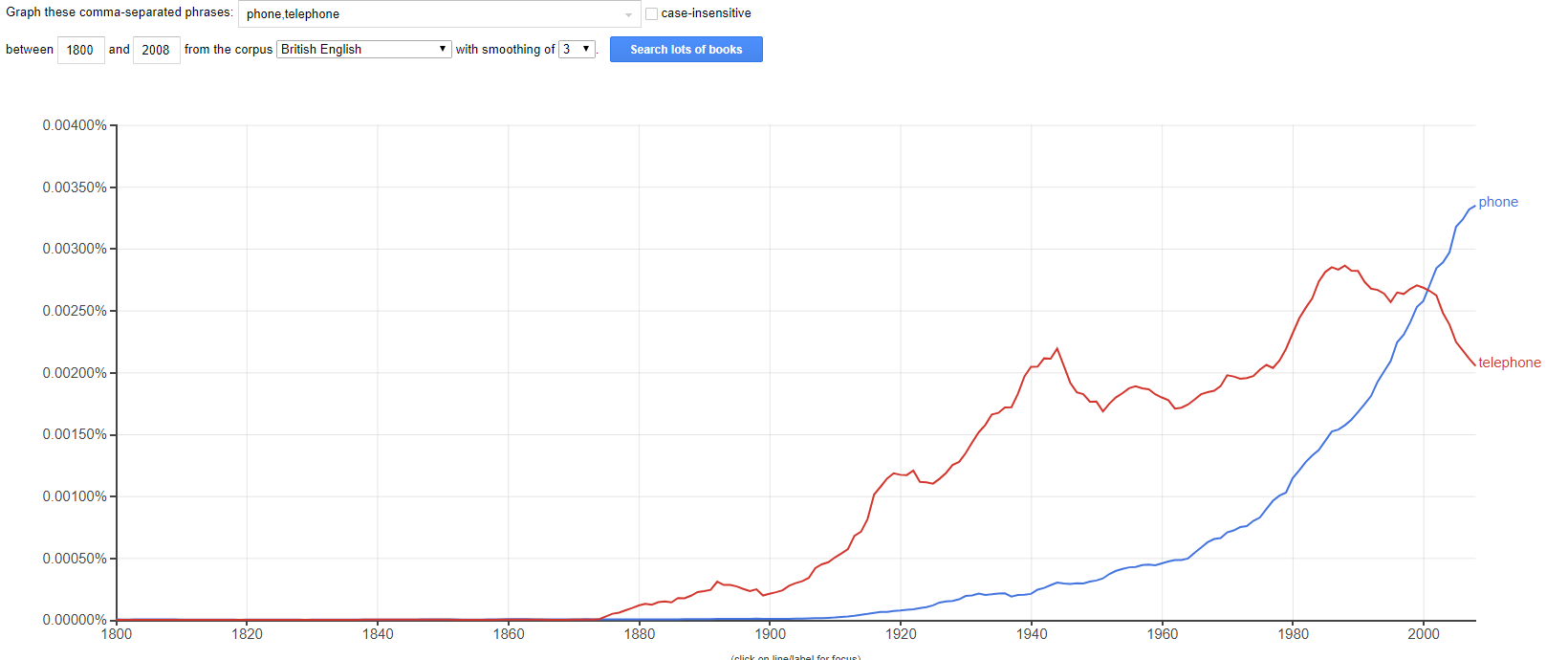
|
Can we update the guidance to recommend the use of 'phone' rather than 'telephone'? Can we update the examples to match that? |

|
On Do not display telephone numbers as links on devices that cannot make calls We've found that Chrome on Android and iOS do not detect phone numbers and make them links, which is a large portion of the market. Also a number of users do have applications that can make phone calls from desktops. Not having the link seems to be more of a hindrance than the popup asking which application to use for users who don't have means to call from their devices. |

|
Hello, I have seen some designers struggling with this piece of guidance in the pattern: The pattern isn't clear where this information should be on a page asking for a telephone number. It doesn't seem right that it's part of the hint text, as the hint needs to be direct reference to what the user is entering into the input field. Would it be best if information on how the phone number will be used was it's own paragraph, separate to the hint text and input field? Could there be some elaboration on that within the pattern guidance? Thanks. |
|
The guidance proposes hint text of: ‘Enter a telephone number, like 01632 960 001, 07700 900 982 or +44 0808 157 0192’. The format '+44 0808 157 0192' is wrong. This is explained in ITU E123 (https://www.itu.int/rec/T-REC-E.123-200102-I/en) which is the relevant standard. A UK number with a zero can be shown as either '0808 157 0192' or '+44 808 157 0192'. The zero has to be dropped otherwise it won't work. British Telecom explains it as follows: https://www.thephonebook.bt.com/DiallingCodes/UkAreaCodeSearch/?AreaIdentifier=london
Please can somebody replace '+44 0808 157 0192’ with '+44 808 157 0192’? |

|
The Request basic criminal record check service uses this pattern, where the country of the mobile number is asked for first (using an autocomplete) followed by the mobile number. As you type the mobile number it is replayed as text below, along with some guidance text if the number does not look like it is valid. (The leading zero is required)
|


|
Obviously I don't know what was tested so my comment may be moot, but it seems overly complex in two ways:
Would it be simpler to do it this way?
As I say, I have no idea what was tested in research so... |


|
We've had some really interesting user feedback about this pattern. I'll share it here so folks on this discussion can say whether it echoes their own views: Telephone numbers should be linksCurrent guidance:
We should not rely on a user agent to automatically identify unlinked phone numbers as telephone numbers. This behaviour is not part of any web standard for a browser to do this, and phone number formats vary greatly from region to region. Some screen reader users will struggle to copy-paste a telephone number into their VoIP and it's simply much easier to have it as a link. Current guidance:
I can sympathise with this argument, but once a user knows a telephone number presented as a link will try to open up their VoIP client, if they don't want this behaviour in the future, then they can just not click it in the future. Current guidance:
Most devices are capable of making phone calls, including desktop devices via Skype, Teams, etc. I would struggle to find a device that is incapable of making phone calls. Do not use
|

|
We have removed the 'Experimental' tag from components, patterns, and guidance in the Design System. 😌 The tag was being used on the Telephone numbers pattern to raise awareness that more research is needed to validate it. However, we recently published new guidance on how to share findings from users which we hope will make it easier to collect and format more information about how the Design System is being used across services. If your team has used this component please let us know. 💪 |

|
Probe: I'm designing the TELEPHONE object for use across GOV.UK, ATM. So the object itself and the schema attributes that give it structure and purpose. This is part of the content design system project for GOV.UK. I'm digesting:
But wanted to probe if there is any active/emergent thinking around how TELEPHONE might be presented in the near future. Partly via the code design system, but mostly the interface design system. Are there any plans to enhance semantics/meaning for contact objects? So things like knowing that an instance of TELEPHONE is for a WhatsApp service (not merely a regular geographic GOV telephone number etc). Basically: I'm trying to work out how to balance flexibility+simplicity vs semantics+precision in the content model. Likewise, backwards compatibility with extant contact schemas so that extant contact services can be decommissioned, and their data subsumed en bloc to a definitive source. |


Uh oh!
There was an error while loading. Please reload this page.
Uh oh!
There was an error while loading. Please reload this page.
Use this issue to discuss this pattern in the GOV.UK Design System.
Contributors
All reactions