Repository navigation
Design

Pacman does not have a detailed background storyline in the traditional sense. The game is set in a simple, abstract maze-like environment where the player controls Pacman, a yellow circular character, tasked with eating all the dots while avoiding ghosts. The game's focus is primarily on arcade-style gameplay rather than narrative depth. However, the overarching premise is that Pacman is navigating through a maze filled with these dots and ghosts, aiming to clear each level by consuming all the dots without being caught. The absence of a complex narrative allows players to focus on the game's core mechanics and enjoy its timeless gameplay experience.
Although the Pacman games don't come with a deep story, they have changed the gameplay and background over the years. For example, the originals: Pac-Man runs through mazes dodging pesky ghosts (Blinky, Inky, Pinky and Clyde) in classic arcade style. Then came Ms. Pac-Man, where Pac-Man falls madly in love with Ms. Pac-Man, and they even have a little Jr. Pac-Man. But he's more of a cameo, not a playable character. Also in Pac-Land, things get interesting. Pac-Man leaves the labyrinth and goes into his hometown, Pac-Land, in a side-scrolling adventure. This time, he's not just eating dots, he's on a mission to rescue the fairies kidnapped by those same pesky ghosts.
-
The difficulty in Pac-Man increases as the player progresses through levels in various ways such as:
-
Ghost Speed: With each level, the ghosts become faster, making it harder for Pac-Man to successfully dodge them.
-
Number of Ghosts: As you progress, more ghosts are added to the maze, increasing the number of threats Pac-Man must avoid.
-
More Complex Mazes: The mazes become more intricate and complicated with each level, with narrower corridors and point arrangements that can make it more difficult for Pac-Man to collect them all without getting caught by the ghosts.
-
Power Pellets Duration: The duration of Power Pellets, which provide Pac-Man with the ability to temporarily eat ghosts, is progressively reduced, meaning Pac-Man has less time to take advantage of this perk as he progresses through the game.
In order to relax and unwind, there are breaks between some screens (between screens 2 and 3, 5 and 6, 9 and 10, and then every fourth screen thereafter) which feature humorous scenes about Pac-Man and the ghosts.
As a fun fact, the game has exactly 255 fully playable levels, which is the largest number that can be expressed in eight digits in the binary system. Although, technically, there is a 256th level, in which if you reach it the right part of the screen appears distorted with incongruent characters and making the game practically unplayable, this happens because the level counter (stored in a single byte) reaches 256 (when the maximum that can be stored in a byte is 255, which produces an "overflow" error). The program then tries to draw 256 fruits, which causes the aforementioned distortion of the right half of the screen (often referred to by game enthusiasts as the final level or split-screen level).

Pac-Man, apart from eating the dots, can get extra points if he eats some prizes that appear twice per level just below the box in the centre of the maze where the ghosts come out of, those prizes are:
- Level 1: Cherry 100 points.
- Level 2: Strawberry 300 points.
- Levels 3 and 4: Orange 500 points.
- Levels 5 and 6: Apple 700 points.
- Levels 7 and 8: Grapes 1000 points.
- Levels 9 and 10: Galaxian 2000 points.
- Levels 11 and 12: Bell 3000 points.
- Levels 13 to 255: Key 5000 points.
There are four larger-than-normal spots near the corners of the maze called Power Pellets, which give Pac-Man, for a limited time, the ability to eat the ghosts himself (they all turn blue while Pac-Man has this ability), after which everything goes back to the way it was before. (they all turn blue while Pac-Man has this ability), after which everything goes back to the way it was in the beginning.

Pac-man's enemies are four ghosts called Blinky, Inky, Pinky, Clyde and each of them have different characteristics.
-
Blinky (Red). After Pac-Man eats a certain amount of points, his speed increases considerably (this number decreases at higher levels). Blinky chases Pac-Man directly.
-
Inky (Blue or Cyan). He is not as fast as Blinky but his behaviour is due to the fact that the game calculates the straight line distance between Blinky and Pac-man and turns him 180 degrees, so Inky always collaborates with Blinky to corner Pac-man.
-
Pinky (pink). This actually his target is four spaces to the right, left and bottom of Pac-man when Pac-man looks in those directions, when Pac-man looks up, the target is four spaces up and two spaces to the left. This makes Pinky try to catch Pac-man from in front while Blinky chases him from behind.
-
Clyde (orange). This moves randomly to Pac-man, however considering Pac-man himself in a circle of eight spaces in any direction, Clyde runs away when he gets too close to him by moving to the bottom left corner of the maze. Since ghosts cannot turn in the opposite direction of their current movement, Clyde will be forced to collide with Pac-man if he finds himself in front of him.
The collision design in Pac-Man determines how game elements interact with each other. In Pac-Man, these interactions include:
-
When Pac-Man moves over a dot in the maze, the dot disappears and is added to the player's score.
-
Pac-Man and Power Pellets: As with the dots, when Pac-Man moves over a Power Pellet, it disappears and temporarily gives Pac-Man the ability to eat ghosts.
-
Pac-Man and mazes: The mazes are made up of solid walls and open corridors. Pac-Man can move freely through the corridors, but cannot pass through the solid walls. The maze walls create a collision structure that limits the movement of Pac-Man and the ghosts.
-
Pac-Man and the ghosts: When Pac-Man comes into contact with a ghost while not under the effect of a Power Pellet, he loses a life and the level restarts. However, when Pac-Man eats a Power Pellet, the roles are reversed and Pac-Man can eat ghosts when he comes into contact with them.
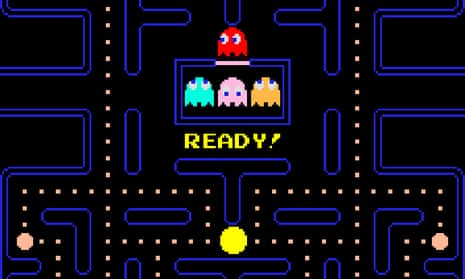
In Pac-Man, you control Pac-Man as he munches through a maze, gobbling up dots and avoiding colorful ghosts. Here's the lowdown:
-
Player Character:
- Pac-Man: You move him around using arrow keys or a joystick.
-
Non-Player Characters:
- Ghosts: These guys chase Pac-Man around the maze, trying to catch him.
-
Room Objects:
-
Mazes: The maze layout is where all the action goes down. Pac-Man zips through corridors and avoids hitting walls.
-
Scoring/Health Objects:
- Dots: These little pellets littered around the maze. Eat them up to rack up points.
- Power Pellets: They're like super snacks. Eat one, and the ghosts turn blue, and Pac-Man can gobble them up for extra points.
-
Controller Objects:
- You! You control Pac-Man's moves with your keyboard or joystick.
-
Game Rules and Events:
- Eat Dots: Pac-Man eats dots, they disappear, and you score points.
- Eat Power Pellets: Pac-Man eats a Power Pellet, ghosts turn blue, you gobble them up, and score even more points.
- Avoid Ghosts: If Pac-Man collides with a ghost, he loses a life and might have to start over.
The user controls in Pac-Man are straightforward and integral to gameplay:

Directional Movement: Players can control Pac-Man's movement using arrow keys or a joystick. Pac-Man moves in the direction indicated by the player's input (up, down, left, right).
Start/Reset: The game typically begins with the player pressing a designated button (e.g., "Start" or "Enter") to initiate gameplay or restart the game after losing a life.