
A complete TLS 1.3 implementation in pure C# targeting .NET 9.0. Every cryptographic primitive runs through managed code — no BCrypt / OpenSSL P/Invoke. The published binary has a single bcrypt.dll import (BCryptGenRandom) which serves as the OS entropy source; everything else — hashes, HMACs, AEADs, EC point arithmetic, signatures — is pure C#. AES-NI is used via JIT-emitted CPU intrinsics (not a P/Invoke, gated by Aes.IsSupported), so the workhorse cipher stays hardware-fast while remaining portable to non-x86 CPUs.
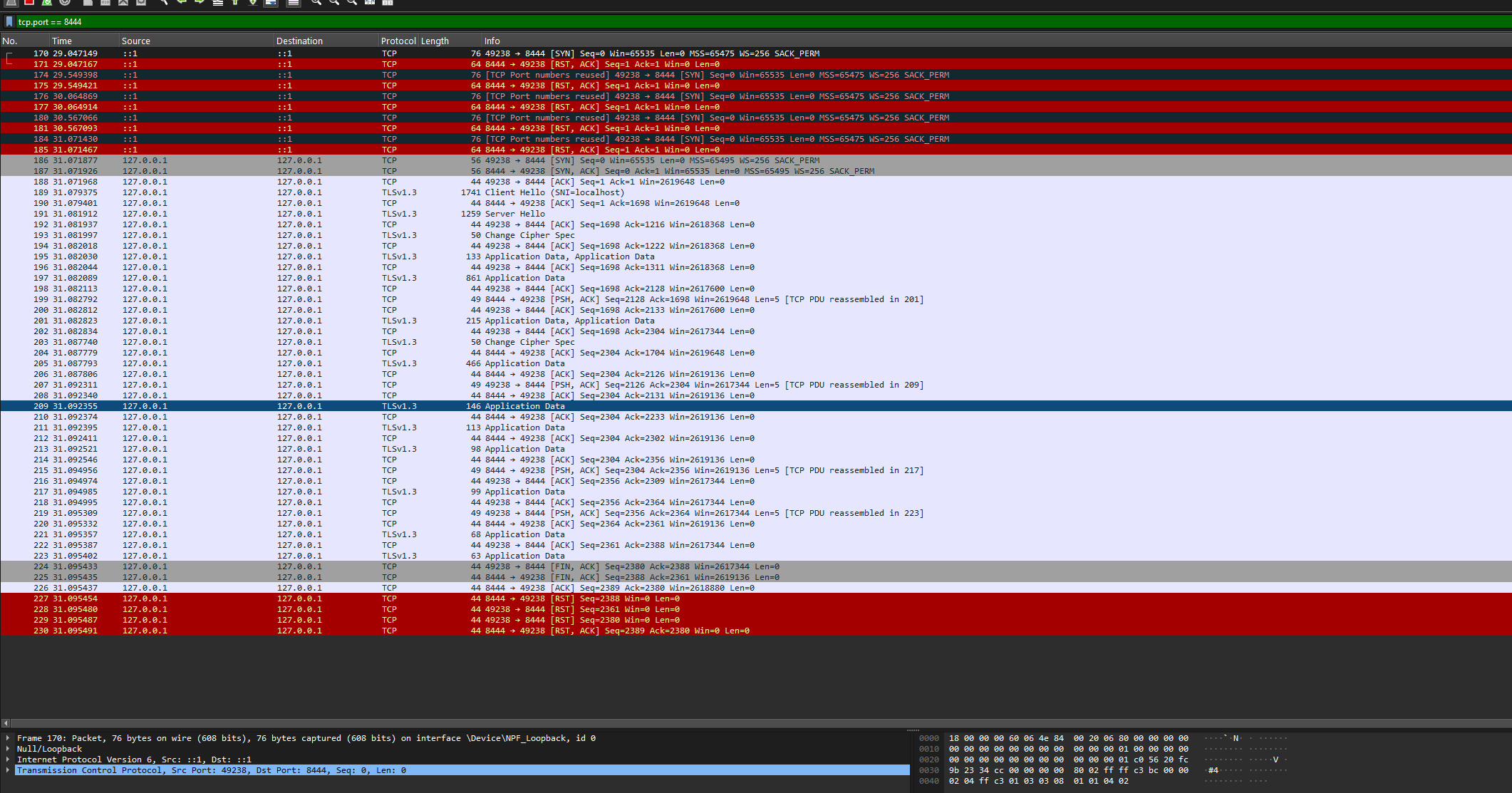
A loopback session captured in Wireshark — the full TLS 1.3 handshake (ClientHello → ServerHello → ChangeCipherSpec → encrypted Application Data) is recognised as TLSv1.3 on the wire. The red ::1 RST rows at the top are the client's IPv6-first connection attempt against the v4-only demo listener (it then falls back to 127.0.0.1); see the performance note below.
Note 1 : AI driven prompt project.
Note 2 : a packable library project lives in
OpenTls13/—dotnet pack -c Release OpenTls13/OpenTls13.csprojproduces the.nupkg(multi-targets net8.0 / net9.0 / net10.0, AGPL-3.0-or-later, zero transitive dependencies). See NuGet package below.
Note 3 : national-crypto suites (GOST, Chinese SM) are KAT-verified against published standard vectors and pass self-interop (this client ↔ this server), but have not yet been cross-validated against external stacks (GmSSL / OpenSSL-GOST). See Limitations.
📖 Public API reference: see
API.mdfor the full consumer-facing surface (TlsClient,TlsServer,TlsStream,TlsConnection, certificates, PSK/resumption, ECH, and the enumerations).
- Full TLS 1.3 (RFC 8446) handshake — client and server, sync + async
- Mutual TLS (mTLS) with client certificate authentication
- PSK session resumption with NewSessionTicket
- 0-RTT early data
- Post-handshake key update (RFC 8446 §4.6.3) with usage-limit automation
- Post-handshake client authentication
- HelloRetryRequest with cookie support
- ALPN negotiation
- OCSP stapling (status_request)
- Encrypted Client Hello (ECH, RFC 9849) + HPKE (RFC 9180)
- GREASE (RFC 8701)
- record_size_limit negotiation (RFC 8449)
- Downgrade-protection sentinel check (RFC 8446 §4.1.3)
- Middlebox compatibility mode (ChangeCipherSpec)
- SSLKEYLOGFILE logging (Wireshark-compatible NSS Key Log Format)
| Category | Algorithms |
|---|---|
| Key Exchange | X25519, X448, ECDH P-256, ECDH P-384, X25519MLKEM768 (hybrid post-quantum), GOST curves (GC256A–D / GC512A–C), curveSM2 |
| Signatures | ECDSA P-256/SHA-256, ECDSA P-384/SHA-384, Ed25519, RSA-PSS, RSA-PKCS#1 (legacy), ML-DSA-44/65/87 (FIPS 204, post-quantum), GOST R 34.10-2012 (256/512), SM2 |
| AEAD Ciphers | AES-128-GCM, AES-256-GCM, ChaCha20-Poly1305, AEGIS-128L, AEGIS-256, Kuznyechik-MGM, Magma-MGM, SM4-GCM, SM4-CCM |
| Hash / KDF | SHA-256/384/512, HKDF (RFC 5869), Streebog-256/512, SM3, HMAC variants |
| Post-Quantum | ML-KEM-768/1024 (FIPS 203) key encapsulation · ML-DSA-44/65/87 (FIPS 204) signatures |
| Keccak Sponge | SHA3-256, SHA3-512, SHAKE-128, SHAKE-256 (pure managed) |
| National | GOST R 34.11/34.12/34.13-2015 (RFC 9367), Chinese SM2/SM3/SM4 (RFC 8998) |
| Certificates | X.509 v3 generation (incl. GOST / SM2 certs), CA chaining, PKCS#12/PFX, PKCS#7 |
| Compression | Certificate compression (RFC 8879) via Brotli and Zstandard |
Symmetric primitives (AES-GCM, SHA-2 family, HMAC) and the asymmetric handshake primitives (RSA, NIST P-256/P-384/P-521 ECDSA/ECDH, X25519, X448) go through BouncyCastle's vendored pure-managed implementations — no System.Security.Cryptography.* runtime calls into BCrypt or OpenSSL. The NIST EC paths use BouncyCastle's optimized Custom*Curve classes (CustomNamedCurves) and X25519/X448 use its Rfc7748 packed-limb implementations — both far lighter on allocations than a generic System.Numerics.BigInteger ladder. ChaCha20-Poly1305 is a hand-written RFC 8439 implementation. The ML-KEM-768 NTT/InvNTT, Ed25519, SM2/SM3/SM4, and Keccak are implemented from scratch. GOST primitives are vendored from OpenGost, with EC scalar-mult on Jacobian projective coordinates (one modular inverse per scalar mult instead of one per point operation).
| Suite | Spec |
|---|---|
| TLS_AES_128_GCM_SHA256, TLS_AES_256_GCM_SHA384, TLS_CHACHA20_POLY1305_SHA256 | RFC 8446 |
| TLS_AEGIS_128L_SHA256, TLS_AEGIS_256_SHA512 | draft-denis-tls-aegis / draft-irtf-cfrg-aegis-aead (KAT-verified; offer via CipherSuites) |
| TLS_GOSTR341112_256_WITH_KUZNYECHIK_MGM_L / _S | RFC 9367 |
| TLS_GOSTR341112_256_WITH_MAGMA_MGM_L / _S | RFC 9367 |
| TLS_SM4_GCM_SM3, TLS_SM4_CCM_SM3 | RFC 8998 |
- BouncyCastle (bc-csharp) — AES + GCM mode, SHA-2 digests, HMAC, RSA, NIST EC curves, BigInteger, ASN.1 (
TLS/BouncyCastle/, ~1330 files) - BrotliSharpLib — Brotli for RFC 8879 cert compression, replaces
System.IO.Compression.BrotliStream(TLS/BrotliSharp/, 58 files) - ZstdSharp — Zstandard for RFC 8879 cert compression (
TLS/Zstd/) - OpenGost — GOST Kuznyechik / Magma block ciphers, Streebog hash, GOST R 34.10-2012 (
TLS/OpenGost/, ~18 files; the upstreamHashAlgorithm/SymmetricAlgorithm/ECDsabase-class inheritance has been stripped so the BCL crypto registry — and its BCrypt imports — don't get linked)
Open-TLS1.3.sln
├── TLS/                    # Shared project — core TLS library
│   ├── TlsConnection.cs    # Handshake state machine (sync + async)
│   ├── RecordLayer.cs      # Record framing, AEAD encryption, fragmentation
│   ├── KeySchedule.cs      # TLS 1.3 key schedule (RFC 8446 §7)
│   ├── Hkdf.cs             # HKDF + HKDF-Expand-Label (multi-hash)
│   ├── AeadCipher.cs       # AES-GCM / ChaCha20 / MGM / SM4-GCM/CCM dispatch
│   ├── AesGcmManaged.cs    # AES-GCM via BC AesEngine + GcmBlockCipher (cached per instance)
│   ├── ChaCha20.cs / Poly1305.cs / ChaCha20Poly1305Managed.cs  # RFC 8439 from scratch
│   ├── Sha2Managed.cs      # SHA-2 / HMAC-SHA wrappers over BC digests (IncrementalSha2 for transcript)
│   ├── RsaManaged.cs / EcdsaManaged.cs  # BC RSA / NIST EC wrappers
│   ├── Ed25519.cs / X25519.cs / X448.cs / EcdhP256.cs / EcdhP384.cs
│   ├── MlKem768.cs         # FIPS 203 ML-KEM-768
│   ├── Keccak.cs           # Keccak-f[1600] sponge (SHA3/SHAKE)
│   ├── Hpke.cs             # HPKE (RFC 9180)
│   ├── EncryptedClientHello.cs  # ECH (RFC 9849)
│   ├── Mgm.cs              # GOST MGM AEAD (RFC 9058/9367), packed-ulong GF(2^128)
│   ├── GostCrypto.cs / GostKdf.cs / GostEcdh.cs  # GOST facade, Streebog KDF, GOST ECDH
│   ├── OpenGost/           # Vendored GOST + Jacobian EC scalar-mult
│   ├── ChineseCrypto.cs    # SM2 / SM3 / SM4 (SM2 EC math = Jacobian projective)
│   ├── Sm4Aead.cs / Sm3Kdf.cs   # SM4-GCM/CCM AEAD, SM3 KDF
│   ├── Grease.cs           # GREASE (RFC 8701)
│   ├── CertificateUtils.cs # X.509 generation (incl. GOST/SM2), CA chaining
│   ├── Asn1.cs / Pkcs12.cs / Pkcs7.cs   # DER, PFX, PKCS#7
│   ├── SessionTicket.cs / KeyLogger.cs / CertificateCompression.cs
│   ├── BouncyCastle/       # Vendored BC core (crypto, math, security, util, asn1)
│   ├── BrotliSharp/        # Vendored Brotli for RFC 8879
│   └── Zstd/               # Vendored Zstandard for RFC 8879
├── TLSServer/  TLSClient/  TLSServerAsync/  TLSClientAsync/   # demo apps
└── Tests/                  # Test-vector + loopback suite (dependency-free)
dotnet build Open-TLS1.3.slnStart the server (listens on port 8443 with mTLS):
dotnet run --project TLSServerConnect with the client:
dotnet run --project TLSClientFor async variants:
dotnet run --project TLSServerAsync
# In another terminal:
dotnet run --project TLSClientAsync
The server auto-generates a CA and server certificate at startup and exports client.pfx for mTLS client authentication.
var client = new TlsClient
{
    CipherSuites = new[] { CipherSuite.TLS_GOSTR341112_256_WITH_KUZNYECHIK_MGM_L },
    NamedGroups  = new[] { NamedGroup.GC256A }   // GOST-curve key exchange
};
// server side: var cert = CertificateUtils.IssueGostCertificate("host", ca, CertificateProfile.Server, SignatureScheme.Gostr34102012_256a);
// or CertificateUtils.IssueSm2Certificate("host", ca, CertificateProfile.Server);Defaults are permissive — the server accepts any suite/group it supports, and the client advertises all its signature schemes (including the draft PQ ones). Each of those is an opt-in restriction you can tighten:
var server = new TlsServer(cert)
{
    // Only ever select from these suites / groups, even if the client offers others we support.
    AllowedCipherSuites = new[] { CipherSuite.TLS_AES_256_GCM_SHA384, CipherSuite.TLS_CHACHA20_POLY1305_SHA256 },
    AllowedGroups       = new[] { NamedGroup.X25519MLKEM768, NamedGroup.X25519 },
    // mTLS: which schemes we'll accept for the client's CertificateVerify.
    AcceptedClientSignatureSchemes = new[] { SignatureScheme.EcdsaSecp256r1Sha256 },
};

var client = new TlsClient
{
    // Drop the draft ML-DSA schemes from the advertisement, for example.
    SignatureSchemes = new[] { SignatureScheme.EcdsaSecp256r1Sha256, SignatureScheme.Ed25519, SignatureScheme.RsaPssRsaeSha256 },
};
Leave any of these unset (null) to keep the permissive default for that dimension. The same knobs exist on
the lower-level TlsConnection (SetAllowedCipherSuites, SetAllowedGroups, SetOfferedSignatureSchemes).
Restricting the client's NamedGroups is a true restriction — the advertised supported_groups follows it,
so the server can't HelloRetryRequest you onto a group you didn't intend to offer.
After the handshake, TlsStream.NegotiatedGroup and TlsStream.NegotiatedCipherSuite report what was
actually selected (the group reflects any HelloRetryRequest).
Set the SSLKEYLOGFILE environment variable before running the server or client to enable key logging:
export SSLKEYLOGFILE=~/keys.log
dotnet run --project TLSServer
Then point Wireshark to the key log file under Preferences > Protocols > TLS > (Pre)-Master-Secret log filename.
A dependency-free test suite lives in Tests/ (known-answer vectors + end-to-end loopback matrix).
dotnet run -c Release --project Tests           # all tests (83 KAT + loopback + record-layer + wire-format round-trips)
dotnet run -c Release --project Tests bench     # AEAD throughput + handshake + bulk-transfer benchmarks
dotnet run -c Release --project Tests profile   # per-phase allocation breakdown of one handshake per suite
dotnet run -c Release --project Tests bulk      # 20 MB + 50 MB bulk loopback (AES-128/256-GCM + ChaCha20)
dotnet run -c Release --project Tests fuzz      # parser fuzz harness (120k inputs across 12 parsers)
dotnet run -c Release --project Tests fuzz 50000  # heavier fuzz (~600k inputs)
Coverage includes KATs vs published vectors (MGM RFC 9058, SM4/SM3 GB/T, SM4-GCM/CCM RFC 8998, Streebog, GOST R 34.10-2012 and SM2 signatures, HKDF RFC 5869, X25519 RFC 7748, ChaCha20 / Poly1305 / AEAD-ChaCha20-Poly1305 RFC 8439) and full handshake+data loopbacks for every cipher suite plus mTLS plus RFC 8879 cert compression.
Bulk data throughput (50 MB, end-to-end through TLS record framing):
| Cipher | Throughput |
|---|---|
| AES-128-GCM | ~90–100 MB/s |
| AES-256-GCM | ~90–100 MB/s |
| ChaCha20-Poly1305 (managed RFC 8439) | ~85–95 MB/s |
Full TLS 1.3 handshake (loopback, after the allocation overhaul — see changelog.txt):
| Suite | Latency | Allocation / handshake |
|---|---|---|
| default (X25519 + AES-256-GCM + ECDSA P-256 cert) | ~5–7 ms | ~1.05 MB |
| GOST (Kuznyechik-MGM + GC256A + GOST cert) | ~14 ms | ~6.4 MB |
| SM (SM4-GCM + curveSM2 + SM2 cert) | ~13 ms | ~7.3 MB |
Earlier revisions of this table reported ~2 s GOST/SM handshakes — that was an IPv6 loopback-fallback artifact in the benchmark (the client resolved
localhostto::1first, where the v4-only listener refused it, then fell back to v4 after ~2 s of SYN→RST backoff). The benchmark now connects to127.0.0.1directly. National-suite latency is dominated by theirSystem.Numerics.BigInteger-based EC scalar multiplication; the default suite uses BouncyCastle's optimized curve paths. Bulk throughput is cipher-bound, not allocation-bound, so it is unchanged by the allocation work — that work cut per-handshake allocation ~10× and per-record bulk allocation ~14× (seechangelog.txtfor the before/after numbers).
All projects are configured for native AOT compilation:
dotnet publish -c Release --project TLSServerThe core library ships as a packable class library in OpenTls13/ that compiles the
shared TLS/ sources (plus the vendored BouncyCastle / BrotliSharpLib / ZstdSharp /
OpenGost) into a single OpenTls13.dll — zero transitive NuGet dependencies.
dotnet pack -c Release OpenTls13/OpenTls13.csproj
# → OpenTls13/bin/Release/OpenTls13.<version>.nupkg (+ .snupkg symbols)- Package id:
OpenTls13· License:AGPL-3.0-or-later· Targets: net8.0 / net9.0 / net10.0 - AOT-friendly (the demo apps publish with
PublishAot=true), thoughIsAotCompatibleis intentionally left off the library to avoid analyzer noise from the vendored crypto. - Consume it with only the public API (
TlsServer,TlsClient,TlsStream,CertificateUtils,CipherSuite,NamedGroup, …):
using TLS;
var ca   = CertificateUtils.GenerateCA("My CA");
var cert = CertificateUtils.IssueCertificate("localhost", ca, CertificateProfile.Server);
var server = new TlsServer(cert);
server.Listen(8443);
using var s = server.Accept();          // TlsStream — Read/Write encrypted app data
Client, authenticating the server certificate (opt-in — see the security note under Limitations):
using TLS;
var client = new TlsClient
{
    CaCertificate = trustAnchor,        // verify the chain, validity window, and hostname; fail closed otherwise
    // — or — supply your own policy:
    // ServerCertificateValidationCallback = (leafDer, warnings) => /* return true to accept */ true,
};
using var s = client.Connect("localhost", 8443);   // throws if the server cert isn't trusted
AGPL note: AGPL-3.0 is strong copyleft — network use of a derivative obliges source disclosure. The vendored crypto stays under its original permissive MIT / Bouncy Castle terms (see
OpenTls13/THIRD-PARTY-NOTICES.txt); only the OpenTls13 code as a whole is AGPL. If you need a non-copyleft option, dual-licensing is the author's call.
Core TLS 1.3 (RFC 8446) is compliant — handshake, HelloRetryRequest + cookie, middlebox-compat, 0-RTT, KeyUpdate, post-handshake auth, alerts, and downgrade-sentinel checking.
| Specification | Coverage |
|---|---|
| RFC 8446 | TLS 1.3 protocol, handshake, record layer, key schedule |
| RFC 8701 | GREASE |
| RFC 8449 | record_size_limit |
| RFC 7748 | X25519 and X448 Diffie-Hellman |
| RFC 8032 | Ed25519 signatures |
| RFC 5869 | HKDF key derivation |
| RFC 8879 | Certificate compression (Brotli, Zstandard) |
| RFC 8937 | Randomness wrapper |
| RFC 9149 | Ticket request extension |
| RFC 9258 | External PSK importer |
| RFC 9261 | Exported authenticators |
| RFC 9266 | TLS channel binding |
| RFC 9963 | Legacy RSA PKCS#1 signature schemes (cert verification) |
| RFC 9180 | HPKE (Hybrid Public Key Encryption) |
| RFC 9849 | Encrypted Client Hello (ECH) |
| RFC 9367 / 9058 | GOST cipher suites (Kuznyechik/Magma MGM, Streebog, GOST R 34.10-2012, GOST curves) |
| RFC 8998 | Chinese SM cipher suites (SM4-GCM/CCM, SM3, SM2, curveSM2) |
| FIPS 203 | ML-KEM-768 (Module-Lattice Key Encapsulation) |
| draft-ietf-tls-ecdhe-mlkem | X25519MLKEM768 hybrid key exchange |
| draft-irtf-cfrg-aegis-aead / draft-denis-tls-aegis | AEGIS-128L / AEGIS-256 AEAD cipher suites (KAT-verified vs the spec test vectors) |
| FIPS 204 / draft-ietf-tls-mldsa | ML-DSA-44/65/87 post-quantum signatures — certificates + CertificateVerify |
| draft-ietf-tls-8773bis | Certificate authentication combined with an external PSK (tls_cert_with_extern_psk) |
RFC vs Internet-Draft. Rows that name a
draft-…are Internet-Drafts — work in progress, not finalized RFCs — so their TLS code points and on-wire details may change before publication, and interop here is validated only against this stack's own test vectors. That currently applies to: AEGIS cipher suites (draft-denis-tls-aegis+ thedraft-irtf-cfrg-aegis-aeadAEAD), ML-DSA in TLS (draft-ietf-tls-mldsa; the ML-DSA algorithm is final in FIPS 204 and its certificate encoding in RFC 9881 — only the TLS signature-scheme code points are draft), the hybrid PQ groups (draft-ietf-tls-ecdhe-mlkem), and certificate + external PSK (draft-ietf-tls-8773bis; a full cert handshake whose key schedule also mixes in an external PSK, so the session survives a future break of the cert's signature algorithm). Treat these as experimental and pin both peers to the same draft revision. ECH (RFC 9849), HPKE (RFC 9180), record_size_limit (RFC 8449), GOST (RFC 9367) and SM (RFC 8998) are published RFCs.
- The client does not authenticate the server certificate by default.
TlsClientperforms the TLS 1.3 handshake and theCertificateVerifycheck (proving the peer holds the presented certificate's private key), but it does not build or validate a chain to a trust anchor, and hostname matching is surfaced only as advisoryTlsStream.CertificateWarnings— it is not enforced. An application using a bareTlsClient.Connect(host, port)is therefore not protected against an active (MITM) network attacker unless it supplies a trust anchor / validation callback (seeTlsClient.CaCertificate/ServerCertificateValidationCallback) or inspectsTlsStream.PeerCertificateitself and applies its own trust policy. - External interop is unverified. This stack passes its own loopback matrix end-to-end (and 120 k+ fuzz inputs across all message parsers without unhandled exceptions), but has not been cross-tested against OpenSSL, BoringSSL, nginx, curl, GmSSL, or OpenSSL-GOST. Production use should validate against the target peer first. In particular, this stack emits Streebog digests in the reverse byte order of RFC 6986's textual presentation, and the GOST/SM CertificateVerify hashing is internally self-consistent — byte-order conventions should be validated before relying on external national-suite interop.
- National AEAD throughput is bound by the managed implementation. Hardware-accelerated AES-GCM does ~100 MB/s end-to-end through TLS framing; managed Kuznyechik / Magma / SM4 are an order of magnitude slower (tens of MB/s) and dominated by their per-block cost. GOST and SM2 scalar-mult is on Jacobian coordinates (one modular inverse per scalar mult, ~18% faster than the previous affine implementation).
- The on-wire ClientHello
signature_algorithms/supported_groupsadvertise the standard set only; national schemes/curves work in self-interop because the server selects directly. max_fragment_length(RFC 6066) is intentionally not sent (superseded byrecord_size_limit).- TLS 1.2 fallback is out of scope by design — this is a TLS-1.3-only stack.