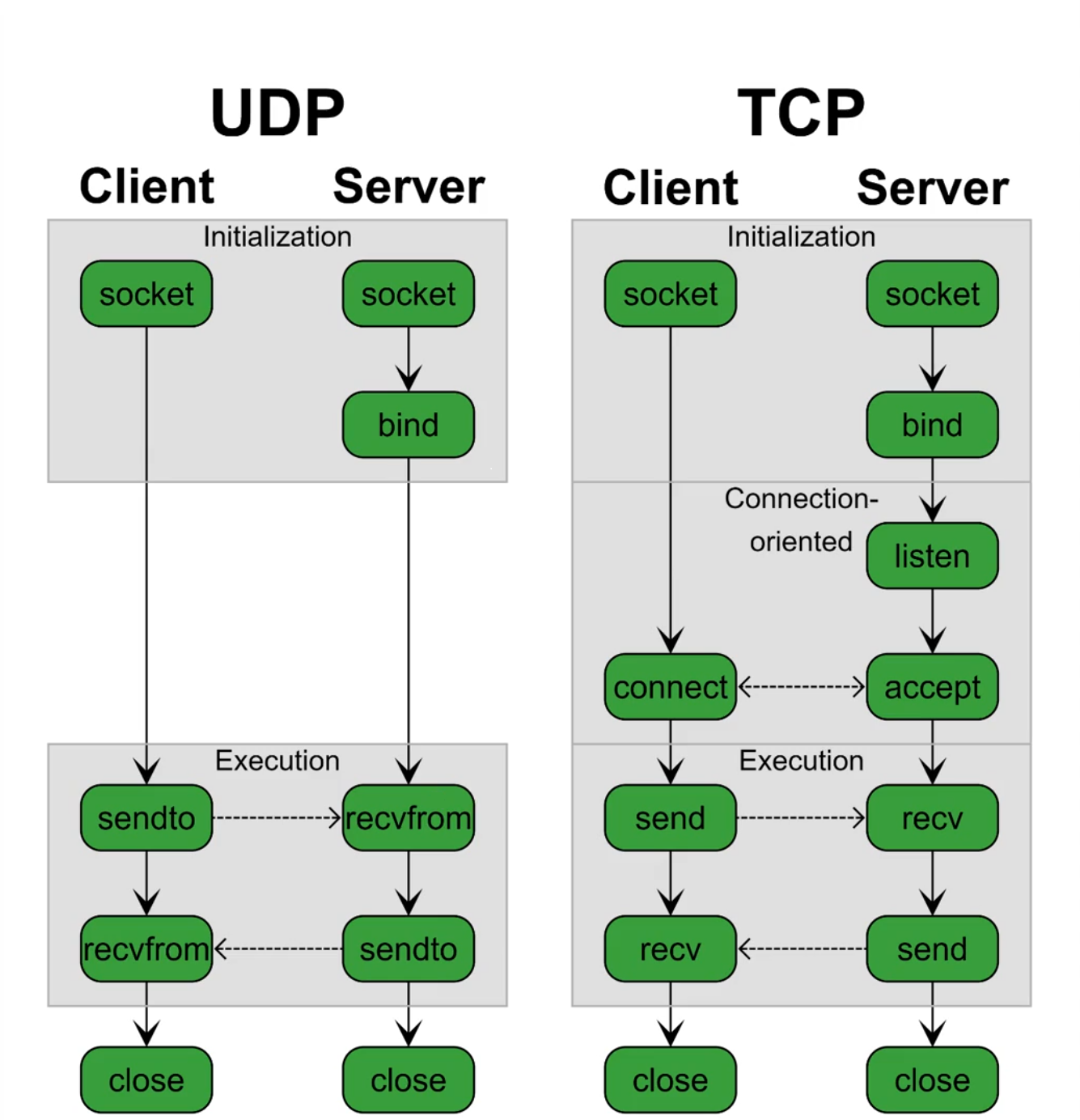
You make 4 applications (UDP Client, UDP Server, TCP Client and TCP Server) that can communicate with each other over the internet via Berkley sockets in C. The 2 Server applications and the 2 Client applications may run on your laptop.
- Working Client application that sends number of packets to send via UDP (proof Packet Sender) [2/15]
-
Working Server application receiving data via UDP (Evidence Packet Sender) [2/15]
-
CSV of received stream is created [1/15]
-
Tracks the number of packets received [1/15]
-
Set a number of packets to receive [1/15]
-
The time difference between first and last packet is shown [1/15]
-
*Timeout can be set [2/15]
-
*When timed out the number actually received versus expected number is shown with packet loss calculation [2/15]
-
*The data is parsed on the server and a min, max and avg is kept [2/15]
-
*Statistical data is kept in a file [1/15]
-
Client can make TCP connection (proof via WireShark) [1/25]
-
Client can successfully send and receive TCP packets (proof via WireShark) [1/25]
-
Client forwards the messages entered by the user (Proof Packet Sender) [1/25]
-
*Messages can be sent and received simultaneously on the Client without an agreed rotational role (e.g. multi-threaded) [4/25]
-
Server can listen to a port for incoming TCP connections [1/25]
-
Server accepts connection and talks to connected client over TCP [1/25]
-
Server application forwards received message to all other participants [1/25]
-
Server does not send to sender its own message [1/25]
-
Server sends the sender information along with the message (i.e. IP address + sender's port) OR Server sends the information of new client connection to all other connected clients (i.e. IP address + sender's port) [2/ 25]
-
Server sends the last 16 chat messages to the client on new connection [2/25]
-
Server can perform HTTP communication with the web server (proof via WireShark) [2/25]
-
*Server forwards the chat messages over HTTP to the web server (proof via WireShark) [2/25]
-
*Server requests the last 16 chat messages via HTTP to the web server (at startup) [2/25]
-
*Multiple Clients can be simultaneously connected and chatting with each other (i.e. processed asynchronously or synchronously on the server) [4/25]