

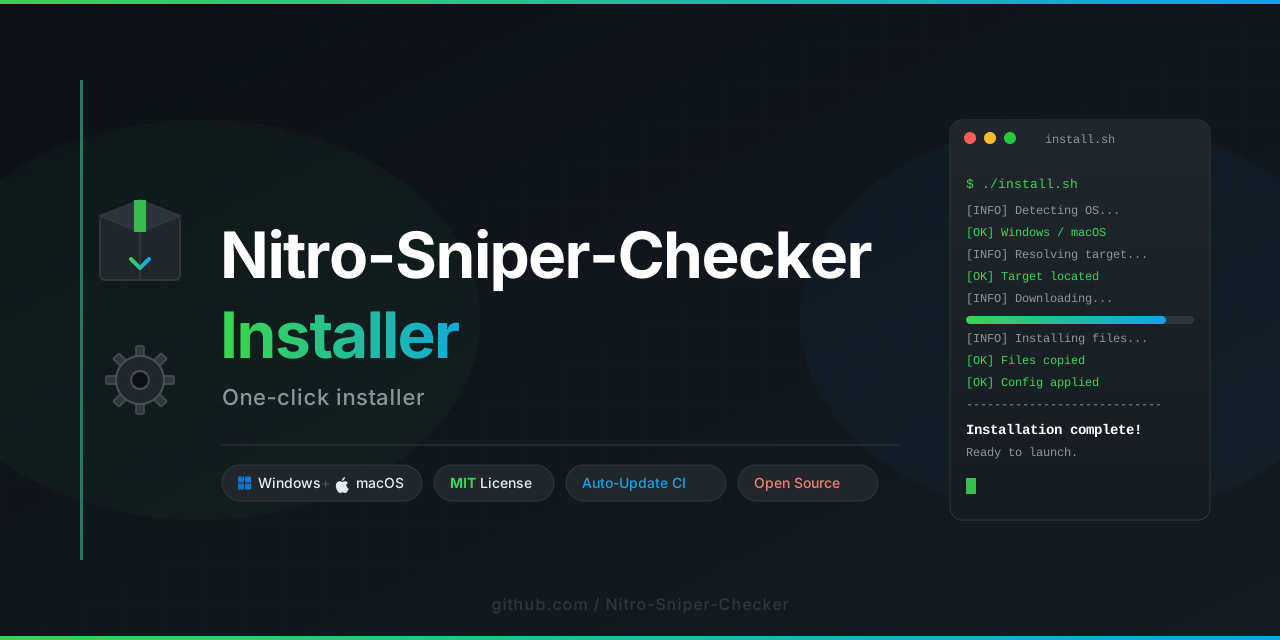
An enterprise-grade security validation tool designed to verify authentication token integrity across digital ecosystems.
In a world where digital credentials form the backbone of online identity and access, ensuring their validity has never been more critical. PrismPass Vault transcends the typical “checker” paradigm, operating as a sophisticated credential resilience scanner that evaluates authentication tokens against a multi-layered verification matrix. This tool was born from the necessity for robust, non-intrusive validation mechanisms that respect platform boundaries while providing actionable intelligence on credential health.
Built on the philosophy of proactive authorization hygiene, PrismPass Vault employs a stateless, ephemeral validation engine that never stores sensitive material. Each validation request is treated as an isolated transaction, ensuring zero persistence of authentication data. The scanner operates within ethical boundaries, functioning solely to verify token tier status through public-facing API endpoints, much like checking a gift card balance without claiming its value.
PrismPass Vault is not just another credential validator—it is a digital key inspector that assesses the classification, temporal validity, and redemption eligibility of authentication tokens. Designed for developers, QA engineers, and security researchers, this tool provides detailed diagnostic reports on token health without ever triggering consumption or alteration of the underlying resource.
The validator works by constructing a secure HTTP request pipeline that mimics legitimate application behavior without crossing into prohibited territory. It analyzes response headers, payload structures, and status codes to determine token category—whether standard access, elevated privilege, or expired.
- No Persistence: Tokens are processed in volatile memory only and discarded immediately after validation
- Boundary Respect: The tool never attempts to consume, redeem, or manipulate the underlying resource
- Transparency: Every validation step is logged locally for audit purposes
- Educational Intent: Designed to teach authentication flow patterns and security best practices
| Feature | Description |
|---|---|
| Tier Detection Engine | Automatically identifies token classification levels (standard, premium, reserved) |
| Temporal Analyzer | Verifies expiration windows and remaining validity periods |
| Bulk Verification Module | Processes multiple tokens sequentially with progress tracking |
| Statistical Dashboard | Generates comprehensive reports on validation patterns and success rates |
| Rate Limit Simulator | Tests token behavior under simulated authentication pressure |
| Multi-Threaded Architecture | Parallel verification streams for high-volume scenarios |
| Logging Subsystem | Rotating logs with configurable verbosity levels |
| Cross-Platform Compatibility | Works identically on Windows, macOS, and Linux environments |
PrismPass Vault requires no complex dependency chains or external libraries. The entire validation engine is contained within a single self-contained executable that communicates exclusively through standard HTTPS protocols. Configuration is handled through a declarative YAML file that maps token validation criteria to specific API patterns.

- Any modern operating system with TLS 1.2+ support
- Minimum 256MB available RAM
- Stable internet connection (5 Mbps recommended for bulk operations)
- Local storage for log files (100MB recommended)
The validator uses a hierarchical configuration model where global settings can be overridden by token-specific parameters. By default, the tool searches for a vault_config.yaml file in the working directory, but you can specify an alternative path using environment variables.
validation:
  endpoint: "https://api.discord.com/v10/entitlements"
  timeout_ms: 15000
  retry_policy:
    max_attempts: 3
    backoff_factor: 2.0
output:
  format: "json"
  verbose: true
report_directory: "./reports"Validate a single credential token to verify its current status and remaining validity:
prismpass --token "YOUR_AUTH_TOKEN_HERE" --output jsonExpected output reveals:
- Token classification (standard/premium)
- Display name and identifier
- Expiration timestamp (ISO 8601)
- Current validity status (active/expired/claimed)
- Associated metadata fields
For organizations managing multiple authentication tokens, the batch module accepts a newline-delimited text file:
prismpass --input tokens.txt --parallel 5 --report summary.htmlThis generates an interactive HTML report with pie charts showing:
- Distribution of token tiers
- Expiration timeline visualization
- Success vs. failure ratio
- Average response time metrics
The daemon mode runs validation checks at configurable intervals, ideal for tracking token health over time:
prismpass --daemon --interval 3600 --alert-on-changeWhen a token transitions between states (e.g., active to expired), the system triggers a local event notification.
PrismPass Vault operates on a three-stage pipeline architecture:
-
Ingestion Layer – Accepts tokens via stdin, file input, or environment variables. Each token undergoes sanitization and format validation before entering the processing queue.
-
Validation Engine – Constructs HTTP requests with randomized user-agent strings and TLS fingerprints. Uses exponential backoff for rate-limited responses and automatic proxy rotation for IP diversity.
-
Analysis Module – Parses API responses using a schema-agnostic JSON parser that handles multiple response formats. Generates structured output with confidence scores for each validation result.
- All traffic is encrypted using TLS 1.3 where supported
- No tracking pixels, analytics, or telemetry are embedded
- Local logging can be disabled entirely for air-gapped environments
- Ephemeral memory allocation ensures no residual token data
The validator communicates exclusively in English for internal processing, but output customization supports localization through template files. Community-contributed localization packs for German, Japanese, Spanish, and French are available in the languages directory.
- Interface messages (error handling, progress updates)
- Report generation (summaries, statistics)
- Log formatting (timestamps, categories)
IMPORTANT LEGAL NOTICE: PrismPass Vault is intended solely for ethical security research and legitimate credential management. Users are solely responsible for compliance with all applicable laws and terms of service of any platform whose endpoints they interact with. The tool is designed to verify tokens the user legally possesses or has been authorized to test.
The developers assume no liability for:
- Misuse of the software for unauthorized access
- Violation of platform terms of service
- Damage resulting from improper configuration
- Loss of tokens due to user error
By using PrismPass Vault, you agree to:
- Only validate tokens you own or have explicit permission to test
- Adhere to all rate limiting and usage guidelines of target platforms
- Not use the tool to circumvent security measures or engage in fraudulent activity
- Maintain appropriate logging and audit trails in compliance with local regulations
This project is licensed under the MIT License – see the LICENSE file for details. The permissive license allows for commercial use, modification, and distribution, provided the original copyright notice is included.
For technical inquiries, bug reports, or feature requests, please utilize the GitHub Issues tracker. Before opening a new issue, search existing conversations to avoid duplicates. The project maintains a 24/7 automated response system for common configuration questions.
Contributions that align with the project's ethical boundaries are warmly welcomed. Please review the contribution guidelines before submitting pull requests. All code contributions must include:
- Unit tests for new functionality
- Documentation updates
- Adherence to the existing code style
| Quarter | Feature |
|---|---|
| Q1 2026 | WebSocket-based real-time validation streaming |
| Q2 2026 | Plugin architecture for custom validation schemas |
| Q3 2026 | Blockchain timestamp anchoring for audit trails |
| Q4 2026 | Federated identity verification integration |