


Concurrent CDS API downloader with an interactive Textual TUI and script mode.
Submit multiple CDS API requests and download them in parallel with a configurable number of workers. Monitor progress through an interactive terminal UI with an htop-style worker table, or run headless in script mode for CI/cron jobs.
Feedback welcome! This project is under active development. If you have suggestions, feature requests, or run into any issues, please open an issue on GitHub or send an email to b.giebl@protonmail.com.
How much faster is parallel downloading? Benchmark with 4 monthly ERA5 files (2m temperature, Germany bounding box):
| Workers | Wall time | Speedup |
|---|---|---|
| 1 | 1m22s | 1.0x |
| 2 | 48s | 1.7x |
| 4 | 38s | 2.2x |
Each CDS request spends most of its time waiting in the server queue and being processed — parallel workers overlap that wait. For large files, download parallelism helps too. Results vary with server load and time of day; larger batches benefit more from higher worker counts.
pip install cdsswarmFor YAML request file support:
pip install "cdsswarm[yaml]"For development (tests, pre-commit):
git clone https://github.com/bgiebl/cdsswarm.git
cd cdsswarm
pip install -e ".[dev]"A valid CDS API configuration file at ~/.cdsapirc:
url: https://cds.climate.copernicus.eu/api
key: <your-personal-access-token>
See the CDS API documentation for setup instructions.
Create a request file requests.json:
[
  {
    "dataset": "reanalysis-era5-single-levels",
    "request": {
      "product_type": ["reanalysis"],
      "variable": ["2m_temperature"],
      "year": ["2024"],
      "month": ["01"],
      "day": ["01", "02", "03"],
      "time": ["12:00"],
      "data_format": "grib"
    },
    "target": "temperature_jan.grib"
  },
  {
    "dataset": "reanalysis-era5-single-levels",
    "request": {
      "product_type": ["reanalysis"],
      "variable": ["total_precipitation"],
      "year": ["2024"],
      "month": ["01"],
      "day": ["01", "02", "03"],
      "time": ["12:00"],
      "data_format": "grib"
    },
    "target": "precipitation_jan.grib"
  }
]
Run with 4 workers:
cdsswarm requests.json --workers 4import cdsswarm
tasks = [
cdsswarm.Task(
dataset="reanalysis-era5-single-levels",
request={
"product_type": ["reanalysis"],
"variable": ["2m_temperature"],
"year": ["2024"],
"month": ["01"],
"day": ["01", "02", "03"],
"time": ["12:00"],
"data_format": "grib",
},
target="temperature_jan.grib",
),
cdsswarm.Task(
dataset="reanalysis-era5-single-levels",
request={
"product_type": ["reanalysis"],
"variable": ["total_precipitation"],
"year": ["2024"],
"month": ["01"],
"day": ["01", "02", "03"],
"time": ["12:00"],
"data_format": "grib",
},
target="precipitation_jan.grib",
),
]
results = cdsswarm.download(tasks, num_workers=4)
for r in results:
if r.success:
print(f"Downloaded {r.task.target}")
else:
print(f"Failed {r.task.target}: {r.error}")usage: cdsswarm [-h] [--version] [-w WORKERS] [-m {interactive,script,auto}]
[--no-skip] [--resume | --no-resume] [--reuse | --no-reuse]
[--max-retries MAX_RETRIES] [--output-dir OUTPUT_DIR]
[--dry-run] [--ignore-warnings] [--log FILE] [--summary FILE]
[--post-hook CMD]
requests_file
| Argument | Description |
|---|---|
requests_file |
Path to a JSON or YAML file with download requests |
-w, --workers |
Number of parallel download workers (default: 4) |
-m, --mode |
Display mode: interactive (TUI), script (plain text), or auto (default) |
--no-skip |
Re-download files that already exist on disk |
--resume / --no-resume |
Resume an interrupted session if state file exists (default: enabled) |
--reuse / --no-reuse |
Reuse existing CDS jobs with matching parameters (default: enabled) |
--max-retries |
Max retry attempts per task (default: 3, 1 to disable) |
--output-dir |
Prepend directory to relative target paths |
--dry-run |
Show what would be downloaded without actually downloading |
--ignore-warnings |
Auto-continue on warnings without prompting |
--log FILE |
Write timestamped log to a file |
--summary FILE |
Export summary as JSON (.json) or CSV (.csv) |
--post-hook CMD |
Shell command to run after each successful download (see below) |
In auto mode, the TUI is used when stdout is a TTY; otherwise it falls back to script mode.
The --post-hook option runs a shell command after each file is successfully downloaded. Use {file} and {dataset} as placeholders:
# Compress each file after download
cdsswarm requests.json --post-hook "gzip {file}"

# Convert GRIB to NetCDF with CDO
cdsswarm requests.json --post-hook "cdo -f nc copy {file} {file}.nc"

# Upload to S3
cdsswarm requests.json --post-hook "aws s3 cp {file} s3://my-bucket/cds/"
Hook failures produce a warning but do not mark the download as failed — the file is already on disk.
The generate subcommand expands a template file into a full request file using Cartesian product expansion:
cdsswarm generate template.json -o requests.json
cdsswarm generate template.json --dry-run          # preview without writing
The template file must contain a single JSON object (not a list). If you pass a single-element list [{...}], it will be auto-unwrapped with a warning.
A template looks like a single request with a split_by field that lists which dimensions to expand:
{
  "dataset": "reanalysis-era5-single-levels",
  "request": {
    "product_type": ["reanalysis"],
    "variable": ["2m_temperature", "total_precipitation"],
    "year": ["2023", "2024"],
    "month": ["01", "02", "03"],
    "day": ["01", "02", "03"],
    "time": ["12:00"],
    "data_format": "grib"
  },
  "target": "output/{variable}_{year}_{month}.grib",
  "split_by": ["variable", "year", "month"]
}
This generates 2 × 2 × 3 = 12 separate tasks, one for each combination of variable, year, and month. Non-split fields (day, time, etc.) are shared across all tasks. The {placeholder} syntax in target fills in each combination's values.
| Option | Description |
|---|---|
--split-by FIELDS |
Override the template's split_by (comma-separated) |
-o, --output FILE |
Output file path (default: stdout) |
--dry-run |
Show task count and target filenames without writing output |
The cancel subcommand cancels active CDS API requests on the server — useful for cleaning up after a crashed session or accidental submissions:
cdsswarm cancel                        # cancel all queued/running requests (new API only)
cdsswarm cancel abc-123 def-456        # cancel specific request IDs (both APIs)
cdsswarm cancel --yes                  # skip confirmation prompt
When no IDs are given, cdsswarm queries the CDS server for all active (accepted/running) requests and presents them for confirmation before cancelling. This requires the new CADS API (ecmwf-datastores). With the old cdsapi, you must provide specific request IDs.
| Option | Description |
|---|---|
request_ids |
Specific request IDs to cancel (omit to cancel all active) |
-y, --yes |
Skip confirmation prompt |
Tab-completion for subcommands and flags is available for bash and zsh:
# Bash (add to ~/.bashrc)
eval "$(cdsswarm completion bash)"

# Zsh (add to ~/.zshrc)
eval "$(cdsswarm completion zsh)"cdsswarm automatically saves session state after each task completes. If a download session is interrupted (e.g. by Ctrl+C or a network failure), rerunning the same command picks up where it left off — completed tasks are skipped and failed/pending tasks are retried.
State files are stored in ~/.cache/cdsswarm/sessions/ (or $XDG_CACHE_HOME), keyed by request file path and output directory. Run logs are automatically saved to ~/.local/state/cdsswarm/logs/ (or $XDG_STATE_HOME).
cdsswarm requests.json -w 4             # interrupted — 50 of 100 tasks done
cdsswarm requests.json -w 4             # resumes from task 51
cdsswarm requests.json -w 4 --no-resume # force a fresh startSettings can be stored in a .cdsswarm.toml file instead of passing CLI flags every time. CLI flags always take precedence.
| Location | Scope |
|---|---|
~/.cdsswarm.toml |
User-global defaults |
.cdsswarm.toml (working directory) |
Project-level overrides |
Example .cdsswarm.toml:
workers = 8
max-retries = 5
mode = "script"
output-dir = "/data/downloads"
post-hook = "gzip {file}"
All CLI flags are supported as config keys (use hyphens, e.g. max-retries, post-hook, skip-existing).
Each entry specifies its own dataset:
[
  {
    "dataset": "reanalysis-era5-single-levels",
    "request": { ... },
    "target": "output1.grib"
  },
  {
    "dataset": "reanalysis-era5-pressure-levels",
    "request": { ... },
    "target": "output2.grib"
  }
]Share a dataset across all requests:
{
  "dataset": "reanalysis-era5-single-levels",
  "requests": [
    { "request": { ... }, "target": "output1.grib" },
    { "request": { ... }, "target": "output2.grib" }
  ]
}Both formats also work in YAML (requires pip install cdsswarm[yaml]):
dataset: reanalysis-era5-single-levels
requests:
  - request:
      product_type: [reanalysis]
      variable: [2m_temperature]
      year: ["2024"]
      month: ["01"]
      day: ["01"]
      time: ["12:00"]
      data_format: grib
    target: temperature.grib
The request dict accepts the same parameters as cdsapi.Client.retrieve().
A single CDS API download request.
| Field | Type | Description |
|---|---|---|
dataset |
str |
CDS dataset name (e.g. "reanalysis-era5-single-levels") |
request |
dict |
Request parameters, same format as cdsapi.Client.retrieve() |
target |
str |
Local file path to save the downloaded data |
cdsswarm.download(tasks, num_workers=4, skip_existing=True, reuse_jobs=True, max_retries=3, on_message=None, post_hook="")
Download multiple CDS API requests concurrently.
| Parameter | Type | Default | Description |
|---|---|---|---|
tasks |
list[Task] |
required | List of download tasks |
num_workers |
int |
4 |
Number of parallel workers |
skip_existing |
bool |
True |
Skip files that already exist |
reuse_jobs |
bool |
True |
Reuse existing CDS jobs with matching parameters |
max_retries |
int |
3 |
Max retry attempts per task (1 to disable) |
on_message |
callable |
None |
Callback fn(message: str) for status updates |
post_hook |
str |
"" |
Shell command to run after each successful download ({file}, {dataset}) |
Returns a list[Result]. Returns an empty list if interrupted by KeyboardInterrupt.
| Field | Type | Description |
|---|---|---|
task |
Task |
The original task |
success |
bool |
Whether the download succeeded |
error |
str |
Error message (empty on success) |
Expand a template dict into a list of Task objects via Cartesian product of the split_by dimensions.
Raised for invalid configuration values in config files or CLI flags. Subclass of ValueError.
Raised for invalid or unrecognized request file formats. Subclass of ValueError.
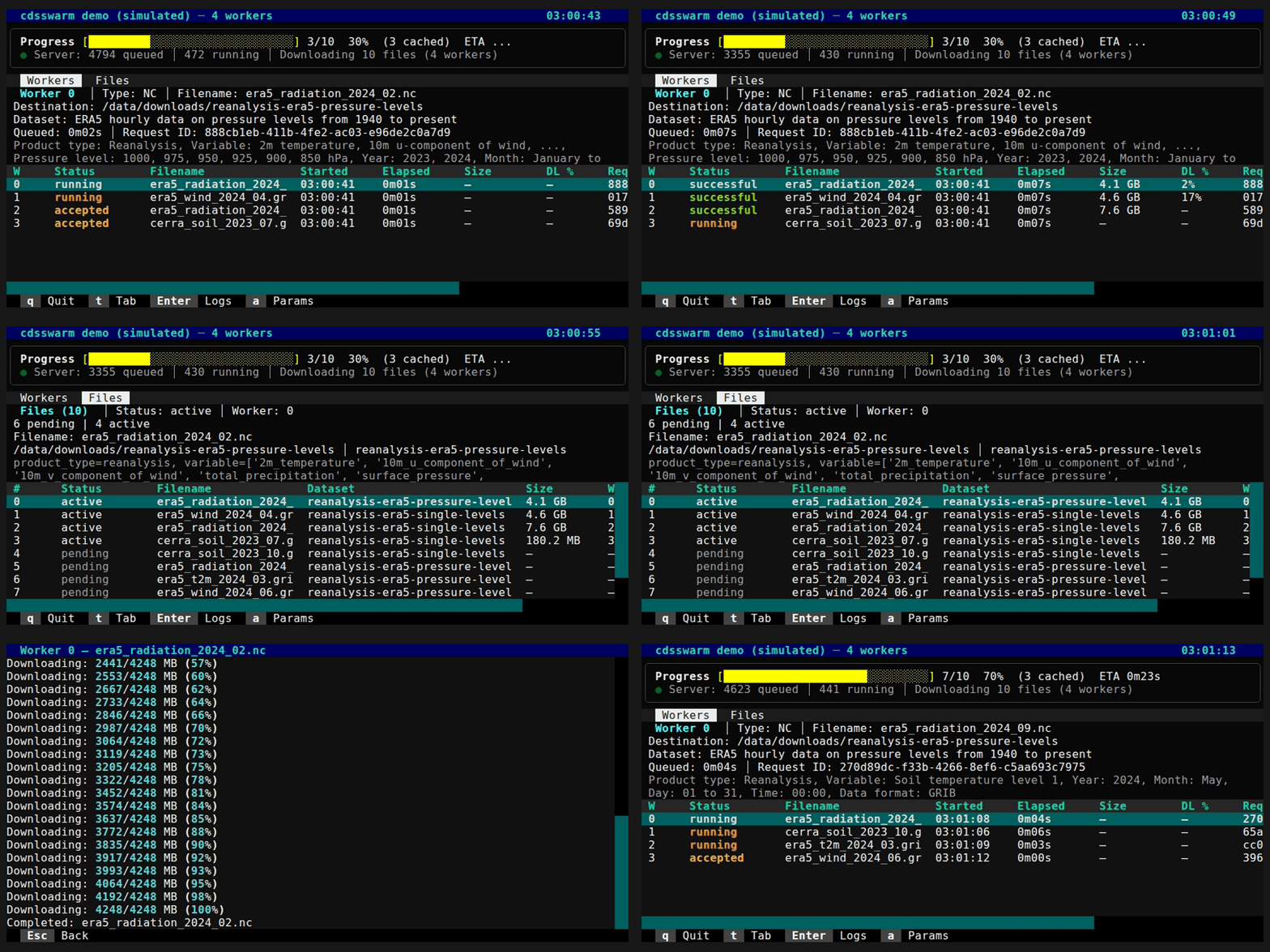
The interactive TUI (terminal user interface) is built with Textual and is available via the CLI only. It shows an htop-style DataTable with one row per worker:
W  │Status      │Filename          │Started  │Elapsed  │Size    │DL %   │Request ID
0  │ running    │era5_2024_01.grib │22:31:24 │2h30m05s │15.2 GB│48%    │af1e2306-28c3...
1  │ successful │era5_2024_02.nc   │22:31:25 │1h15m00s │8.1 GB │100% ✓ │b2f4a891-...
The layout has two tabs (Workers and Files), an info panel above the table, and a progress footer with an overall progress bar and ETA.
Key bindings:
| Key | Action |
|---|---|
q |
Quit |
t / Tab |
Switch tab |
Enter |
Open scrollable log for the selected worker |
a |
Show full request parameters |
Esc |
Dismiss screen / go back |
Ctrl+C |
Cancel — in-flight CDS API requests are cancelled on the server |
pip install -e ".[dev]"
pytest -vMIT