


Spend fewer tokens on the same work.
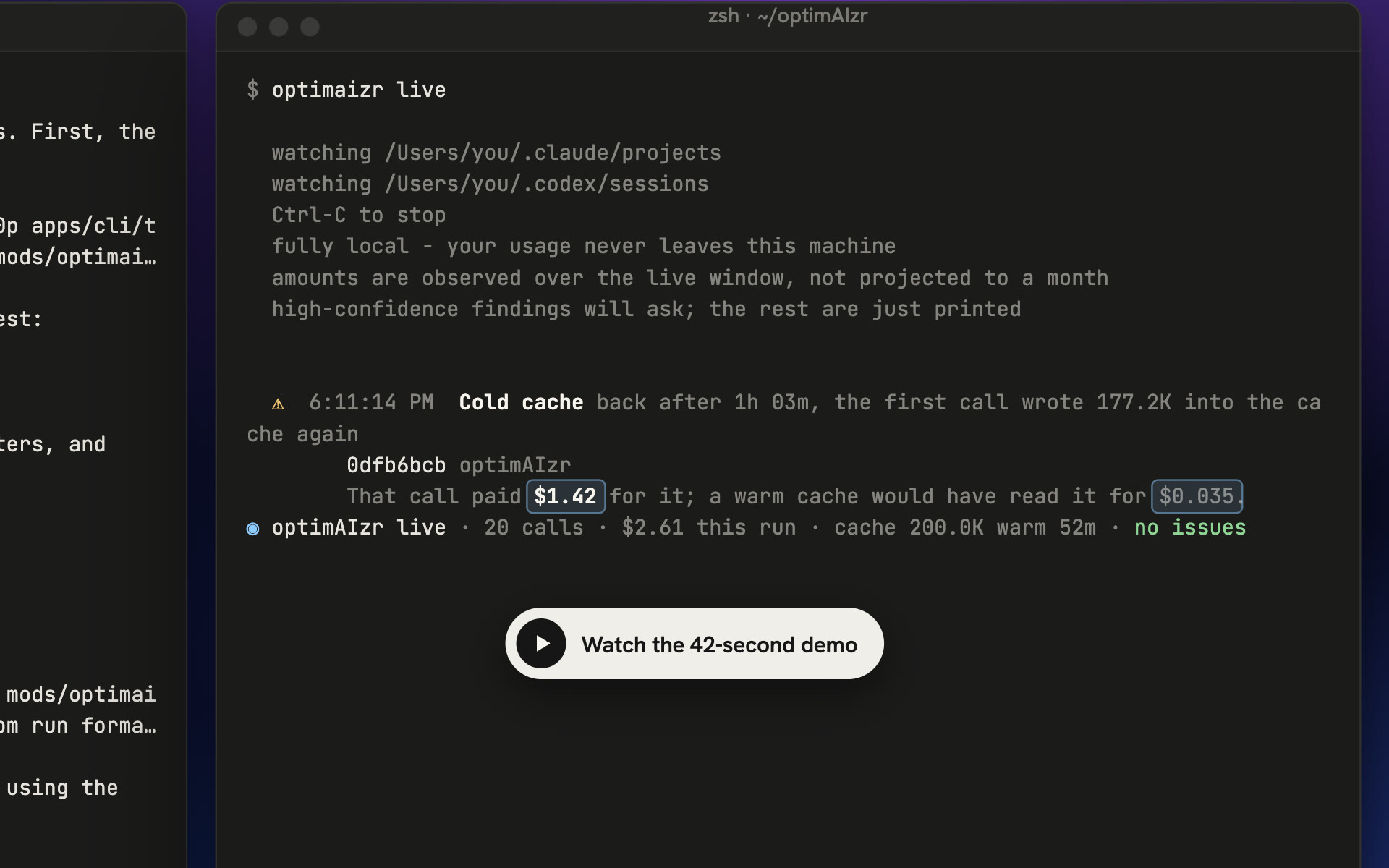
In a long Claude Code session, most of what you pay for isn't Claude writing code. It's Claude re-reading your conversation on every call, cheap per token but paid again and again, and writing it into the cache again after a break, at up to twice the input price. optimAIzr shows where your tokens go, warns you before the expensive moments, and fixes what it can in one command. For Claude Code, Codex and opencode.
npx optimaizrNo account, no upload, no telemetry. It reads token counts from the logs already on your machine, never your prompts or Claude's answers. To spot repeated work it also reads what each tool call was given (a file path, a command, the first 200 characters of anything else), in memory only, and stores none of it.
  Your Claude Pro did $938.12/mo of work at API prices: 47x what you pay

  Savings found
    Clear waste             $13.07/mo  $159.01/yr · fix it, nothing to lose
    Likely, if you try      +$1.54/mo  model mismatch, excess reasoning
    Up to, if you test     $263.14/mo  compact earlier · 48% of calls carry over 200K of conversation

  Where it goes
    Re-reading the conversation    56%  ███████████░░░░░░░░░
    Loading context into cache     24%  █████░░░░░░░░░░░░░░░
    Answers, code and thinking     20%  ████░░░░░░░░░░░░░░░░
The cache countdown. Claude Code keeps a conversation cached for an hour. Come back later and your first message writes all of it again. One command puts a countdown under Claude Code's prompt, with what coming back will cost.
optimaizr statusline on◉ optimAIzr · 161.0K context, $0.032/call to re-read · cache warm 12m, then $1.29 to write again · leaving? handoff note, then /clear · 5h 61%
Live, beside your agent. optimaizr live warns when context jumps or
passes 200K, and 5 minutes before a cache expires, and offers a fix you take
with Y. After each turn it says what that turn cost and how much of your
5-hour window it took.
Where long sessions turn expensive. optimaizr sessions opens with your
costliest conversations, by the title Claude Code gave them, and what each one
took of your 5-hour window (mine, with the titles changed):
  Costliest conversations (subagents included)
         cost   of 5h   worked   conversation
       $91.16   ~222%   1h 53m   Refactor payment webhook handling
       $89.81   ~219%   2h 21m   Migrate auth to session tokens
       $74.40   ~182%   2h 36m   Build analytics dashboard filters
       $74.35   ~181%   1h 31m   Fix flaky checkout integration tests
       $71.99   ~176%   2h 25m   Add search indexing pipeline
    The top 5 of 122 conversations, 34% of spend.
    5h share at $0.410 per 1%, learned from 27 windows of your plan meter.
Then it finds the context size where re-reading takes over, what each cache write was for, and every time you came back too late:
  Cold cache returns
    16 times you came back after a long conversation's cache
    expired, and paid for all of it again: 5.9M tokens for
    $47.25, where a warm cache would have read it for $1.19.
optimaizr apply context-compaction   # Claude Code and Codex compact at 200K
optimaizr undo context-compaction    # and back
optimaizr results                    # did it work?
Compact earlier: Claude Code at 200K
applied Oct 7, 7 days ago
Working: 26% less per prompt than the 14 days before. It comes with a
cost: compactions a day and waiting for summaries a day went up.
before after
cost per prompt $1.06 $0.787 -26%
calls past 200K 60% 0% -60 pts
compactions a day 0.23 5.3 23x trade-off
waiting for summaries a day 0.4m 7.1m 17x trade-off
That's my own change, a week in. Against just the 5 days before it, the drop
is 7%, and results says so too.
Every finding says what happened, why it matters and what it saves, in dollars from your own logs. Savings are split into clear waste, likely, and "up to", and never added together.
The optional optimAIzr mod runs inside the session: the cost of each answer and
your 5-hour window as you work, Y in live moves the session you're in to a
cheaper model, and /optimaizr handoff writes a note to start fresh from.
  ⏺ optimaizr: this turn $0.18 · 2m 10s · 4 requests · ~0.4% of 5h

  optimAIzr  █████████░░░░░░░  56% of 5h · resets 15:00
/plugin marketplace add blendbunjaku/optimaizr
/plugin install optimaizr@optimaizr
| Command | What it does |
|---|---|
optimaizr |
Where your tokens go, and what to fix first |
optimaizr live |
Watches while you work, fixes with Y |
optimaizr statusline on |
The cache countdown under Claude Code's prompt |
optimaizr sessions |
Where long conversations start to cost more |
optimaizr why |
Spend by model, project and kind of work |
optimaizr apply <rule> |
Applies a fix; undo <rule> takes it back |
optimaizr results |
Did it work? The days after against before |
optimaizr verify <rule> |
Replays your own requests on the cheaper option |
optimaizr card |
Your last 30 days as an image to post |
optimaizr --help lists the rest.
Claude Code, Codex and opencode 1.x with no setup. opencode history is read
from ~/.local/share/opencode/opencode.db (under $XDG_DATA_HOME when that is
set) and needs Node 22.13 or later. History from opencode 2.0 isn't read yet.
Reports, live and the steps in apply cover all three;
apply context-compaction changes Claude Code and Codex only.
Your Claude plan (Pro, Max, Team) and ChatGPT plan are detected. Your own app
with one line, optimaizr.wrap(new Anthropic()) or new OpenAI(), and CSV or
JSON usage exports. Node 20.11 or later.
- 0.11 (Oct 13, 2026): did the change work?
optimaizr resultsmeasures it on your own usage, with what the saving cost you. Mine, a week after compacting at 200K: 26% less per prompt, for 7 minutes a day waiting on summaries.livesays what each turn cost and how much of your 5-hour window it took, andsessionsranks your costliest conversations the same way. In 0.11.1: opencode support. - 0.10 (Oct 7, 2026): a cache countdown under Claude Code's prompt, no mod
needed. In 0.10.3: spot conversations that start heavy, and see what each
cache write was for in
optimaizr sessions. - 0.9 (Oct 6, 2026): your plan detected, savings labelled by how sure they are, compacting earlier in one command.
- 0.8 (Oct 2, 2026): the Claude Code mod, with the cost of every answer and cheaper models mid-session.
Every release in full:
changelog or
optimaizr changelog.
Everything runs on your machine and stays in ~/.optimaizr/. The only network
calls are verify (to your own provider, with your own key), the optional Jev
second opinion, and a daily version check against npm, off with
OPTIMAIZR_NO_UPDATE_CHECK=1.
SECURITY.md
lists every file read and written.
- Docs and the CLI reference: every command, flag and figure explained
- Contributing:
npm install && npm run build && npm test - Report a bug
First presented on September 13, 2026, open source since September 30, 2026. optimAIzr Pro, the hosted product coming to optimaizr.com, is separate from this repository.