New/exception classes #3
Conversation


It's always preferable to create custom exceptions for weird edge-cases
like missing attributes from the Report object. This is esspecially
helpful in cases where certain nessus plugins don't return all of the
attributes that are necessary, and gives users a straight-forward way to
handle and pass the exception accordingly.
implemented exception handling for missing attributes
plus fixed some minor spelling errors.


|
Thanks a lot for you contribution to this project.
we should then have a partial green build |

|
Alright. Changes are pushed. Thanks for catching that typo. Travis doesn't seem to like the There is another issue I encountered with a separate Nessus file that resulted in similar issues that cause the parser to fail. This is because it can't find all the necessary attributes, even though it would normally be handled by The problem is that this area of the code is meant to be transparent to the user, or at least I assume so based on the number of private method calls. Raising the error here won't really have any useful effect for the user if they create a The issue is that there is at least one "Info" plugin that is missing these required attributes by design, and there may be more in the future. Ultimately, I think it would be more ideal to accept all ReportItems regardless of what attributes are missing and let the user decide whether or not to accept them or throw them away accordingly by raising the This is my temporary workaround just so that I can parse the file and throw away the invalid ReportItems: Obviously not a permanent solution. I'm willing to help change the implementation, but I'll wait to know how you would want to handle the issue.
I've noticed that in every case, the problematic plugin is the "You didn't set Credentials" Info finding which is a bit annoying. It's actually completely empty, except for the name and description. So far, it looks like this is the only problematic plugin.
Curse you Tenable -.- |
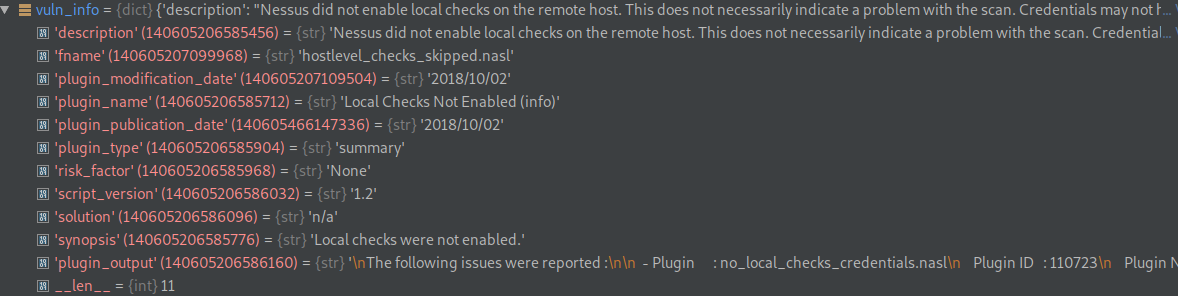
|
Hey, |
|
Hey, no worries. Sorry that I'm a bit late too. I can work on this and should be able to solve the issues of encountering empty plugins. I think the best solution is to catch any exceptions due to incomplete plugins and warn the user. I have a feeling that if I push this PR now that it will likely break things down the line, so I will fix things here when I have the time. |
Implemented pythonic log parser

Added debug logging + PEP 257 Docstring changes

Implementing libnessus logging

Edited to PEP 257 compliant docstrings

Implemented "Strict" parsing option and log warnings to alert users when invalid report items are encountered
|
Hi there @bmx0r Sorry this sat for so long, but I finally managed to gather some time to implement some changes that I think are a reasonable approach to dealing with the Bad/MissingAttributes situation. In order to prevent existing codebases that depend on libnessus from breaking, I implemented an optional "strict" boolean argument to all of the parser functions which get passed down to the private functions. By default, it is set to false. As long as strict parsing is false, it will simply warn users when it encounters an invalid ReportItem object due to missing attributes. Users may explicitly set strict parsing to True, which will throw an exception and force the user to deal with it as they please. So far my testing of this has not introduced any other problems and works as intended. Unfortunately, I am not at all familiar with Travis-CI and cannot get it to behave. As far as I can tell, the code meets all the reasonable PEP8 standards, and works on Python 3.3+. I have not tested any versions prior to that. If it is explicitly required that all of the Travis-CI build checks pass, let me know, but otherwise, I believe this is good to go. If any specific changes are needed, mark them and I'll be happy to address. Cheers 🍻 |
|
Fixed the Travis-CI build config. |
|
@bmx0r Just wanted to drop a reminder in here in case this hasn't been seen yet. If changes are needed, let me know. Would be nice if this could get merged into pypi so that a local fork isn't needed anymore. 😆 |

|
and finnaly: https://pypi.org/project/python-libnessus/ |
2 participants


I had a need for this in order to implement my own parser for nessus's xml output and ran into some trouble that prompted me to implement a few changes to the library. The most significant change was the creation of a new
exceptionsclass file in the base of the library (because it should be accessible from a base import).The purpose of the exception class file is to introduce custom exceptions for the library which should be created for edge-case scenarios such as the one I encountered while parsing a nessus file. Specifically the error was caused by a configuration change in the scan for nessus to not scan the local host. This apparently creates a unique pluginID that is missing most of the ordinarily common and essential attributes that libnessus requires.
Aside from this tweak, it's mostly just adding some new functionality (like getting the CVE as a string) and some minor spelling mistakes I encountered while casually making changes.
Thanks in advance for reviewing this and your work on this library. Extremely useful stuff. 👍