
Lightweight, open-source crypto portfolio optimizer.
10 optimization strategies, 8 risk metrics, AI-powered views, DeFi yields, sentiment analysis — all from a single CLI or interactive dashboard.



Installation • Who Is This For • Quick Start • Dashboard • Strategies • Features • Python API
Most portfolio optimization tools are built for equities. Crypto is different — 24/7 markets, extreme volatility, fat-tailed returns, and correlations that spike during crashes. Orbiter is built specifically for this.
- Fast — Real optimization (not brute-force), results in seconds
- Honest — Walk-forward backtesting to avoid overfitting
- Practical — CLI for quick analysis, dashboard for exploration, Python API for integration
- Comprehensive — From basic mean-variance to regime detection and factor models
You hold multiple crypto assets and want to know the optimal allocation — not just gut feeling, but mathematically optimized weights based on real risk-return tradeoffs. Orbiter tells you exactly how much to put in each coin, shows you the efficient frontier, and validates the strategy with out-of-sample backtesting so you're not just curve-fitting to the past.
What you get:
- Run
orbiter optimize BTC ETH SOL AVAXand get an allocation in seconds - See how your portfolio would have performed with walk-forward backtesting
- Understand your actual risk exposure — max drawdown, CVaR, tail risk
- Compare 7 different strategies side-by-side to find what fits your risk tolerance
You're studying portfolio theory, crypto markets, or quantitative finance and need a clean, well-tested codebase to experiment with. Every module is independent, documented, and covered by tests.
What you get:
- Factor model with market, momentum, size, and liquidity factors for crypto
- Regime detection (HMM) to study bull/bear/sideways market dynamics
- Monte Carlo stress testing with fat-tailed (Student-t) distributions
- Efficient frontier computation, correlation analysis, covariance estimation
- All code is modular — import just the pieces you need into your own research
You're building a trading system, a portfolio dashboard, or an automated rebalancing bot. Orbiter gives you a clean Python API to plug into your stack.
What you get:
pip install orbiter-cryptoand import directly — no API keys needed for price data- Programmatic access to all strategies, metrics, and stress tests
- Rebalancing simulation with transaction cost modeling (maker/taker fees, slippage)
- Calendar, threshold, or hybrid rebalancing triggers
- Works with any exchange supported by ccxt (Binance, Bybit, Kraken, OKX, etc.)
You manage crypto allocations for clients or a fund and need institutional-grade analytics without paying for Bloomberg PORT.
What you get:
- Ledoit-Wolf shrinkage covariance — the same estimator used by institutional quant desks
- Risk parity and HRP — strategies used by Bridgewater and other systematic funds
- Correlation stress testing — see how your diversification breaks down during crashes
- Factor decomposition — understand what's driving your portfolio returns
- Interactive Streamlit dashboard for client presentations and exploration
pip install orbiter-cryptoWith the interactive dashboard:
pip install orbiter-crypto[dashboard]Or install from source:
git clone https://github.com/borghei/orbiter.git
cd orbiter
pip install -e ".[dashboard]"# Find the optimal allocation for a portfolio
orbiter optimize BTC ETH SOL AVAX --strategy max-sharpe
# Try different strategies
orbiter optimize BTC ETH SOL AVAX BNB --strategy hrp
orbiter optimize BTC ETH SOL --strategy risk-parity
# Regime-aware: auto-detects bull/bear/sideways and picks the best strategy
orbiter optimize BTC ETH SOL AVAX --strategy regime-aware
# Walk-forward backtest with out-of-sample validation
orbiter backtest BTC ETH SOL AVAX --strategy hrp --train-days 180 --test-days 30
# Stress test your portfolio (Monte Carlo + correlation stress)
orbiter stress BTC ETH SOL AVAX --distribution student-t --horizon 30
# Discover top coins by market cap
orbiter discover --top 30
# Launch the interactive dashboard
orbiter dashboardStrategy: Hierarchical Risk Parity
Optimal Allocation
┏━━━━━━━┳━━━━━━━━┳━━━━━━━━━━━━━━━━━━━━━━━┓
┃ Asset ┃ Weight ┃ ┃
┡━━━━━━━╇━━━━━━━━╇━━━━━━━━━━━━━━━━━━━━━━━┩
│ BTC │ 53.3% │ █████████████████████ │
│ ETH │ 17.0% │ ██████ │
│ SOL │ 15.5% │ ██████ │
│ AVAX │ 14.2% │ █████ │
└───────┴────────┴───────────────────────┘
Portfolio Metrics
┏━━━━━━━━━━━━━━━━━┳━━━━━━━━┓
┃ Metric ┃ Value ┃
┡━━━━━━━━━━━━━━━━━╇━━━━━━━━┩
│ Ann. Return │ -18.8% │
│ Ann. Volatility │ 56.7% │
│ Sharpe Ratio │ -0.33 │
│ Sortino Ratio │ -0.46 │
│ Max Drawdown │ -58.4% │
│ Calmar Ratio │ -0.32 │
│ CVaR (95%) │ -6.72% │
│ Omega Ratio │ 0.95 │
└─────────────────┴────────┘
Launch with orbiter dashboard and open http://localhost:8501.
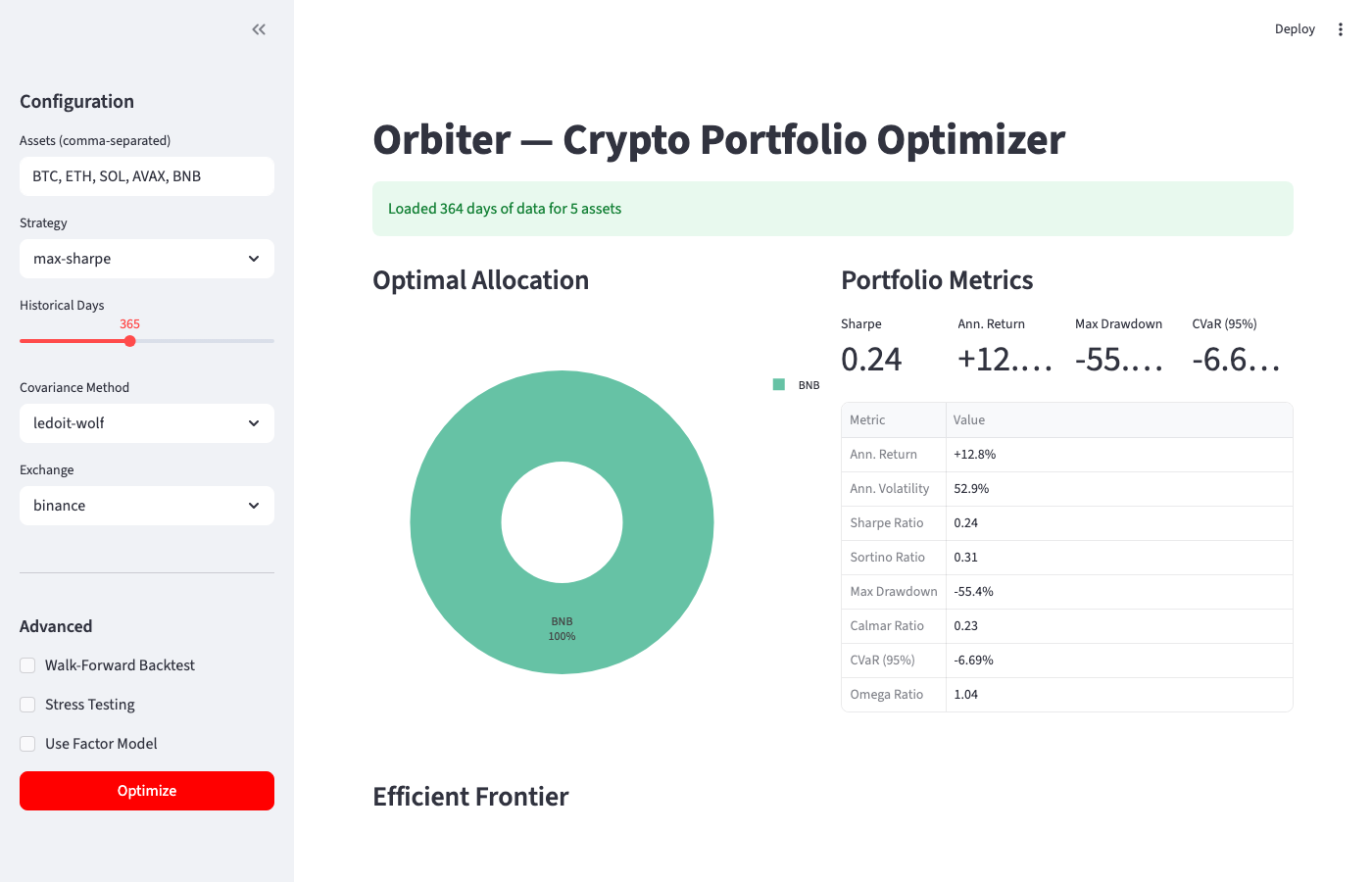
The dashboard provides:
- Sidebar configuration — pick assets, strategy, covariance method, exchange, lookback period
- Allocation pie chart — see how your portfolio is weighted
- Metrics overview — Sharpe, return, drawdown, CVaR at a glance
- Efficient frontier — interactive scatter plot showing the risk-return tradeoff
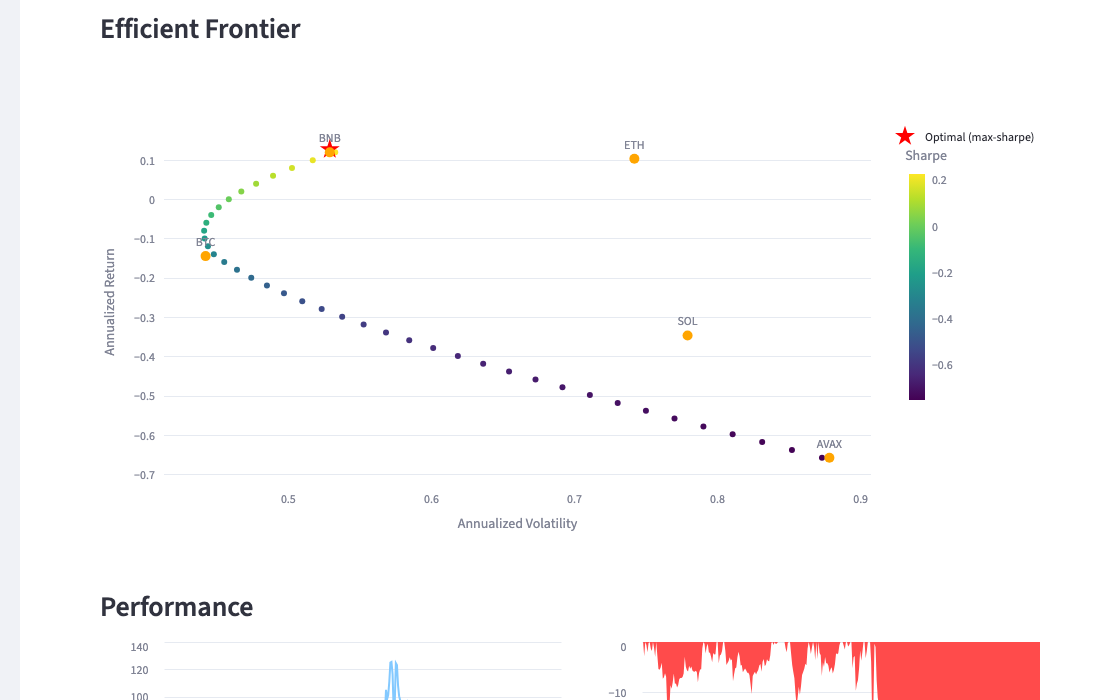
- Performance chart — cumulative returns vs equal-weight benchmark
- Drawdown chart — visualize peak-to-trough declines
- Correlation heatmap — understand how your assets move together
Toggle advanced features in the sidebar:
- Walk-Forward Backtest — out-of-sample validation with weight history
- Stress Testing — Monte Carlo VaR/CVaR + correlation stress
- Factor Model — factor loadings heatmap and R-squared per asset
| Strategy | Description | Best For |
|---|---|---|
max-sharpe |
Maximize risk-adjusted return (Sharpe ratio) | Aggressive growth |
min-vol |
Minimize portfolio volatility | Capital preservation |
min-cvar |
Minimize tail risk (Conditional Value-at-Risk) | Downside protection |
risk-parity |
Equal risk contribution from each asset | Balanced exposure |
hrp |
Hierarchical Risk Parity — correlation-based, no return estimates | Robust diversification |
regime-aware |
HMM detects bull/bear/sideways, auto-switches strategy | Adaptive allocation |
factor-max-sharpe |
Max Sharpe using factor-model implied returns | Data-driven views |
black-litterman |
Black-Litterman model with investor views (manual or AI-generated) | Subjective + quantitative |
sentiment-regime |
HMM + Fear & Greed, funding rates, exchange flows | Early regime detection |
yield-adjusted |
Max Sharpe with DeFi staking/lending yields factored in | Yield-aware allocation |
Every optimization returns 8 risk metrics:
| Metric | Description |
|---|---|
| Annualized Return | Geometric mean return, annualized to 365 days |
| Annualized Volatility | Standard deviation of returns, annualized |
| Sharpe Ratio | Return per unit of risk |
| Sortino Ratio | Return per unit of downside risk |
| Max Drawdown | Largest peak-to-trough decline |
| Calmar Ratio | Return divided by max drawdown |
| CVaR (95%) | Expected loss in the worst 5% of scenarios |
| Omega Ratio | Probability-weighted gains over losses |
| Method | Description |
|---|---|
ledoit-wolf |
Shrinkage estimator — default, most robust for small samples |
sample |
Standard sample covariance |
exponential |
Exponentially weighted — gives more weight to recent data |
Prevents overfitting by separating training and testing periods:
orbiter backtest BTC ETH SOL AVAX --strategy hrp --train-days 180 --test-days 30- Train on 180 days of data → find optimal weights
- Test those weights on the next 30 days (out-of-sample)
- Slide forward, repeat
- Report aggregated out-of-sample performance vs equal-weight benchmark
orbiter stress BTC ETH SOL AVAX --distribution student-t --horizon 30 --corr-stress 2.0- Monte Carlo simulation — 10,000 paths with normal or Student-t (fat-tailed) distributions
- VaR & CVaR — at 95% and 99% confidence levels
- Correlation stress — see how portfolio risk increases when correlations spike (as they do during crashes)
Hidden Markov Model identifies three market states:
| Regime | Characteristics | Strategy Used |
|---|---|---|
| Bull | Positive drift, moderate volatility | max-sharpe |
| Sideways | No clear direction, low volatility | risk-parity |
| Bear | Negative drift, high volatility | min-vol |
orbiter optimize BTC ETH SOL AVAX --strategy regime-awareCrypto-specific four-factor model:
- Market — overall market return (equal or cap-weighted)
- Momentum — long recent winners, short recent losers
- Size — small-cap minus large-cap returns
- Liquidity — high-volume minus low-volume returns
orbiter optimize BTC ETH SOL AVAX --strategy factor-max-sharpe --use-factorsCombine market equilibrium with your own views — or let AI generate them:
from orbiter import BlackLitterman, View, get_ai
from orbiter.prompts import MARKET_VIEWS_SYSTEM, market_views_prompt
from orbiter.black_litterman import parse_ai_views

# Manual views
views = [
    View(asset="SOL", return_view=0.30, confidence=0.7),
    View(asset=("ETH", "BTC"), return_view=0.05, confidence=0.6),
]
bl = BlackLitterman(returns)
result = bl.optimize(views)

# Or generate views with AI (Claude, OpenAI, or Perplexity)
ai = get_ai("claude")  # reads ANTHROPIC_API_KEY from env
response = ai.generate(MARKET_VIEWS_SYSTEM, market_views_prompt(...))
views = parse_ai_views(response, assets=["BTC", "ETH", "SOL"])
result = bl.optimize(views)
Supports three AI providers with a single middleware:
| Provider | Model | Env Variable |
|---|---|---|
| Claude | claude-sonnet-4-20250514 |
ANTHROPIC_API_KEY |
| OpenAI | gpt-4o |
OPENAI_API_KEY |
| Perplexity | sonar-pro |
PERPLEXITY_API_KEY |
pip install orbiter-crypto[ai] # installs anthropic + openai SDKsGoes beyond price-only HMM by fusing multiple sentiment signals:
- Fear & Greed Index — free API, updated daily
- Funding rates — crowded leverage detection from perpetual futures
- Exchange net flows — coins moving to exchanges = selling pressure
from orbiter import SentimentCollector
from orbiter.regime import SentimentRegimeModel

collector = SentimentCollector(exchange="binance")
sentiment = collector.collect(["BTC", "ETH", "SOL"])

model = SentimentRegimeModel(n_regimes=3)
model.fit(market_returns, sentiment_features_df)
regime = model.current_regime(market_returns, sentiment_features_df)Staking ETH at 3.5% APY changes the efficient frontier. Orbiter accounts for this:
from orbiter import YieldCollector
from orbiter.defi import adjust_expected_returns

yields = YieldCollector().collect(["ETH", "SOL", "ATOM"])
adjusted_mu = adjust_expected_returns(daily_returns.mean(), yields)- Pulls live yields from DeFiLlama (7000+ protocols)
- Falls back to conservative manual estimates if API is down
- Includes yield reliability scoring (higher APY = more smart contract risk)
Built-in fee and slippage models for realistic simulations:
- Maker/taker exchange fees
- Bid-ask spread costs
- Almgren-Chriss square-root market impact model
Three rebalancing triggers:
| Trigger | Description |
|---|---|
calendar |
Rebalance every N days |
threshold |
Rebalance when any weight drifts beyond a threshold |
hybrid |
Threshold check on a calendar schedule |
orbiter discover --top 20 --min-mcap 1000000000Fetches top coins from CoinGecko by market cap, with price and volume data.
from orbiter import PriceLoader, PortfolioOptimizer

loader = PriceLoader(exchange="binance")
returns = loader.get_returns(["BTC", "ETH", "SOL", "AVAX"], days=365)

optimizer = PortfolioOptimizer(returns, cov_method="ledoit-wolf")
result = optimizer.optimize("max-sharpe")

print(result.weights)
print(result.metrics)frontier = optimizer.efficient_frontier(n_points=50)
# DataFrame with columns: return, volatility, sharpe, BTC, ETH, SOL, AVAXfrom orbiter.backtest import WalkForwardBacktest
bt = WalkForwardBacktest(returns, train_days=180, test_days=30, strategy="hrp")
result = bt.run()
print(result.metrics) # Out-of-sample performance
print(result.weights_history) # Weights at each rebalancefrom orbiter.stress import monte_carlo_stress, correlation_stress
# Monte Carlo with fat tails
mc = monte_carlo_stress(
weights=result.weights.values,
mu=returns.mean().values,
cov=returns.cov().values,
distribution="student-t",
df=5.0,
horizon_days=30,
)
print(mc["cvar_95"], mc["var_99"])
# Correlation stress
cs = correlation_stress(weights, cov_matrix, stress_factor=2.0)
print(cs["stressed_volatility"])from orbiter.factors import CryptoFactorModel
model = CryptoFactorModel(returns)
exposures = model.fit()
print(exposures.loadings) # Factor betas per asset
print(exposures.r_squared) # Model fit per asset
print(model.expected_returns()) # Factor-implied expected returnsfrom orbiter.regime import RegimeModel
model = RegimeModel(n_regimes=3)
model.fit(returns["BTC"])
regime = model.current_regime(returns["BTC"])
print(regime) # Regime.BULL, Regime.SIDEWAYS, or Regime.BEAR
print(model.get_strategy(regime))from orbiter.rebalance import simulate_rebalancing, RebalanceConfig, RebalanceTrigger
from orbiter.costs import FeeSchedule
config = RebalanceConfig(
trigger=RebalanceTrigger.THRESHOLD,
drift_threshold=0.05,
fee_schedule=FeeSchedule(maker=0.001, taker=0.001),
)
result = simulate_rebalancing(returns, target_weights, config)
print(result.total_turnover)
print(result.total_cost)
print(result.metrics)| Source | Data | API Key |
|---|---|---|
| Binance (via ccxt) | OHLCV price data | Not required |
| Any ccxt exchange | OHLCV price data | Not required |
| CoinGecko | Market caps, coin discovery | Not required (free tier) |
| Blockchain.com | BTC active addresses, NVT ratio | Not required |
Change the exchange:
orbiter optimize BTC ETH SOL --exchange kraken
orbiter optimize BTC ETH SOL --exchange bybit| Command | Description |
|---|---|
orbiter optimize SYMBOLS... |
Optimize portfolio allocation |
orbiter backtest SYMBOLS... |
Walk-forward backtest |
orbiter stress SYMBOLS... |
Monte Carlo + correlation stress test |
orbiter discover |
List top coins by market cap |
orbiter dashboard |
Launch Streamlit dashboard |
Run orbiter COMMAND --help for full options.
src/orbiter/
├── data.py            # Price fetching via ccxt
├── data_sources.py    # CoinGecko, on-chain metrics
├── metrics.py         # Risk & performance metrics
├── covariance.py      # Covariance estimation (sample, Ledoit-Wolf, exponential)
├── optimize.py        # 10 optimization strategies + efficient frontier
├── backtest.py        # Walk-forward backtesting engine
├── costs.py           # Transaction cost & slippage modeling
├── rebalance.py       # Rebalancing simulation (calendar/threshold/hybrid)
├── regime.py          # HMM regime detection + sentiment-enhanced regime
├── stress.py          # Monte Carlo & correlation stress testing
├── factors.py         # Crypto factor model (market, momentum, size, liquidity)
├── black_litterman.py # Black-Litterman model with AI-generated views
├── ai.py              # AI middleware (Claude, OpenAI, Perplexity adapters)
├── prompts.py         # Prompt templates for AI-powered analysis
├── sentiment.py       # Fear & Greed, funding rates, exchange flows
├── defi.py            # DeFi yield data from DeFiLlama
├── cli.py             # Click CLI
└── dashboard.py       # Streamlit interactive dashboard
MIT + Commons Clause — Free to use in open-source projects, personal use, education, and internal business workflows. You cannot sell this software or repackage it as a paid product. See LICENSE for full terms.

