A trivial method for testing primality of an integer n is to try dividing n by all numbers between 2 and √n. While naive, this process should scale well in a parallel context.
Develop a program Factor, that takes 2 arguments:
$java Factor p nLet n be a BigInteger type so it can run on large numbers. The program analyzes n and either print out “prime” or a space-separated list of the prime factors of n all on one line (in any order).
It uses p threads to speed up this process as much as possible.
Time the useful part of your code, ignoring I/O costs as much as possible. On a multiprocessor machine, find a value n that takes at least a minute to run, and then increase p until the speedup curve peaks. Show a graph of the resulting speedup in relation to number of threads, and briefly explain why you get the results you do.
The number space is split latterally. Basically it will test every multiple of its (id + 2) (so we avoid zero and 1). Here is an example of number attribution per thread for p=4 and n=64. Notice it only goes up to 8 because 2^(bitlenght(64)/2) = 8.
| #0 | #1 | #2 | #3 |
|---|---|---|---|
| 2 | 3 | 4 | 5 |
| 6 | 7 | 8 |
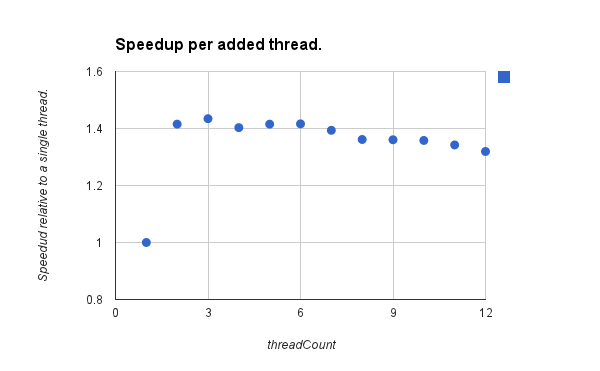
We can see that the speedup peaks around 2 (the number of cores in my computer), but also at 3. This is due to the CPU cache, for thez always try to find the factors of the same number.