Home
- What is Crowd Task Manager?
- Current goals and how Crowd Task Manager achieves them
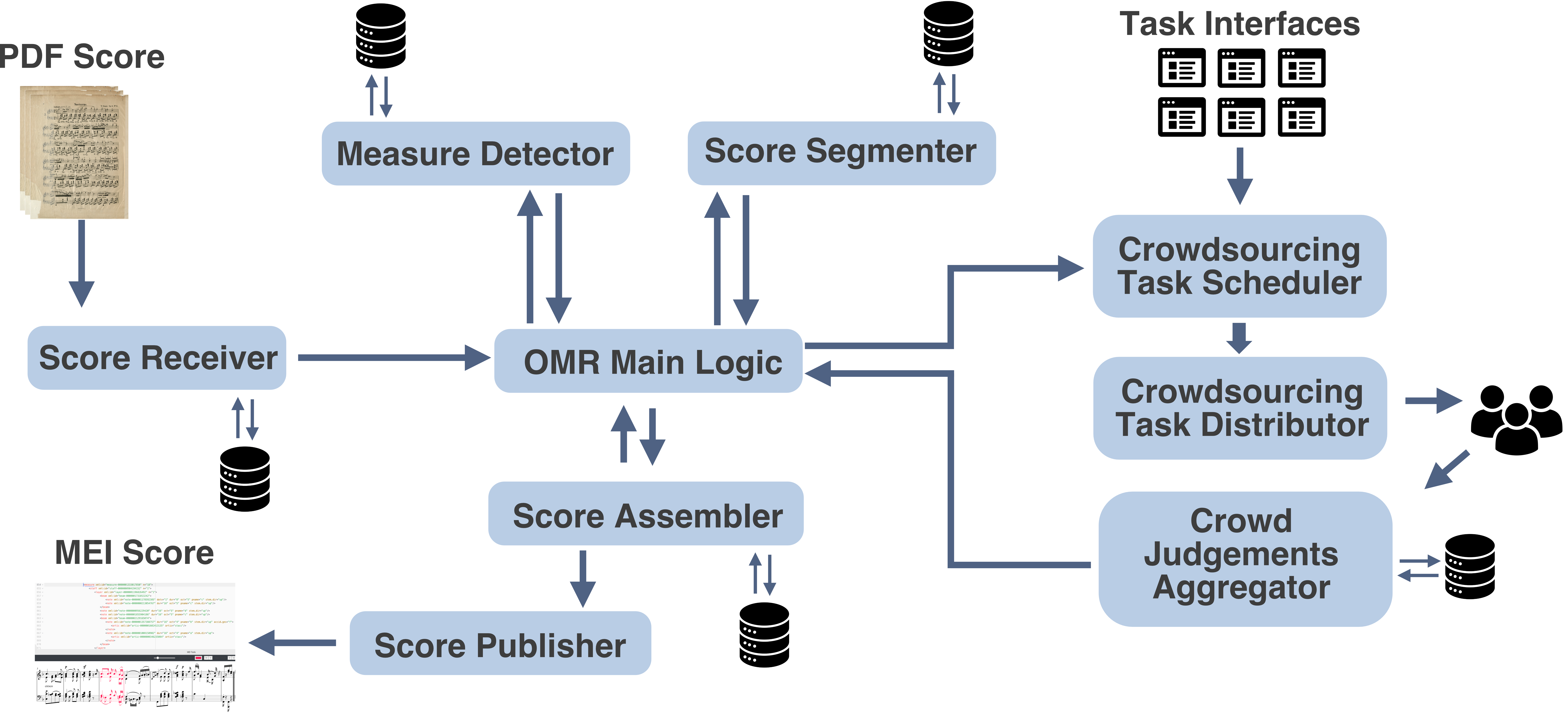
- Current Architecture
The Crowd Task Manager is a crowdsourcing back-end system which processes input data and distributes them to crowdsourcing tasks. These tasks have their own URLs and can be hosted in a crowdsourcing platform of your choice. The system in its current form, is optimized for an Optical Music Recognition (OMR) crowdsourcing pipeline. The system has been developed within TROMPA, an EU project for classical music heritage preservation.
Optical Music Recognition is a process similar to Optical Character Recognition (OCR) but for music scores. Scanned music scores need to be transformed to a machine readable format, so they can be easily manipulated and annotated by users or developers. A scientific publication for more information.
Automated methods for MEI transcription are currently sub-optimal with high error rate. To tackle this problem, we suggest the creation of tasks that will split and share OMR processes to a crowd and based on their judgements we generate or improve digital music scores. Crowd Task Manager is a system which identifies data that need to be processed by the crowd, associates them with crowdsourcing task profiles and pushes the tasks to an online platform. The data to be annotated alongside the platform to publish the tasks, are all hosted by a partner in TROMPA, VideoDock. As a result the system is able to interact with their API, which can be found here.
- Segmentation of an input PDF file of a music score, on a measure level
- Creation of an MEI file which contains information of regions of segments per page, alongside their corresponding measure headers
- Creation of crowdsourcing tasks to transcribe the segments of the music score into MEI format
- Separation of crowdsourcing tasks into Transcription and Validation tasks
- Aggregation of results from the crowdsourcing tasks, which will dictate the content under each measure header in the MEI
- Rebuilding a semantically correct MEI version of the input music score (follow correct order of measures, valid MEI format etc)
- Pushing MEI versions of input music scores on Github.