You signed in with another tab or window. Reload to refresh your session.You signed out in another tab or window. Reload to refresh your session.You switched accounts on another tab or window. Reload to refresh your session.Dismiss alert
Walter R. Fisher / 1989 / University of South Carolina Press
这是传播学当中的叙事范式
Walter Fisher
American psychologist
Description
Walter Fisher was an American academic credited with formalizing Kenneth Burke's Dramatism and introducing the narrative paradigm to communication theory. Fisher was Professor Emeritus at the Annenberg School for Communication. Wikipedia
Walter R. Fisher, professor emeritus of communication and former director of the School of Communication, died on July 26 2018 at the age of 87. An esteemed teacher and mentor to generations of USC Annenberg students for more than 40 years, Fisher was a prolific scholar best known for his groundbreaking research on the “Narrative Paradigm.” https://annenberg.usc.edu/news/faculty/memoriam-walter-r-fisher-87
Rational-world Paradigm
Fisher lists five assumptions of the prevailing rational-world paradigm. See if they match what you’ve been taught all along in school.
People are essentially rational.
We make decisions on the basis of arguments.
The type of speaking situation (legal, scientific, legislative) determines the course of our argument.
Rationality is determined by how much we know and how well we argue.
The world is a set of logical puzzles that we can solve through rational analysis.
A First Look at Communication Theory
Em Griffin Andrew M. Ledbetter Glenn G. Sparks / 2018 / McGraw-Hill Education
Narrative Paradigm
Fisher is convinced that the assumptions of the rational-world paradigm are too limited. He calls for a new conceptual framework (a paradigm shift) in order to better understand human communication. His narrative paradigm is built on five assumptions similar in form to the rational-world paradigm, but quite different in content.12
People are essentially storytellers.
We make decisions on the basis of good reasons, which vary depending on the communication situation, media, and genre (philosophical, technical, rhetorical, or artistic).
History, biography, culture, and character determine what we consider good reasons.
Narrative rationality is determined by the coherence and fidelity of our stories.
The world is a set of stories from which we choose, and thus constantly re-create, our lives.
Narrative coherence Internal consistency with characters acting in a re- liable fashion; the story hangs together.
Narrative fidelity Congruence between values embedded in a message and what listeners regard as truthful and humane; the story strikes a responsive chord.
The heuristic-systematic model of information processing (HSM) is a widely recognized model by Shelly Chaiken that attempts to explain how people receive and process persuasive messages.[1] The model states that individuals can process messages in one of two ways: heuristically or systematically. Whereas systematic processing entails careful and deliberative processing of a message, heuristic processing entails the use of simplifying decision rules or ‘heuristics’ to quickly assess the message content. The guiding belief with this model is that individuals are more apt to minimize their use of cognitive resources (i.e., to rely on heuristics), thus affecting the intake and processing of messages.[2] HSM predicts that processing type will influence the extent to which a person is persuaded or exhibits lasting attitude change. HSM is quite similar to the elaboration likelihood model, or ELM. Both models were predominantly developed in the early to mid-1980s and share many of the same concepts and ideas.[3]
reacted with thumbs up emoji reacted with thumbs down emoji reacted with laugh emoji reacted with hooray emoji reacted with confused emoji reacted with heart emoji reacted with rocket emoji reacted with eyes emoji


Uh oh!
There was an error while loading. Please reload this page.
作为叙述的人类传播
Human Communication as Narration
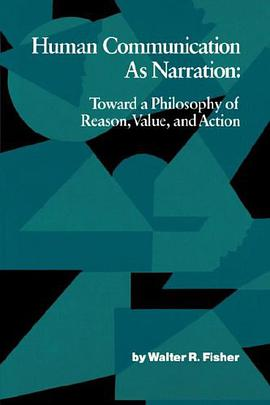
Walter R. Fisher / 1989 / University of South Carolina Press
这是传播学当中的叙事范式
Walter Fisher
American psychologist
Description
Walter Fisher was an American academic credited with formalizing Kenneth Burke's Dramatism and introducing the narrative paradigm to communication theory. Fisher was Professor Emeritus at the Annenberg School for Communication. Wikipedia
Walter R. Fisher, professor emeritus of communication and former director of the School of Communication, died on July 26 2018 at the age of 87. An esteemed teacher and mentor to generations of USC Annenberg students for more than 40 years, Fisher was a prolific scholar best known for his groundbreaking research on the “Narrative Paradigm.” https://annenberg.usc.edu/news/faculty/memoriam-walter-r-fisher-87
Rational-world Paradigm
Fisher lists five assumptions of the prevailing rational-world paradigm. See if they match what you’ve been taught all along in school.
A First Look at Communication Theory
Em Griffin Andrew M. Ledbetter Glenn G. Sparks / 2018 / McGraw-Hill Education
Narrative Paradigm
Fisher is convinced that the assumptions of the rational-world paradigm are too limited. He calls for a new conceptual framework (a paradigm shift) in order to better understand human communication. His narrative paradigm is built on five assumptions similar in form to the rational-world paradigm, but quite different in content.12
People are essentially storytellers.
Strong Experiences with Music
Gabrielsson, Alf / 2011
https://en.wikipedia.org/wiki/Heuristic-systematic_model_of_information_processing
The heuristic-systematic model of information processing (HSM) is a widely recognized model by Shelly Chaiken that attempts to explain how people receive and process persuasive messages.[1] The model states that individuals can process messages in one of two ways: heuristically or systematically. Whereas systematic processing entails careful and deliberative processing of a message, heuristic processing entails the use of simplifying decision rules or ‘heuristics’ to quickly assess the message content. The guiding belief with this model is that individuals are more apt to minimize their use of cognitive resources (i.e., to rely on heuristics), thus affecting the intake and processing of messages.[2] HSM predicts that processing type will influence the extent to which a person is persuaded or exhibits lasting attitude change. HSM is quite similar to the elaboration likelihood model, or ELM. Both models were predominantly developed in the early to mid-1980s and share many of the same concepts and ideas.[3]
Journal of Communication
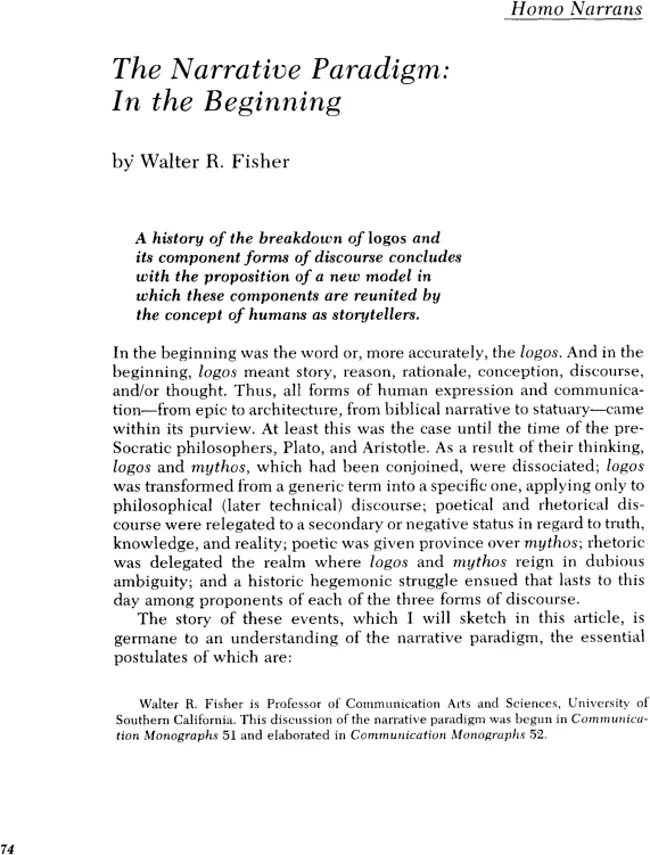
The Narrative Paradigm: In the Beginning
Walter R. FisherFirst published: December 1985 https://doi.org/10.1111/j.1460-2466.1985.tb02974.x
All reactions