"...the Champagne of the North" - Neopolean's Troops in 1809
(from Brewing with Wheat, p150-154)
What we today call "Berliner Weiss" evolved from several different brewing practices and variations.
It is widely believed that the term "weiss", meaning white, was used in the past to distinguish pale wheat beer from its darker contemporaries.
The earliest reference to the beer is from a special tax was established on Berlin's weissbier in 1680. But nothing indicates that Berlin's wheat beer was any different from any other "white" beer in the region at the time, and there's no mention of the sour, lactic flavors we associate with the style today.
When sourness was associated with the style, it wasn't always considered desirable. In 1765, at least some brewers were trying to find a way to make a white beer that would not turn sour.
It seems the beer was always kept as light as possible, using air-dried or lightly kilned malts and little or no boiling of the wort.
Until the 1860s, smoked wheat malt was used to brew Berliner weiss, until one brewer experimented with an unsmoked version that was received so well that other brewers quickly followed.
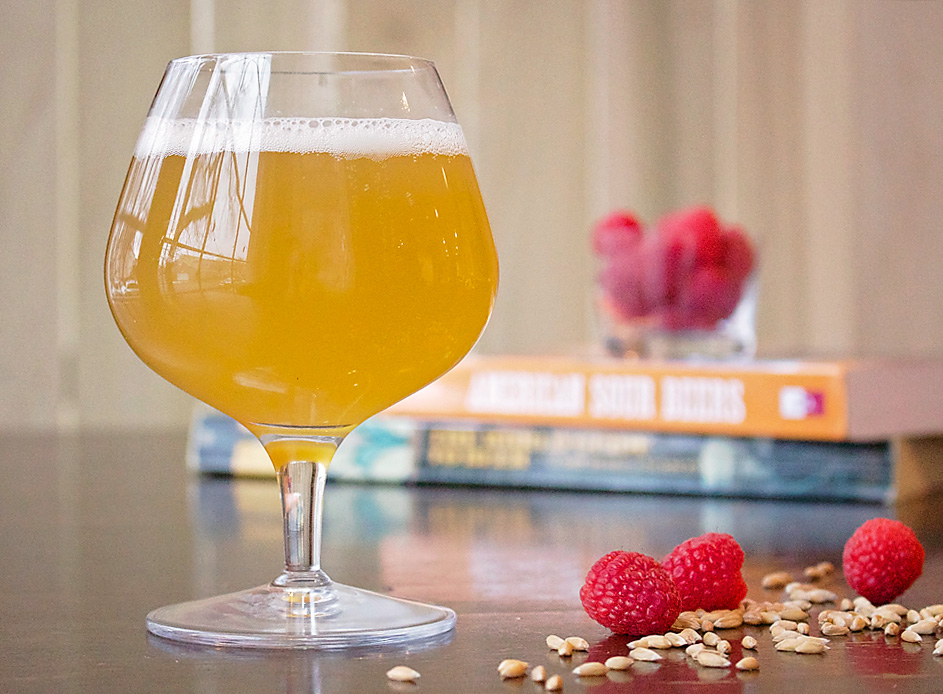
Traditionally the beer was consumed after sweetening in the glass with caraway liqueur. Today the beer is traditionally consumed instead with a dash of rasberry or woodruff syrup.
Aroma
- Sharply sour
- Up to moderately fruity, lemon or tart apple
- No hop aroma
- Uncooked bread dough or sourdough-like aroma from wheat
Appearance
- Pale straw color
- Clear to hazy
- Large, dense, white head with poor retention
Flavor
- Clean, lactic sourness, can be quite strong
- Light, bread dough or grainy malt flavor
- No hop flavor or bitterness
- Should have some malt flavor, but dominated by sourness
- Very dry finish
- May have a restrained funk from Brettanomyces
Mouthfeel
- Light body
- High carbonation
- No alchohol sensation
- Crisp, juicy acidity
| Name | Range |
|---|---|
| IBUs | 3-8 |
| SRM | 2-3 |
| OG | 1.028-1.032 |
| FG | 1.003-1.006 |
| ABV | 2.8-3.8% |
Highly carbonated, 2.9-4 CO2 volumes
- Malt bill consists of wheat and pilsner malts
- Use a high percentage of wheat, from 40-70%
- If decoction mashing, traditional German malts are recommended (Avangard recommends decoction mashing with their wheat malt, for example)
- Use a low amount of any German hop
- Can be added to mash (particulary useful to add to decocted portion of mash that will be boiled, if decoction mashing)
- Can also be first wort hopped and/or added for the full length of the boil
- Keep the hopping low! (most strains of Lactobacillus are inhibited by hop compounds)
For Madison's hard water, you will probably want to lower the mash pH in some way for this very light beer. This is one beer where the sour flavors added from using acidulated malt to lower mash pH are welcome!
Start with about 5% acidulated malt.
- Triple decoction mash is traditional
- Can use a single decoction or even infusion to save time
- Example mash schedule
- Mash in at protein rest temperature (122-132 ˚F) for 10-30 min
- Decoction
- Pull thick decoction
- Raise to 150 ˚F and hold for 5-10 min for saccharification
- Raise to boiling and hold for 5 min (keep the boil short to avoid color development)
- Add decoction back to main mash to raise mash temp to 148-152 ˚F for 30-60 min
- Some mash schedules also call for an additional rest at 162-166 ˚F for 30 min
- Raise mash to 168-170 ˚F to mash out
- Traditionally beer is not boiled, but sent directly from the mash tun into the coolship
- Modern santitation practices recommend bringing the wort up to near a boil, then chilling to fermentation temperature
- Some brewers boil for 5-30 min, to ensure sanitation
You need to get Lactobacillus from somewhere. You can:
- Pitch a commercial Lactobacillus culture
- Cultivate it yourself: Lacto grows on lots of things, including malt!
You need to introduce lacto into the wort. You can:
- Sour the mash
- Mash normally, until mash out
- Instead of mashing out, let mash cool to ~100 ˚F and add 0.5 lb of uncrushed 2 Row malt
- Hold at 100-105 ˚F for 1-3 days
- Beware of dropping below 100 ˚F, into the range where bacteria is more likely to grow
- Sample every 8-12 hours
- Once the wort is "sour enough", lauter the wort into the kettle
- Boiling (or bringing wort to near boiling temperature) will kill Lactobacillus (and anything else) and lock in the sour profile
- Sour the wort in the kettle
- Same as above, but lauter the wort into the kettle first, and conduct souring in the kettle
- Pitch Lactobacillus in the fermentor by itself before the yeast
- This allows using an established Lactobacillus culture
- If possible, conduct intial fermentation at 85-105 ˚F to encourage Lacto culture
- Sample every 8-12 hours
- Once the wort is "sour enough", lower the fermentation temperature to 69-75 ˚F and pitch brewing yeast as normal
- Don't wait too long to pitch the yeast (no more than about 3 days), as it may not be very happy once the pH drops significantly
- This is my favorite method, because it allows control over the sourness, souring relatively quickly, and yet keeps the Lactobacillus alive to develop more complexity if beer is aged
- Pitch Lacctobacillus in the fermentor with the yeast
- Typically need about 5:1 ratio of Lacto to yeast to get the right of sourness
- Pitch at high 60s or low-to-mid 70s (higher is better for Lacto)
- Could take a long time for beer to develop adequate sourness
You could also try a 100% Lactobacillus beer, if you have a strong enough culture.
- Can be made with malt/malt extract or with apple juice
- Keep the starter warm, 100-105 ˚F for the most growth
- Lactobacillus does not need oxygen like brewing yeast does, so you skip the stir plate
- A yogurt maker is a great tool for cultivating a lacto starter, if you have one, since it's made to hold the temperature at ~100 ˚F
- Note that Lactobacillus doesn't floculate like yeast to the bottom... pitch the whole starter
- German brewing scientists believe that Brettanomyces is essential to get the correct flavor profile, but this character is never strong
- Some commercial yeast/lacto blends include Brett
- This flavor will become more promenant the longer the beer ages
Berliner-Kindl-Schultheiss in Germany
(Brewing with Wheat p 155-156)
- 25% wheat malt (though morebeer.com says 50%)
- Mash starts 125 °F (52 °C) and heated up to 162 °F (72 °C) over the course of two-and-a-half hours in an infusion mash
- Split the wort into halves
- One half is not boiled, not hopped, and infused with Lactobacillus (80 liters for 800 hectoliters) for primary fermentation
- The other half is boiled with the tiniest portion of hops and primary fermentation done with Saccharomyces (brewing yeast)
- Primary fermentation for 1 week, starting at 59 ˚F and rising to 77 ˚F
- Both halves are combined and cold condition for secondary fermentation
Nodding Head Brewery
(Brewing with Wheat p 166-168)
- 40% wheat malt
- Single infusion mash
- Boils wort for 10 min
- Pitches a blend of yeast and Lactobacillus
- Primary fermentation for 2-3 days, conditioning for 5-6 weeks
White Labs
Standard cultures
- WLP672 Lactobacillus brevis
- Typically produces more lactic acid than Lactobacillus delbrueckii, this is the culture traditionally found in Berliner weiss
- WLP677 Lactobacillus delbrueckii Bacteria
- WLP630 Berliner Weisse Blend
- Blend of yeast and Lactobacillus
Yeast vault cultures
(https://www.whitelabs.com/yeast-vault#wlp669-lactobacillus-paracollinoides)
- WLP669 Lactobacillus paracollinoides
- WLP673 Lactobacillus buchneri
- WLP678 Lactobacillus hilgardii
- WLP692 Debaryomyces hansenii
- WLP693 Lactobacillus plantarum
White Labs Wild Yeast & Bacteria Experiements (PDF)
White Labs Wild Yeast & Bacteria General Instructions (PDF)
Wyeast Labs
Omega Yeast Labs
- Blend of brevis and plantarum
- Works over a wider temperature range
- Extremely sensitive to hops (max of of 1 IBU)
Berliner Weisse - Berliner Weisse (17A)
| Name | Range |
|---|---|
| Batch Size | 5.25 gal |
| Boil Size | 5.375 gal |
| Boil Time | 0.000 s |
| Efficiency | 75% |
| OG | 1.030 sg |
| FG | 1.006 sg |
| ABV | 3.1% |
| Bitterness | 0.0 IBU (Tinseth) |
| Color | 2.5 srm (Morey) |
Fermentables
| Name | Type | Amount | Mashed | Late | Yield | Color |
|---|---|---|---|---|---|---|
| Pilsen Malt (Briess) | Grain | 3.000 lb | Yes | No | 74% | 1.2 srm |
| Wheat Malt, White (Briess) | Grain | 3.000 lb | Yes | No | 81% | 2.5 srm |
| Acidulated Malt (Best) | Grain | 4.000 oz | Yes | No | 78% | 2.0 srm |
| Rice Hulls | Adjunct | 8.000 oz | Yes | No | 0% | 0.0 srm |
Total grain: 6.250 lb
Hops
| Name | Alpha | Amount | Use | Time | Form | IBU |
|---|---|---|---|---|---|---|
| Saaz, Leaf (Czech) | 3.0% | 0.500 oz | Mash | 30.000 min | Leaf | 0.0 |
Yeast
| Name | Type | Form | Amount | Stage |
|---|---|---|---|---|
| Omega - Lactobacillus Blend | Ale | Liquid | 8.00 tbsp | Primary |
| WLP001 - California Ale Yeast | Ale | Liquid | 8.00 tbsp | Primary |
Mash
| Name | Type | Amount | Temp | Target | Time |
|---|---|---|---|---|---|
| Protein Rest | Infusion | 3.125 gal | 133.839 F | 122.000 F | 20 min |
| Single Decoction | Decoction | 1.243 gal | --- | 148.000 F | 1 hr |
| Mash Out | Temperature | --- | --- | 168.000 F | 10 min |
| Batch Sparge | Infusion | 1.593 gal | 168.000 F | 168.000 F | 5 min |
| Batch Sparge 2 | Infusion | 1.593 gal | 168.000 F | 168.000 F | 5 min |
Lacto Fermentation and recipes
http://www.themadfermentationist.com/2008/02/berliner-weiss.html
http://www.themadfermentationist.com/2009/07/cabernet-berliner-weiss.html
http://www.themadfermentationist.com/2010/05/double-berliner-weisse-brew.html
http://www.themadfermentationist.com/2014/09/lemon-berliner-weisse-recipe.html
http://www.themadfermentationist.com/2012/06/100-lactobacillus-berliner-weisse.html
https://www.morebeer.com/articles/berliner_weisse
http://www.homebrewtalk.com/showthread.php?t=95539
http://www.beetsandbones.com/berliner-style-weisse-beer-recipe/
Sour Mashing
http://www.homebrewtalk.com/Sour-Mashing-My-Berliner-Weisse.html
http://www.thepourreport.com/berliner-weisse-recipe-and-brewday/
http://anarchylane.com/blog/?p=1442
Brewing with Wheat by Stan Hieronymus
p 149-155, 166-168, 174-176