




The pipeline language for AI, data, and automation — with auto-tracing built in.
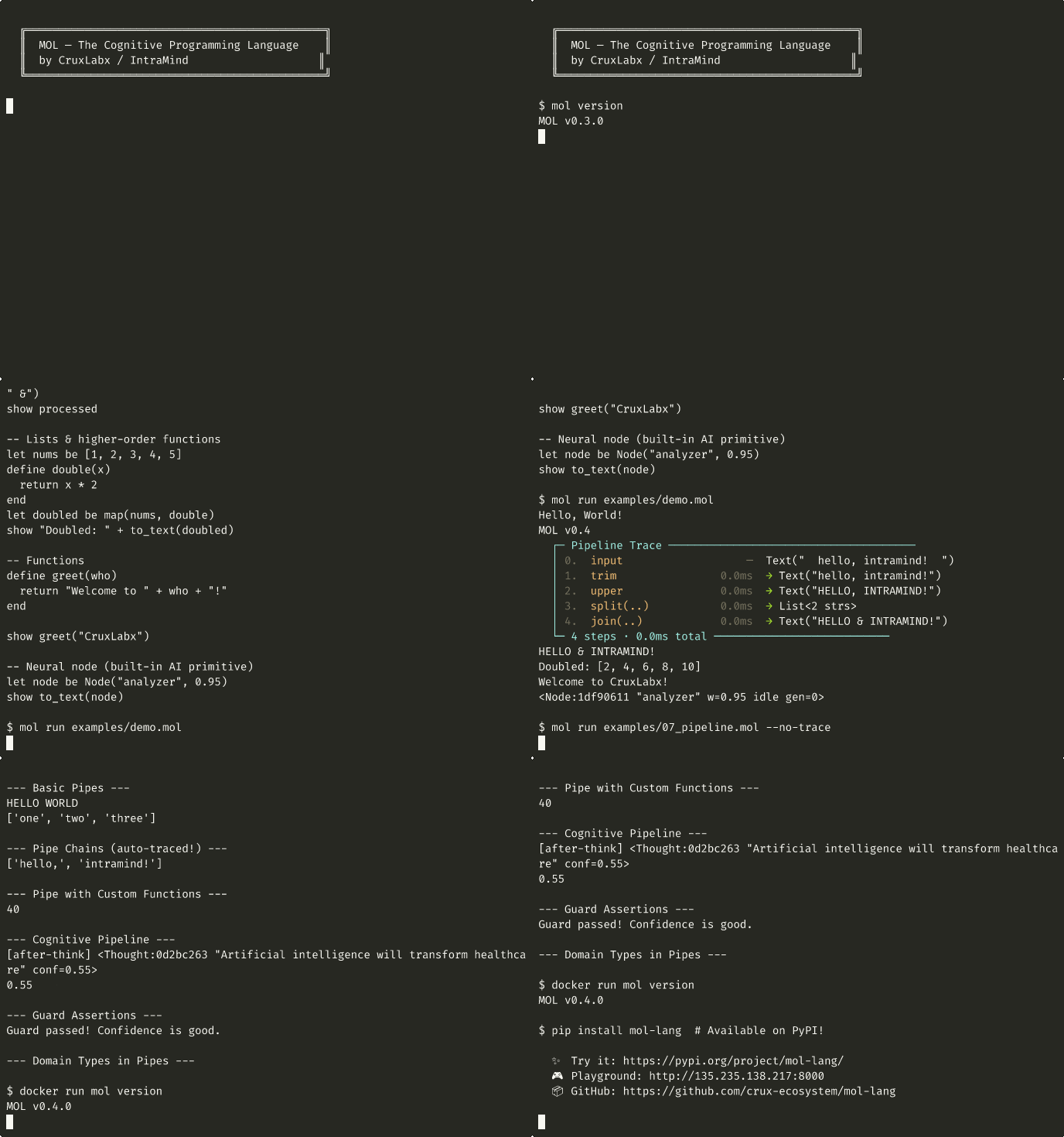
Every AI pipeline today is glue code — Python scripts stitching together LangChain, LlamaIndex, vector DBs, and LLMs with no visibility into what happens between steps. MOL fixes this.
| Problem | How Python/JS Handle It | How MOL Handles It |
|---|---|---|
| Pipeline Debugging | Add print() everywhere, use logging libs |
Auto-tracing built into |> — every step timed & typed automatically |
| Data Flow Visibility | No native pipe operator | |> operator — data flows left-to-right, traced at every stage |
| Type Safety for AI | Generic dicts, no domain types | First-class types: Thought, Memory, Node, Document, Chunk, Embedding |
| RAG Boilerplate | 50+ lines of setup code | One expression: doc |> chunk(512) |> embed |> store("index") |
| Safety Rails | Hope for the best | guard assertions + access control at the language level |
| Portability | Rewrite in each language | Transpiles to Python and JavaScript from single .mol source |
No other language has this combination:
| Language | Pipe Operator | Auto-Tracing | AI Domain Types | RAG Built-in |
|---|---|---|---|---|
| Python | No | No | No | No |
| Elixir | |> |
No | No | No |
| F# | |> |
No | No | No |
| Rust | No | No | No | No |
| MOL | |> |
Yes | Yes | Yes |
MOL is purpose-built for domains where pipeline visibility and readable code directly reduce debugging time and onboarding cost.
Every RAG pipeline is invisible glue code. MOL makes every stage visible — automatically.
let index be doc |> chunk(512) |> embed("model-v1") |> store("kb")
let answer be retrieve(query, "kb", 5) |> think("answer this")
guard answer.confidence > 0.5 : "Low confidence"
Auto-trace output — zero configuration, every step timed:
  ┌─ Pipeline Trace ──────────────────────────────────────
  │ 0.  input                   ─  <Document "data.txt">
  │ 1.  chunk(512)          0.1ms  → List<5 Chunks>
  │ 2.  embed("model-v1")   0.2ms  → List<5 Embeddings>
  │ 3.  store("kb")         0.0ms  → <VectorStore "kb">
  └─ 3 steps · 0.4ms total ───────────────────────────
Smart higher-order functions eliminate boilerplate. Filter, transform, and aggregate with one-liner pipes.
let sales be load_data("sales.json")

-- Top performers: filter → sort → extract
let top_reps be sales |>
  filter("closed") |>
  where(fn(s) -> s["amount"] > 15000) |>
  sort_by("amount") |>
  pluck("rep")

-- Revenue summary
let total be sales |> filter("closed") |> pluck("amount") |> sum_list
let avg be sales |> pluck("amount") |> mean
Log analysis, monitoring, SLA validation — with guard assertions and built-in statistics.
let logs be load_data("app.log")

let errors be logs |>
  where(fn(l) -> l["level"] == "ERROR") |>
  group_by("service")

let p95 be logs |> pluck("latency") |> percentile(95)
guard p95 < 1000 : "P95 latency exceeds SLA"
| Benefit | How |
|---|---|
| 60-80% less debugging time | Auto-tracing replaces manual print()/logging |
| Lower onboarding cost | Reads like English, not like Perl |
| Audit-ready pipelines | Every execution is traced and timed |
| Safe scripting | Sandboxed execution for production environments |
| No vendor lock-in | Transpiles to Python or JavaScript |
📖 See full examples: Use Cases Documentation
MOL v2.0 introduces 5 major systems that transform MOL from a scripting language into kernel-grade infrastructure for Neural Kernel and De-RAG / Sovereign Memory.
| Feature | What It Does | Functions Added |
|---|---|---|
| 🛡️ Memory Safety | Rust-inspired borrow checker with own, borrow, transfer, release, lifetime |
6 new AST constructs |
| 📐 Native Vectors | First-class Vector type with SIMD-like ops, ANN search, quantization |
25 functions (vec_*) |
| 🔐 Integrated Encryption | Homomorphic encryption (Paillier), symmetric crypto, zero-knowledge proofs | 15 functions (he_*, sym_*, zk_*) |
| ⚡ JIT Tracing | Self-optimizing hot-path detection, type specialization, inline caching | 7 functions (jit_*) |
| 🌐 Swarm Runtime | Multi-node distributed execution, consistent hashing, MapReduce | 12 functions (swarm_*) |
Total: 210 stdlib functions (up from 162 in v1.1)
-- Declare owned variable (exclusive ownership)
let own buffer be [1, 2, 3, 4, 5]

-- Multiple immutable borrows are allowed
let ref reader1 be borrow buffer
let ref reader2 be borrow buffer

-- Transfer ownership (original becomes invalid)
transfer buffer to new_owner

-- Lifetime scopes auto-drop at end
lifetime request_scope do
    let own temp be "scoped resource"
end
-- Create and operate on vectors as primitives
let a be vec(1.0, 0.0, 0.0)
let b be vec(0.0, 1.0, 0.0)
show vec_cosine(a, b)            -- 0.0
show vec_distance(a, b)          -- 1.414

-- Text to vector embedding + ANN search
let idx be vec_index("knowledge_base", 32)
vec_index_add(idx, vec_from_text("quantum computing", 32), "quantum")
vec_index_add(idx, vec_from_text("machine learning", 32), "ml")
let results be vec_index_search(idx, vec_from_text("deep learning", 32), 2)
-- Homomorphic encryption: add encrypted values without decrypting
let keys be crypto_keygen(512)
let enc_a be he_encrypt(42, keys)
let enc_b be he_encrypt(18, keys)
let enc_sum be he_add(enc_a, enc_b)
show he_decrypt(enc_sum, keys)   -- 60 (computed on ciphertext!)

-- Zero-knowledge proofs
let commitment be zk_commit("secret")
show zk_verify("secret", commitment["commitment"], commitment["blinding"])
-- JIT automatically traces and optimizes hot functions
define fibonacci(n)
    let a be 0
    let b be 1
    let i be 0
    while i < n do
        let temp be b
        set b to a + b
        set a to temp
        set i to i + 1
    end
    return a
end

-- After 50+ calls, JIT specializes for int fast-paths
show jit_stats()
show jit_hot_paths()
-- Initialize a 5-node simulated cluster
let cluster be swarm_init(5, 2)

-- Shard data across nodes via consistent hashing
let data be ["weight_1", "weight_2", "weight_3", "weight_4"]
swarm_shard(data, cluster, "hash")

-- MapReduce over the swarm
let mapped be swarm_map(cluster, fn(d) -> len(d))
let total be swarm_reduce(mapped, fn(acc, v) -> acc + v)

-- Dynamic scaling
swarm_add_node(cluster)
swarm_rebalance(cluster)
pip install mol-lang
mol version
⚠️ Gettingexternally-managed-environmenterror? (Python 3.12+ on Ubuntu/Debian/Fedora) Your OS blocks system-wide pip installs (PEP 668). Use one of these instead:
# Ubuntu/Debian
sudo apt install pipx && pipx ensurepath

# macOS
brew install pipx && pipx ensurepath

# Windows (PowerShell)
python -m pip install --user pipx && python -m pipx ensurepath

# Then install MOL:
pipx install mol-lang# Linux/macOS
python3 -m venv mol-env && source mol-env/bin/activate
# Windows (PowerShell)
python -m venv mol-env; mol-env\Scripts\Activate.ps1
pip install mol-langThen use anywhere:
mol run hello.mol
mol repl
mol version# Run a program
docker run --rm -v "$(pwd)":/app ghcr.io/crux-ecosystem/mol run /app/hello.mol
# Interactive REPL
docker run --rm -it ghcr.io/crux-ecosystem/mol repl
# Start the online playground
docker run --rm -p 8000:8000 ghcr.io/crux-ecosystem/mol playgroundImage size: ~144 MB (Python 3.12-slim based)
git clone https://github.com/crux-ecosystem/mol-lang.git
cd mol-lang
python3 -m venv .venv
source .venv/bin/activate
pip install -e .pipx install 'mol-lang[lsp]'
# or in a venv:
pip install mol-lang[lsp]Then install the VS Code extension from mol-vscode/ or copy it:
cp -r mol-vscode/ ~/.vscode/extensions/mol-language-0.5.0Try MOL directly in your browser: https://mol.cruxlabx.in
🔒 Sandbox Mode: The playground runs in a secure sandbox. File I/O, network requests, server binding, and concurrency primitives are disabled. Install MOL locally for full access to all 143 stdlib functions.
The MOL playground implements multiple layers of security:
| Protection | Details |
|---|---|
| Sandbox Mode | 26 dangerous functions blocked (file I/O, network, server, concurrency) |
| Execution Timeout | Code killed after 5 seconds to prevent infinite loops |
| Rate Limiting | 30 requests/minute per IP address |
| Code Size Limit | Maximum 10KB input code |
| Output Truncation | Output capped at 50K characters |
| Recursion Limit | Python recursion depth enforced |
| Loop Detection | Built-in infinite loop detector (1M iterations) |
| CORS Restricted | Only authorized origins allowed |
Check the security policy at: GET /api/security
To report security issues: open a GitHub issue or contact kaliyugiheart@gmail.com.
show "Hello from MOL!"
mol run hello.mol-- A full RAG ingestion pipeline in ONE expression
let doc be Document("notes.txt", "MOL is built for IntraMind pipelines.")
let index be doc |> chunk(30) |> embed |> store("my_index")
show index
Output:
  ┌─ Pipeline Trace ──────────────────────────────────────
  │ 0.  input                   ─  <Document:a3f2 "notes.txt" 39B>
  │ 1.  chunk(..)           0.1ms  → List<2 Chunks>
  │ 2.  embed               0.2ms  → List<2 Embeddings>
  │ 3.  store(..)           0.0ms  → <VectorStore:b7c1 "my_index" 2 vectors>
  └─ 3 steps · 0.3ms total ───────────────────────────
<VectorStore:b7c1 "my_index" 2 vectors>
Zero configuration. Every step timed, typed, and traced automatically.
-- Inferred type
let name be "IntraMind"
let count be 42

-- Explicit type annotation (mismatch = compile error)
let x : Number be 10
let msg : Text be "hello"
let flag : Bool be true

-- Reassignment
set count to count + 1
if score > 90 then
  show "excellent"
elif score > 70 then
  show "good"
else
  show "needs work"
end

while count < 10 do
  set count to count + 1
end

for item in range(5) do
  show to_text(item)
end
define greet(name)
  return "Hello, " + name + "!"
end

show greet("Mounesh")
-- This is a comment
show "code"  -- inline comment
The core of MOL. Data flows left → right through functions:
-- Single stage
"hello world" |> upper              -- "HELLO WORLD"

-- With arguments
"a,b,c" |> split(",")              -- ["a", "b", "c"]

-- Multi-stage chain (auto-traced when 3+ stages)
"  HELLO  " |> trim |> lower |> split(" ")

-- With custom functions
define double(x)
  return x * 2
end

5 |> double |> add_ten |> double    -- 40
Named, reusable pipelines:
pipeline preprocess(data)
  return data |> trim |> lower
end

let clean be "  RAW INPUT  " |> preprocess
show clean   -- "raw input"
Any pipe chain with 3+ stages automatically prints a trace:
  ┌─ Pipeline Trace ──────────────────────────────────────
  │ 0.  input                   ─  Text("  HELLO  ")
  │ 1.  trim                0.0ms  → Text("HELLO")
  │ 2.  lower               0.0ms  → Text("hello")
  │ 3.  split(..)           0.0ms  → List<1 strs>
  └─ 3 steps · 0.0ms total ───────────────────────────
Disable tracing with --no-trace:
mol run program.mol --no-trace| Type | Purpose | Constructor |
|---|---|---|
Thought |
Cognitive unit with confidence score | Thought("idea", 0.9) |
Memory |
Persistent key-value with decay | Memory("key", value) |
Node |
Neural graph vertex with weight | Node("label", 0.5) |
Stream |
Real-time data buffer | Stream("feed") |
| Type | Purpose | Constructor |
|---|---|---|
Document |
Text document with source metadata | Document("file.txt", "content...") |
Chunk |
Text fragment from a document | Chunk("text", 0, "source") |
Embedding |
Vector embedding (64-dim, deterministic) | Embedding("text", "model") |
VectorStore |
In-memory vector index with similarity search | Created via store() |
trigger "event_name"           -- Fire an event
listen "event_name" do ... end -- Listen for events
link nodeA to nodeB            -- Connect nodes
process node with 0.3          -- Activate & adjust
evolve node                    -- Next generation
access "mind_core"             -- Request resource (checked!)
sync stream                    -- Synchronize data
emit "data"                    -- Emit to stream
Inline safety checks that halt execution on failure:
guard confidence > 0.8 : "Confidence too low for production"
guard len(data) > 0 : "Empty dataset"
guard answer |> assert_not_null
-- 1. Create a document
let doc be Document("kb.txt", "Machine learning enables computers to learn. Deep learning uses neural networks.")

-- 2. Ingest: chunk → embed → store (ONE expression)
doc |> chunk(50) |> embed |> store("knowledge")

-- 3. Query
let results be retrieve("What is deep learning?", "knowledge", 3)

-- 4. Synthesize answer
let answer be results |> think("answer the question")

-- 5. Validate quality
guard answer.confidence > 0.5 : "Low confidence"

show answer.content
access "mind_core"      -- ✅ Allowed
access "memory_bank"    -- ✅ Allowed
access "secret_vault"   -- 🔒 DENIED — MOLSecurityError
Default allowed: mind_core, memory_bank, node_graph, data_stream, thought_pool.
let x : Number be "hello" -- 🚫 MOLTypeError at declaration
| Category | Functions |
|---|---|
| General | len, type_of, to_text, to_number, range, abs, round, sqrt, max, min, sum, print |
| Functional | map, filter, reduce, flatten, unique, zip, enumerate, count, find, find_index, take, drop, group_by, chunk_list, every, some |
| Math | floor, ceil, log, sin, cos, tan, pi, e, pow, clamp, lerp |
| Statistics | mean, median, stdev, variance, percentile |
| Collections | sort, sort_by, sort_desc, binary_search, reverse, push, pop, keys, values, contains, join, slice |
| Strings | split, upper, lower, trim, replace, starts_with, ends_with, pad_left, pad_right, repeat, char_at, index_of, format |
| Hashing & Encoding | hash, uuid, base64_encode, base64_decode |
| Random | random, random_int, shuffle, sample, choice |
| Map Utilities | merge, pick, omit |
| Type Checks | is_null, is_number, is_text, is_list, is_map |
| Serialization | to_json, from_json, inspect |
| Time | clock, wait |
| RAG Pipeline | load_text, chunk, embed, store, retrieve, cosine_sim |
| Cognitive | think, recall, classify, summarize |
| Debug | display, tap, assert_min, assert_not_null |
# Core
mol run <file.mol>                    # Run a program
mol run <file.mol> --no-trace         # Run without pipeline tracing
mol parse <file.mol>                  # Show AST tree
mol transpile <file.mol>              # Transpile to Python
mol transpile <file.mol> -t js        # Transpile to JavaScript
mol repl                              # Interactive REPL
mol version                           # Show version

# Package Manager (v0.5.0)
mol init                              # Initialize mol.json manifest
mol install <package>                 # Install a package
mol uninstall <package>               # Remove a package
mol list                              # List installed packages
mol search <query>                    # Search available packages
mol publish                           # Publish your package

# Browser/JS Compilation (v0.5.0)
mol build <file.mol>                  # Compile to standalone HTML (browser)
mol build <file.mol> --target js      # Compile to JavaScript
mol build <file.mol> --target node    # Compile to Node.js module
mol build <file.mol> -o output.html   # Custom output path

# LSP Server
mol lsp # Start language server (for editors)mol transpile pipeline.mol --target python > output.py
mol transpile pipeline.mol --target js > output.jsPipe chains are desugared into nested function calls:
-- MOL
"hello" |> upper |> split(" ")
# Python output
split(upper("hello"), " ")
// JavaScript output
split(upper("hello"), " ")Full IDE support included in mol-vscode/:
- LSP Server — Autocomplete (112 stdlib + keywords), hover docs, diagnostics, signature help, go-to-definition, document symbols
- Syntax Highlighting — TextMate grammar
- Auto-closing — Brackets and quotes
- Code Folding —
if...end,define...end,pipeline...end - 20+ Snippets — Quick templates
pipx install 'mol-lang[lsp]'
cp -r mol-vscode/ ~/.vscode/extensions/mol-language-0.5.0
# Restart VS CodeMOL ships with 7 built-in packages:
| Package | Functions |
|---|---|
std |
len, type_of, range, map, filter, reduce, sort, ... |
math |
sqrt, pow, sin, cos, pi, e, floor, ceil, ... |
text |
split, upper, lower, trim, replace, join, ... |
collections |
flatten, unique, zip, group_by, sort_by, ... |
crypto |
hash, uuid, base64_encode, base64_decode |
random |
random, random_int, shuffle, sample, choice |
rag |
chunk, embed, store, retrieve, cosine_sim, think |
-- Import everything
use std

-- Import specific functions
use math : sqrt, pi

-- Alias
use text as T
let task be spawn do
  sleep(1000)
  "result"
end
show "main continues..."
let result be await task
let results be parallel(items, fn(x) -> process(x))
let ch be channel()
spawn do
  send(ch, "hello")
end
let msg be receive(ch)
let winner be race([task1, task2])    -- first to finish
let all be wait_all([task1, task2])   -- wait for all
let double be fn(x) -> x * 2
let result be [1, 2, 3] |> map(fn(x) -> x * x)
let grade be match score with
  | s when s >= 90 -> "A"
  | s when s >= 80 -> "B"
  | [x, y] -> f"pair({x}, {y})"
  | _ -> "default"
end
let timeout be config ?? 30 -- fallback if null
let msg be f"Hello {name}, you have {count} items"
let [first, ...rest] be [1, 2, 3, 4]
let {x, y} be {"x": 10, "y": 20}
try
  let data be risky_operation()
rescue e
  show f"Error: {e}"
ensure
  cleanup()
end
define greet(name, greeting be "Hello")
  show f"{greeting}, {name}!"
end
greet("World")          -- Hello, World!
greet("MOL", "Welcome") -- Welcome, MOL!
test "arithmetic" do
  assert_eq(2 + 2, 4)
  assert_true(10 > 5)
end
Run tests with: mol test (discovers all .mol files) or mol test myfile.mol.
Compile MOL programs to standalone HTML or JavaScript:
mol build app.mol                  # → app.html (runs in browser)
mol build app.mol --target js      # → app.js (standalone JS)
mol build app.mol --target node    # → app.node.js (Node.js module)
Compiled output includes the complete MOL runtime (90+ stdlib functions ported to JavaScript). No dependencies required.
MOL/
├── mol/                        # Language implementation
│   ├── __init__.py             # Package metadata (v0.5.0)
│   ├── grammar.lark            # Lark EBNF grammar specification
│   ├── parser.py               # LALR parser + AST transformer
│   ├── ast_nodes.py            # 45+ AST node dataclasses
│   ├── interpreter.py          # Visitor-pattern interpreter with auto-tracing
│   ├── types.py                # Domain types (8 types)
│   ├── stdlib.py               # 90+ built-in functions
│   ├── transpiler.py           # Python & JavaScript transpiler
│   ├── lsp_server.py           # Language Server Protocol (LSP) server
│   ├── package_manager.py      # Package manager (init/install/publish)
│   ├── wasm_builder.py         # Browser/JS compilation
│   ├── runtime.js              # JavaScript runtime (90+ functions)
│   └── cli.py                  # CLI interface
├── docs/                       # MkDocs Material documentation source
├── examples/                   # 16 example programs
├── tutorial/                   # 6 tutorial files + cheatsheet
├── tests/test_mol.py           # 202 tests (all passing)
├── mol-vscode/                 # VS Code extension + LSP client
├── mkdocs.yml                  # MkDocs configuration
├── pyproject.toml              # Python project config
├── Dockerfile                  # Docker image (144 MB)
├── LANGUAGE_SPEC.md            # Formal language specification
├── CHANGELOG.md                # Version history
├── ROADMAP.md                  # Development roadmap
└── LICENSE                     # License
┌─────────────┐     ┌──────────────┐     ┌─────────────┐     ┌──────────────┐
│  .mol file  │ ──▶ │  Lark LALR   │ ──▶ │     AST     │ ──▶ │ Interpreter  │
│  (source)   │     │  Parser      │     │  (35+ node  │     │  (Visitor +  │
│             │     │              │     │   types)    │     │  Auto-Trace) │
└─────────────┘     └──────────────┘     └──────┬──────┘     └──────────────┘
                                                │
                                    ┌───────────┼───────────┐
                                    ▼           ▼           ▼
                              ┌──────────┐ ┌──────────┐ ┌──────────┐
                              │  Python  │ │   JS     │ │  (more)  │
                              │  Output  │ │  Output  │ │          │
                              └──────────┘ └──────────┘ └──────────┘
source .venv/bin/activate
python tests/test_mol.py
202 tests covering: variables, arithmetic, control flow, functions, recursion, lists, maps, strings, domain types, typed declarations, access control, events, pipes, guards, pipelines, chunking, embedding, vector search, full RAG integration, functional programming (map/filter/reduce), math functions, statistics, string algorithms, hashing, sorting, type checks, lambdas, pattern matching, null coalescing, string interpolation, destructuring, error handling, default parameters, built-in testing, spawn/await, channels, parallel map, race, concurrency patterns, field/index mutation, zero-arg lambdas, try/rescue with return, JSON functions, struct methods, and module system.
| Version | Highlights |
|---|---|
| v1.1.0 (current) | Smart functions & developer experience: 162 stdlib functions, smart HOFs (filter("active"), sort_by("name")), ==/!= operators, 19 new functions (where, select, reject, pluck, compact, first, last, sum_list, min_list, max_list, contains), better error messages, 202 tests |
| v1.0.0 | First stable release: 143 stdlib functions, structs, pattern matching, generators, concurrency, modules, WASM, LSP, sandboxed playground, 181 tests, community infrastructure |
| v0.10.0 | Security hardening: sandboxed playground, 26 dangerous functions blocked, execution timeout, rate limiting, code size limits, CORS restrictions, /api/security endpoint, 181 tests |
| v0.9.0 | Self-hosted codebase, web API server, IntraMind AI core, field/index mutation, serve(), json_parse/stringify, 147 tests |
| v0.8.0 | Structs with methods, generators/iterators, file I/O, HTTP fetch, modules (use/export), 123 tests |
| v0.7.0 | spawn/await, channels, parallel(), race(), wait_all(), sleep(), 102 tests |
| v0.6.0 | Pattern matching, lambdas, ?? null safety, f"" interpolation, destructuring, try/rescue/ensure, default params, mol test |
| v0.5.0 | Package manager, use statement, browser/JS compilation, JS runtime |
| v0.4.0 | Docker support (144MB), LSP server, VS Code extension, 16 examples |
| v0.3.0 | 90+ stdlib functions, MkDocs docs, online playground |
| v0.2.0 | RAG types (Document, Chunk, Embedding, VectorStore), full RAG pipeline |
| v0.1.0 | Core language: pipes ` |
See CHANGELOG.md for full details.
See ROADMAP.md for the full plan.
We ran 5 independent benchmarks comparing MOL against Python, JavaScript, Elixir, Rust, and F# across real AI/data tasks. Full methodology, raw data, and reproducible scripts are in research/.
| Language | Avg LOC | Avg Tokens | Avg Imports | Reduction vs MOL |
|---|---|---|---|---|
| MOL | 7.2 | 72.8 | 0 | — |
| Python | 9.8 | 75.3 | 1.3 | +36% more code |
| JavaScript | 11.5 | 141.7 | 1.0 | +60% more code |
| Elixir | 11.7 | 141.3 | 0.0 | +63% more code |
| Rust | 15.5 | 182.7 | 0.8 | +115% more code |
Measured across 6 equivalent tasks: data pipeline, RAG pipeline, statistics, safety guards, functional pipeline, error handling.
| Metric | MOL | Python | JavaScript | Elixir | Rust |
|---|---|---|---|---|---|
| Built-in functions | 143 | 32 | 56 | 62 | 27 |
| Categories covered | 16/16 | 5/16 | 7/16 | 8/16 | 3/16 |
6 categories ONLY MOL provides with zero imports:
- ⚡ Statistics —
mean,median,stdev,variance,percentile - 🧠 AI Domain Types —
Thought,Memory,Node,Stream,Document,Chunk,Embedding,VectorStore - 🔍 RAG Pipeline —
chunk,embed,store,retrieve,think,recall - 📐 Vector Operations — 25 functions:
vec_cosine,vec_softmax,vec_relu,vec_quantize,vec_index_search... - 🔐 Encryption — 15 functions:
he_encrypt,he_add,zk_commit,zk_verify,sym_encrypt... - 👁️ Auto-Tracing — Built-in: 3+ stage pipes auto-traced with timing
| Feature | MOL | Python | JS | Elixir | Rust |
|---|---|---|---|---|---|
| Sandbox Mode | ✅ | ❌ | ✅ | ❌ | |
| Guard Assertions | ✅ | ✅ | ❌ | ✅ | ✅ |
| Dunder Blocking | ✅ | ❌ | ✅ | ✅ | ✅ |
| Homomorphic Encryption | ✅ | ❌ | ❌ | ❌ | ❌ |
| Zero-Knowledge Proofs | ✅ | ❌ | ❌ | ❌ | ❌ |
| Rate Limiting | ✅ | ❌ | ❌ | ❌ | ❌ |
| Built-in Score | 10/10 | 2/10 | 3/10 | 6/10 | 5/10 |
12 weighted features evaluated. MOL: 100/100 (6 exclusive capabilities).
| MOL | Python | JS | Elixir | Rust | F# | |
|---|---|---|---|---|---|---|
| Score | 100 | 6 | 13 | 22 | 21 | 28 |
MOL-exclusive features (no other compared language has these built-in):
- 🔭 Auto-Tracing Pipelines
- 🧠 First-Class AI Domain Types
- 🔍 Built-in RAG Pipeline
- 🔐 Homomorphic Encryption
- 🛡️ Zero-Knowledge Proofs
- 📐 Native Vector Engine
MOL is an interpreted language running on CPython. Average overhead: 109x vs native Python. This is the cost of auto-tracing, type safety, and observability.
But MOL isn't competing on raw speed. In real AI workloads, LLM inference takes 100–5000ms. MOL's interpreter overhead is negligible compared to I/O-bound operations. MOL wins on:
- 27–54% less code to write and maintain
- Zero-config observability (no OpenTelemetry setup)
- 143 built-in functions (no dependency management)
- 10/10 security out of the box
📄 Full research paper:
research/paper.tex— LaTeX paper with all methodology, data, and 12 academic references.📊 Reproducible benchmarks:
research/benchmarks/— Runpython run_all.pyto regenerate all data.📈 10 publication charts:
research/figures/— PNG + SVG figures for every benchmark.
Full documentation available at: https://crux-ecosystem.github.io/mol-lang/
Join the MOL community — we're building a dev circle of language developers, security researchers, AI engineers, and tool builders.
- Discord: Join the MOL server — chat with the team, get help, share projects
- GitHub Discussions: Ask questions, share ideas
- Issue Tracker: Report bugs, request features
- Security: See SECURITY.md — report vulnerabilities, earn Hall of Fame credit
- Contributing: See CONTRIBUTING.md for all contribution tracks
- Code of Conduct: See CODE_OF_CONDUCT.md
Built for IntraMind by CruxLabx.
Creator: Mounesh Kodi
MOL is stronger because of the people who contribute code, report bugs, and responsibly disclose vulnerabilities.
| Researcher | Contribution | Version |
|---|---|---|
| a11ce | Discovered & reported Full RCE vulnerability (Python class hierarchy traversal) | Fixed in v2.0.1 |
We're building a community of developers, security researchers, and language enthusiasts. See CONTRIBUTING.md for guidelines.
- Security Researchers — Found a vulnerability? Report it via SECURITY.md. You'll be credited in the Hall of Fame.
- Language Developers — Add new stdlib functions, improve the parser, or build tooling.
- Documentation — Help write tutorials, guides, and examples.
- Community — Share MOL, write blog posts, or help others in Discussions.
MIT License — Copyright (c) 2026 CruxLabx / IntraMind. See LICENSE.