A Chinese Named Entity Recognition (NER) model implementation using BiLSTM + CRF architecture, with character-level input processing and sequence labeling optimization.
This repository provides a complete implementation of a Chinese NER system:
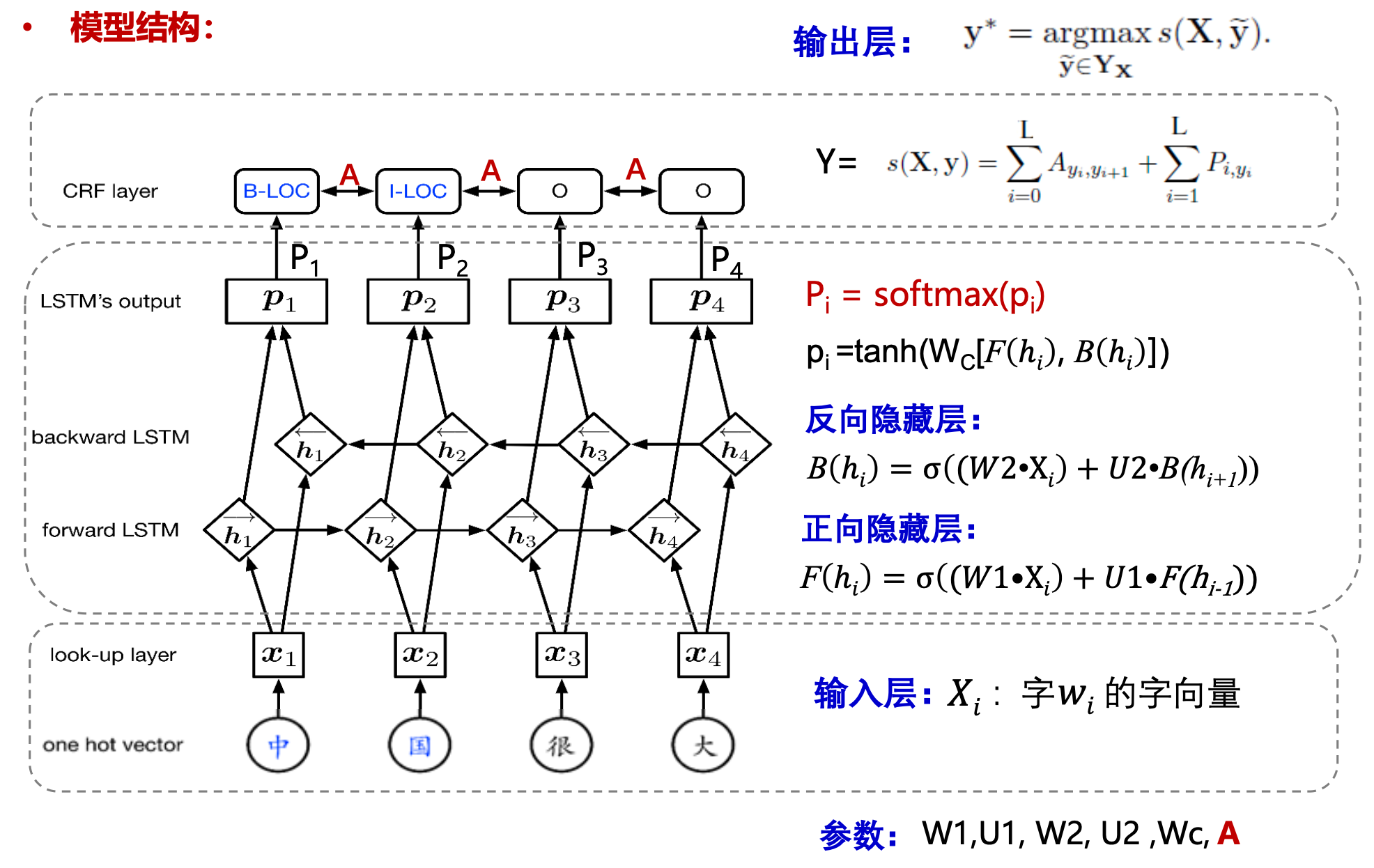
- Model Architecture: Character Embedding → Bidirectional LSTM → Linear Projection → CRF
- Labels: Supports 7 entity types in BIO format:
O, B-PER, I-PER, B-LOC, I-LOC, B-ORG, I-ORG - Training Pipeline: End-to-end training with BPTT optimization and checkpoint management
-
Input Layer
Converts raw Chinese characters to dense vector representations via embedding layer. -
Bidirectional LSTM
-
Forward LSTM computes contextual features from left-to-right
-
Backward LSTM computes contextual features from right-to-left
-
Hidden states concatenated for bidirectional context modeling:
$$P_i = \text{softmax}(\tanh(W_c [F(h_i), B(h_i)]))$$
-
-
CRF Layer
Performs sequence decoding with transition constraints:-
Sequence score calculation:
$$s(X,y) = \sum_{i=0}^{L} A_{y_i,y_{i+1}} + \sum_{i=1}^{L} P_{i,y_i}$$ -
Viterbi algorithm for optimal label sequence prediction:
$$y^* = \arg \mathop{\max}\limits_{\tilde{y} \in Y_X} s(X,\tilde{y})$$
-
-
Training Objective
Cross-entropy loss with joint optimization of:- LSTM weights (
$W1, U1, W2, U2$ ) - Concatenation layer weights (
$W_c$ ) - CRF transition matrix (
$A$ )
- LSTM weights (
data/
├── train_corpus.txt    # Training text corpus
├── train_label.txt     # Training labels
├── train.txt           # Combined training data
├── test_corpus.txt     # Test text corpus
├── test_label.txt      # Test labels
└── test.txt            # Combined test data
char2id: Character-to-index mapping built from training/test corpustag2label: Fixed label mapping:
{"O":0, "B-PER":1, "I-PER":2, "B-LOC":3, "I-LOC":4, "B-ORG":5, "I-ORG":6}
NERDataset handles data loading with:
- Line-by-line text parsing with empty-line sentence segmentation
- Direct tensor conversion without padding (
BATCH_SIZE=1)
# Clone repository
git clone git@github.com:cuiluyi/bilstm-crf-chinese-ner.git
cd bilstm-crf-chinese-ner

# Install dependencies
pip install -r requirements.txt# Basic training
python train.py
# With GPU and logging (recommended)
bash scripts/train.sh- Hyperparameters configured in
constants.py - Checkpoints saved to
ckpts/model_epoch_{n}.pth - Training logs written to
logs/train.log
# Evaluate specific checkpoint
python test.py --model_path ckpts/model_epoch_1.pth

# Batch evaluation
bash scripts/test.sh
Output metrics:
- Overall Accuracy (including "O" class)
- Accuracy (excluding "O" class for meaningful entity detection evaluation)
# Interactive prediction
python predict.py --model_path ckpts/model_epoch_5.pth

# Run with logging
bash scripts/predict.sh
Enter Chinese sentences interactively to get BIO-tagged entity predictions.
| Epoch | Accuracy (Overall) | Accuracy (Ignore "O") |
|---|---|---|
| 1 | 97.1002% | 89.1687% |
| 2 | 97.4994% | 87.3307% |
| 3 | 97.6263% | 88.1358% |
| 4 | 97.5945% | 88.6165% |
| 5 | 97.3169% | 88.0750% |
| 6 | 97.6535% | 87.8508% |
| 7 | 97.5585% | 86.8199% |
| 8 | 97.6089% | 88.1359% |
| 9 | 97.3140% | 84.5975% |
| 10 | 97.5261% | 86.7769% |
- Peak entity detection performance at Epoch 1 (89.17% accuracy ignoring "O" class)
- Overall accuracy consistently high (>97%) due to dominant "O" class in dataset
- Best trade-off between overall and entity accuracy at Epoch 6 (97.65% overall)
.
├── README.md           # Project documentation
├── constants.py        # Hyperparameter configuration
├── ner_dataset.py      # Dataset loading and preprocessing
├── model.py            # BiLSTM-CRF architecture implementation
├── train.py            # Training script
├── test.py             # Evaluation script
├── predict.py          # Inference script
├── data/               # Training/test data
├── ckpts/              # Model checkpoints
├── logs/               # Training/evaluation logs
└── scripts/            # Bash scripts for batch operations