Botao Ye · Boqi Chen · Haofei Xu · Daniel Barath · Marc Pollefeys



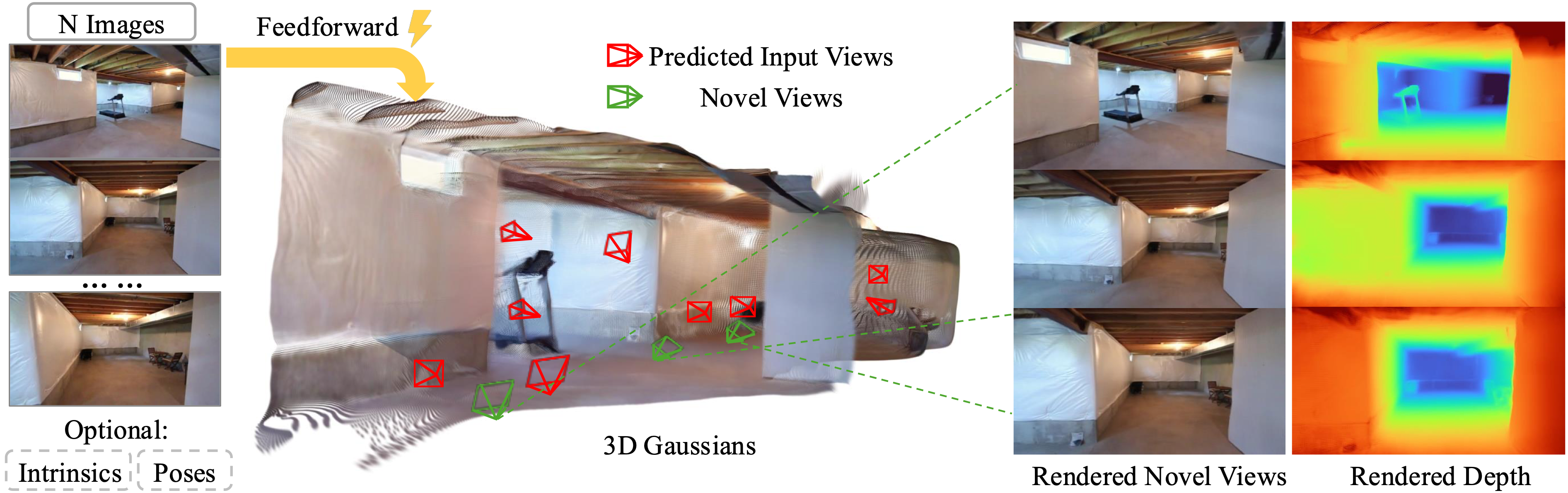
YoNoSplat reconstructs 3D Gaussian splats directly from unposed and uncalibrated images, while flexibly leveraging ground-truth camera poses or intrinsics when available.
- Release code and pretrained models
- Release high-resolution models
- Dynamic dataloaders for training on more datasets
- Release models trained on a mixture of more datasets
Table of Contents
Our code requires Python 3.10+ and is developed with PyTorch 2.1.2 and CUDA 11.8, but it should work with higher PyTorch/CUDA versions as well.
- Clone YoNoSplat.
git clone https://github.com/cvg/YoNoSplat
cd YoNoSplat- Create the environment (example using conda).
conda create -y -n yonosplat python=3.10
conda activate yonosplat
pip install torch==2.1.2 torchvision==0.16.2 torchaudio==2.1.2 --index-url https://download.pytorch.org/whl/cu118
pip install -r requirements.txtOur models are hosted on Hugging Face 🤗
| Model name | Training resolutions | Training data |
|---|---|---|
| re10k.ckpt | 224x224 | re10k |
| dl3dv.ckpt | 224x224 | dl3dv |
Download the checkpoints and place them in the pretrained_weights/ directory.
The camera system follows the pixelSplat convention:
- Intrinsics: Normalized camera intrinsic matrices (first row divided by image width, second row divided by image height)
- Extrinsics: OpenCV-style camera-to-world matrices (+X right, +Y down, +Z forward into the scene)
Please refer to DATASETS.md for dataset preparation instructions.
Please refer to EVALUATION.md for detailed evaluation commands, including novel view synthesis, pose estimation, and metrics calculation.
First download the Pi3 pretrained model and save it as ./pretrained_weights/pi3.safetensors directory.
python -m src.main \
  +experiment=yono_re10k \
  trainer.num_nodes=8 \
  wandb.mode=online \
  wandb.name=re10k_ctx2to32 \
  optimizer.lr=1e-4 \
  data_loader.train.batch_size=1 \
  checkpointing.save_weights_only=false \
dataset.re10k.view_sampler.num_context_views=[2,32]python -m src.main \
+experiment=yono_dl3dv \
trainer.num_nodes=8 \
wandb.mode=online \
wandb.name=dl3dv_ctx2to32 \
optimizer.lr=1e-4 \
data_loader.train.batch_size=1 \
checkpointing.save_weights_only=false \
dataset.dl3dv.view_sampler.num_context_views=[2,32]You can adjust the batch size and number of GPUs/nodes to fit your hardware. Note that changing the total batch size may require adjusting the learning rate to maintain performance.
This project builds upon several excellent repositories: NoPoSplat, Pi3, pixelSplat.
If you find this work useful in your research, please cite:
@inproceedings{ye2026yonosplat,
  title     = {YoNoSplat: You Only Need One Model for Feedforward 3D Gaussian Splatting},
  author    = {Ye, Botao and Chen, Boqi and Xu, Haofei and Barath, Daniel and Pollefeys, Marc},
  booktitle = {International Conference on Learning Representations (ICLR)},
  year      = {2026}
}