Data Read Actions
Note: This feature is available in Enterprise and AWS editions only.
Data read actions let you quickly inspect parts of your database. These actions are read-only and safe to use in any environment.
By default, CloudBeaver sends only table and column names to the AI provider. No other metadata is shared unless you enable the data read actions.
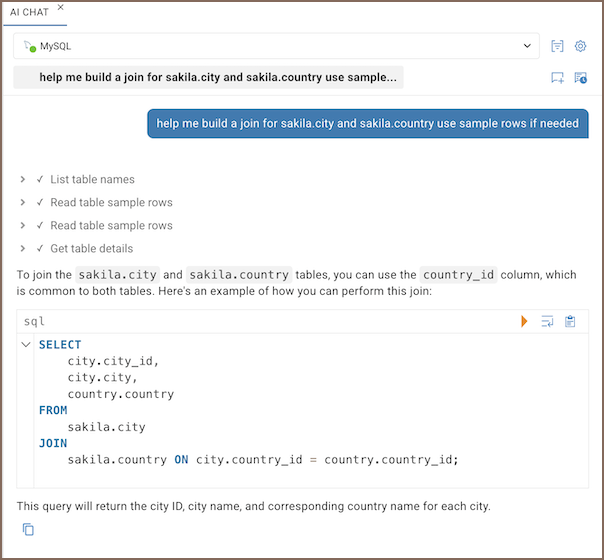
To use the actions:
-
Open AI chat on the connection you want to explore
-
Write a prompt that describes what you want to inspect
Note: To use an action, make sure it’s turned on in the Tools & MCP settings.
-
AI reads your request and uses a small sample of rows to better understand the table structure and return a more accurate answer.
Tip: Set a scope if you want AI to focus on a specific object.
Use it when you want the assistant to understand a table’s structure (for example, columns, typical values, and relationships) so it can generate more accurate SQL, filters, or mappings.
| Action | What it does | What happens | Example |
|---|---|---|---|
| Read table sample rows | Reads a few rows from a table so AI can better understand its structure and generate more accurate SQL or mappings. | - CloudBeaver reads only a few rows - AI uses this as internal context to improve query generation and mapping - No SQL and no editors are required |
"help me build a join for Album and Artist, use sample rows if needed" |
- Getting started
- Create connection
- Connection network options
- Supported databases
-
Drivers management

- Database authentication methods
- Database navigator
- Properties editor
- Data editor
- SQL editor
-
Entity relation diagrams
- Cloud services
- Data transfer
- General user guide
- Administration
- Server configuration
-
Server security and access configuration
- Authentication methods
- Access management
- Proxy configuration
-
Secret management
- Logs
-
Query manager
- Workspace location
- Command line parameters
-
Session manager
- Deployment options
- CloudBeaver Editions
- FAQ
- Development