
This repo implements a visual simulator of elevators system, along with several simple optimization algorithms and analysis of their results.
Some of the results are demonstrated here, and some of them can be reproduced using these scripts.
A Reinforcement-Learning manager is intended to be implemented and tested vs. the classic DirectManager.
Note: all the currently-implemented managers are either naive or incomplete, and were mainly used for testing and demonstration of the simulative infrastructure, as well as future reference for more advanced algorithms.
- NaiveManager: Use the first elevator to handle passengers arrivals sequentially.
- NaiveRoundRobin: Use the elevators in turns to handle passengers arrivals.
- GreedyManager: Try to disperse waiting elevators, and assign elevators to passengers greedily.
- DirectManager: Go on while there're more passengers in the current motion direction, then turn around (variant of the classic elevator algorithm).
 |
|---|
| Summary of the results of the various managers |
This class implements a simulation of elevators which serve arriving passengers.
Involved classes:
- Simulator = simulation manager
- ElevatorManager = decision makers
- Elevator = represent the elevators in the simulation
- Arrival = encode a single event of arrival of passengers
- Passenger = encode and track a single passenger
- SimPlot = visualize the simulation dynamically via matplotlib
Main flow:
generate_scenario()
run_simulation()
    sim_initialize()
        Manager.handle_initialization()
        update_missions()
    loop: handle_next_event()
        update the state to the time of the next event: sim_update()
        handle next event: handle_arrival() / end_mission() / sim_end()
            Manager.handle_arrival() / Manager.handle_no_missions()
            update_missions()
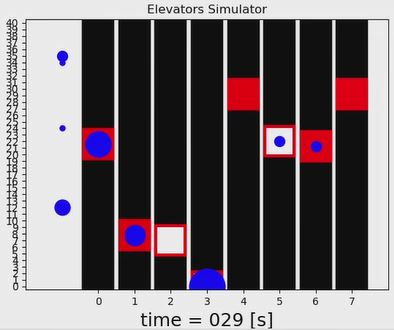 |
|---|
| A screenshot from the visual simulation |
This module defines various scenarios, tests the managers of ElevatorManager using ElevatorSimulator, and summarizes the results.
This module contains the elevator-managers (one class per manager).
A manager handles 3 kinds of events:
- Initialization of elevators locations.
- Arrival of passengers.
- End of tasks of a certain elevator.
A manager can assign tasks in the format {elevator_index : list_of_missions} where a single task is encoded as a 3D-tuple:
- (n,True,-1) = go to floor n and open.
- (n,False,-1) = go to floor n (without opening).
- (n,True/False,k) = get in the middle of another mission - go to n and push it as the k'th task of the elevator.
- (None,False,k) = remove the current k'th mission of the elevator.
In cases of new arrival, the output dict must also include: {-1 : elevator_assigned_to_arrival}.
This module is NOT IMPLEMENTED, up to definition of states and a simple count of them (or at least a lower-bound of the count), demonstrating that direct search in state-space (e.g. Value Iteration) is impractical for any interesting configuration. Instead, some encoding of the states should be used (e.g. like here).
Implementation of this module should take care of the following issues:
- Sampling resolution: high-resolution (e.g. sample every time the elevators move one floor) permits simple state-space, but low-resolution (e.g. sample when an elevator reaches its destination, etc.) is better synced with the simulator interface.
- State encoding: compact encoding of the states so that a learner can use an encoded state to make a decision.
- Train & test process: train the decision-maker in various scenarios and test it.
- Elevator Chooser: Need to fix chooser's dispatcher method
- Presentation:
-
poisson distribution generation with timestamp
-
model with only one elevator
- demo
-
model with 4 elevator -> Look 演算法怪怪的,他不會正確pick up
- waiting time boxing plot
- waiting time accross time
- service time box plot
- service time accress time
-
model with 4 elevator with limitation vs without limitation
- waiting time boxing plot
- waiting time accross time
- service time box plot
- service time accress time
-
model with DDS algorithm
- waiting time boxing plot
- waiting time accross time
- service time box plot
- service time accress time
- 各樓層waiting time
-
service level
- 體驗
-
動機
-
資料分析 -> 上課人數
-
資料搜集 -> 人流分析
-
假設
-
Simulation
-
建議
-
Exploration
-