
Declarative and Distributed Benchmarking for AI Agents
pySunshower is a Python library for evaluating AI agents during the design phase of system development. It allows you to pit AI agents against each other in parallel environments to find the best architecture for your specific agent-driven task.
Not all AI agents are created equal. In the design phase of system development, choosing the right harness and model is critical. pySunshower automates this decision-making process by running trials in parallel and using an LLM to score the results.
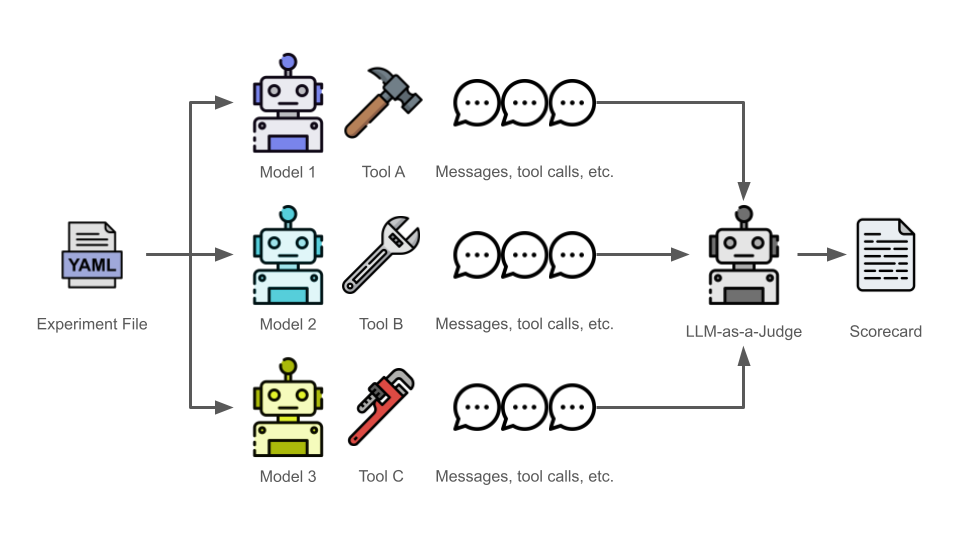
- Declarative: Define your entire experiment (teams, models, harnesses, and metrics) in YAML
- Efficient: Uses Ray to run multiple trials in parallel across available CPU/GPU cores
- Automated Judging: Implements a LLM-as-a-Judge approach to evaluate outputs based on custom rubrics like
accuracy,cost,trajectory, andspeed
Step 1. Create a Python virtual environment.
python -m venv .venvStep 2. Activate the Python virtual environment you just created. This step assumes you're working in a Linux-based environment. If you're using another operating system, adjust accordingly.
source .venv/bin/activateStep 3. Install pySunshower.
pip install pysunshowerpySunshower uses Kubernetes-inspired YAML to define experiments. The example below defines an experiment that will run two different AI agents three times (in parallel).
---
apiVersion: v1
kind: ExperimentSet
metadata:
  name: Experiment Set 1
  description: The purpose of this experiment is to determine which team is the best at achieving the task.
spec:
  task: Generate a report that summarized the top 3 trending topics in cyber-related news.
  trials: 3
  teams:
    - name: Team 1
      agents:
        - name: Alpha
          model:
            provider: openai
            name: gpt-4.1
            prompt: You are a helpful assistant.
          harness:
            tools:
              - serper
    - name: Team 2
      agents:
        - name: Bravo
          model:
            provider: openai
            name: gpt-4.1
            prompt: You are a Cyber Threat Intelligence analyst assigned to support a Cyber Security Service Provider (CSSP) within the Department of Defense.
          harness:
            tools:
              - serper
  judges:
    - name: Judge 1
      model:
        provider: openai
        name: gpt-4.1
        prompt: You are a judge responsible for evaluating the output of AI agents.
      harness:
        tools:
          - serper
      metricsToEvaluate:
        - metric: cost
          prompt: The total cost for the agent's execution must not exceed $0.05 USD, calculated from total token usage for all LLM calls.
        - metric: speed
          prompt: The agent's total execution time must remain under 3.0 seconds.
        - metric: trajectory
          prompt: Penalize the team 1 point for every unnecessary tool call made during the workflow.
teamsToEvaluate: [ all ]Step 1. Create a .env file in your current working directory to contain your API keys.
OPENAI_API_KEY=your_key_here
SERPER_API_KEY=your_key_here
Step 2. Run an experiment using a Python script or Jupyter Notebook. Below is a code block example.
from sunshower import engine

# This will:
# 1. Spin up a local Ray cluster
# 2. Run your agents in parallel
# 3. Generate a 'results.md' scorecard
engine.start(experiments.yaml)
Step 3. After the run finishes, pySunshower will produce a results.md containing a detailed breakdown of which team "won" based on the criteria defined in your experiment file.