Mechanomyography (MMG) is the principle of sound-generated by our muscle fibers, when they're activated for initiating a motion. These sounds are very low frequency and are detectable at the skin-surface. They are usually captured using a wearable microphone or accelerometers.
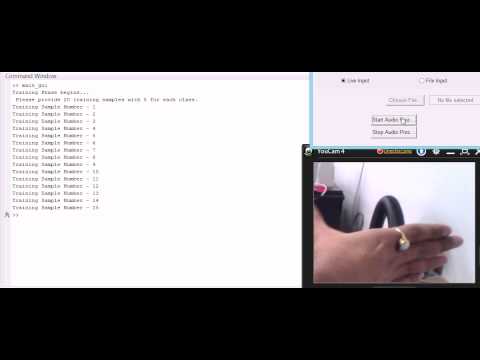
The system works by first detecting MMG signal by a moving window energy detector and thresholding. Once the MMG window is identified, a set of 14 statistical features (see below for a list) are computed from the window. PCA is used for orthogonalizing the features while reducing the feature count by keeping features that represent 95% of the variance in the data. These reduced feature sets are passed through machine learning algorithms to train the system at train-time. At test-time, a class of gesture is predicted in real-time as seen in the video below:
The code for statistical feature extraction from Mechanomyography time-series data is avaiable in generateFeatures.m
A few selected features are:
- Integrated Absolute MMG amplitude
- Mean of Absolute Amplitude
- Mean of Absolute-deviation
- Skewness and Kurtosis
- Number of Zero-crossings
- Slope of Sign Change
- Wilson's Amplitude
- Coefficients of 7th AutoRegressive (AR) Coefficients
TODO: Ceptrum Coefficients from AR Coefficients : They're known to contain highly discriminative information for the MMG signal.