Repository navigation
Search
Search is a word-prefix index, not a substring or full-text index. Knowing that is the difference between "the search is broken" and "the search is doing exactly what the index can do".
EventIngestor.stage_event normalises the line before tokenising it:
eventString.downcase!
eventString.gsub!(/([^a-zA-Z0-9 \-_:@\*\/.])/," " )
split_text = eventString.split(/\s+/)
So an indexed word contains only lowercase letters, digits, and - _ : @ * / .
— anything else became a word separator. events.hunks still holds the original,
unmodified line, which is what Displays and the event views render. The index
and the display are built from different strings; that is the single most common
source of "the search missed something I can see on screen".
Event.search(search_string, time_range, offset, limit):
- Split
search_stringon whitespace and downcase it. Each token is a term. - For each term, find every
words.textthat starts with the term (text like 'term%' escape '\').%and_in your term are escaped to literals, sofoo_barcannot matchfooXbar. - Relationally divide: keep only events whose
events_wordsrows cover every term. Counting distinct matchingword_ids instead of distinct terms would break whenever one term is a prefix of another word on the same event — "test" also matches "testservice" — which silently hides events. - Page the result with
offset/limit, ordered oldest-first.
An empty or whitespace-only query returns []. A non-Range time argument raises
ArgumentError rather than binding as the string '0' and matching everything,
which is what it used to do.
| You search for | You get | You do not get |
|---|---|---|
sshd |
any word starting with sshd — sshd:, sshd2
|
a line containing xsshd
|
failure |
failure, failures
|
fail — a prefix match runs term → word, not word → term |
connection refused |
events containing both words, in any order | an exact phrase, or that the two are adjacent |
user=bob |
nothing, ever | — = is not in any indexed word; it was replaced by a space, so the words are user and bob
|
Terms are ANDed. There is no OR, no NOT, and no proximity. To narrow what the dashboard shows, use Exclusions; to change how a line renders, use Displays.
Because the query is downcased but not punctuation-normalised, a term holding
any character outside - _ : @ * / . silently matches nothing. Strip it or split
the term.
Word text is truncated at 255 characters on ingest (the column is a fixed-width string), so very long tokens collide on the truncated form and are searched as one word.
- The time window is not optional. A search over all history is not something this
index answers cheaply;
events_wordsis partitioned bygeneratedon Postgres, so a bounded window also prunes partitions. - Each term's word set is resolved exactly once. It used to be resolved twice —
once to restrict
events_wordsand again insideHAVING— which made the planner scanwords2n times. Measured on 280k words / 6Mevents_wordsrows with a term matching 60k words: 534ms → 394ms for one term, 1386ms → 1067ms for three. - The term →
word_idlookup stays a subquery rather than joiningwordsinto the scan: joining drivesevents_wordsoff the time window and then re-filters, a full scan of every join row in that window. Restricting onword_idlets Postgres useindex_events_words_on_word_id_and_generated_and_event_idas a covering index, which is why that index is composite and why it is the only oneevents_wordscarries. A standalone index ongeneratedexisted until 2026 and was dropped:EXPLAINnever chose it, and on Postgres the composite index recordedidx_scan=2against itsidx_scan=0. Search timings are identical with and without it (5.94 ms vs 5.95 ms). - Prefix search was silently returning nothing on Postgres under an
en_US.UTF-8collation. The narrowing trick it relied on — a[term, term + U+10FFFF)range — is sound only under a byte-wise collation. Under glibcen_US.UTF-8,strcollsorts U+10FFFF before ASCII letters, so the bound falls below every longer word and the range matches nothing: measured on 280k words, the termsshdmatched 60 000 words byLIKEand 0 by that range. The range is gone; theLIKE 'term%'alone is used, served byindex_words_on_text_pattern(varchar_pattern_ops, byte-wise, and therefore collation-blind). It cannot be repaired rather than removed either: that collation gives trailing punctuation no primary weight, so the strings above'foo-'are unbounded — checked exhaustively over the 94 printable ASCII characters the tokenizer can emit, and incrementing the last character is an unsound bound for 35 of them. Do not reintroduce the range. This is exactly the class of bug a single-engine test suite cannot see; the suite now runs only on the engine production uses. See Development.
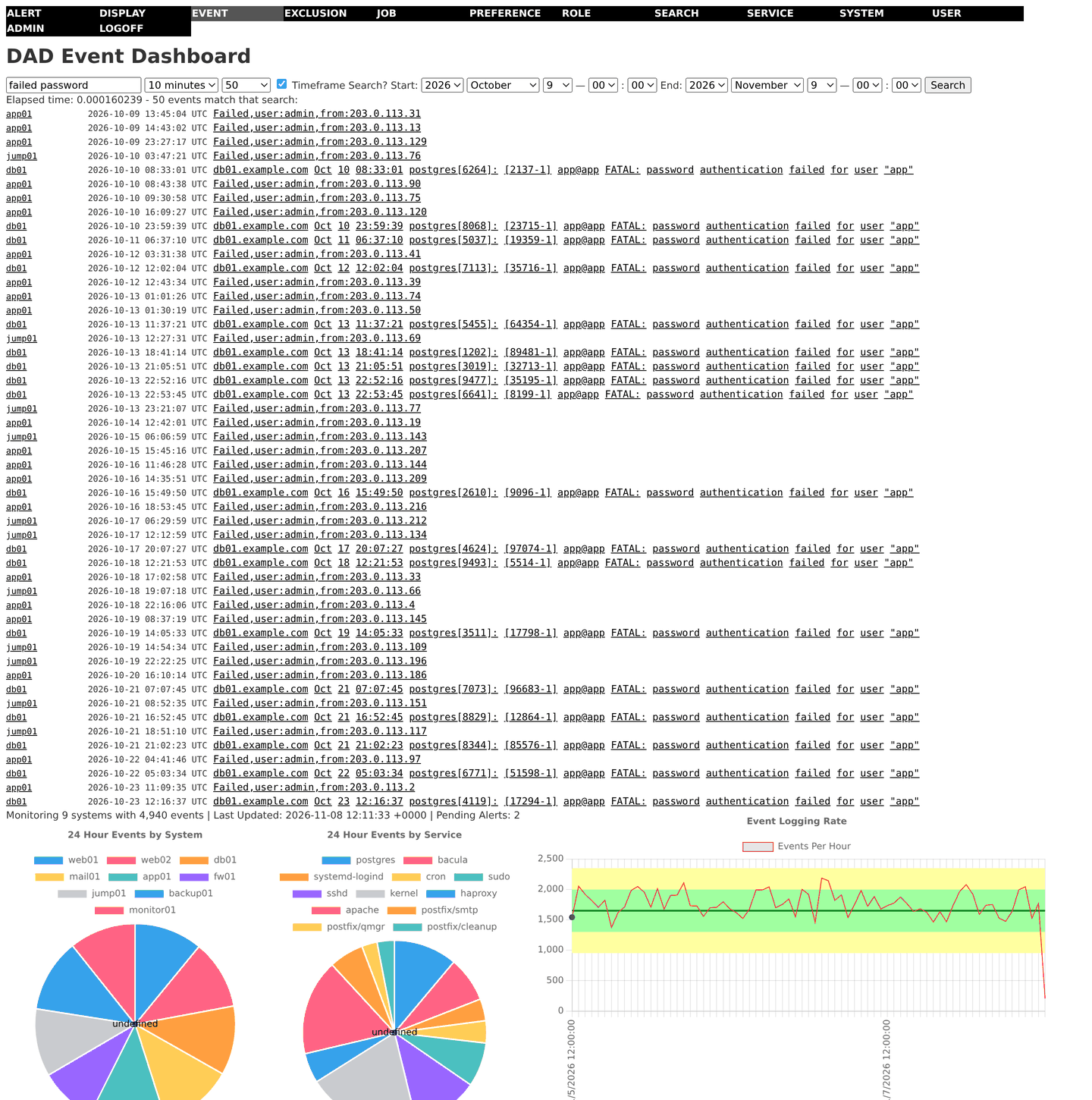
The bar, timeframe, and result limit sit above the live feed; results replace the feed in place. Screenshot from a seeded demonstration dataset; see Interface.
Unticked, Timeframe Search searches the relative window from the Timeframe
dropdown. Ticked, it searches the absolute start/end range. When the date fields
cannot be read the result line says so, rather than returning 0 events match for
a window the operator never asked for.
This toggle was broken until recently (RECOMMENDATIONS §2.3). The checkbox is a Rails
check_box, which always submitstimesearch_enabled[enabled]=0when unticked, andEventsController#searchbranched on the presence of that key — a Hash, so always truthy. Every search submitted from the form took the absolute-date branch with thedatetime_selectdefaults, a now→now window, and reported0 events match. Fixed in7e0f435; the screenshot above predates the fix and was taken by ticking the box.
A Search row is a saved search string — a bookmark. There is no time window
stored: searches carries string, user_id, description and
short_description and nothing else, so the timeframe is chosen again when the
search is re-run. The query is still executed by Event.search; nothing is
cached.