





Payment infrastructure for Python AI agents.
Gate any function, MCP tool, or LangChain agent behind a SolvaPay paywall
with one decorator. Fully async. Verified against the live API. mypy --strict clean.
Community SDK — v0.7.2, MIT, available on PyPI as
solvapay-python.
Mirrors the full surface of @solvapay/core.
Potential official adoption pending — thesolvapayPyPI namespace is held for the founders.
Production-oriented community SDK under active development. The API surface covers the full
@solvapay/core operation set, is wire-verified against the real SolvaPay sandbox, and ships
with 142 tests, mypy --strict clean source, and py.typed for downstream type checking.
Stability guarantees follow SemVer for the public surface in
solvapay.__init__. Private modules (_http, _config, _async_client) may change between
minor versions. v1.0 stability contract — including a formal deprecation policy and API freeze —
is gated on official SolvaPay adoption. Until then, treat this as pre-v1: solid for production
use, with the understanding that minor versions may introduce breaking changes to non-public APIs.
Python is the dominant language for AI agent frameworks — FastMCP, LangChain, CrewAI, AutoGen, and raw Anthropic/OpenAI tool-use all live in Python. SolvaPay's official SDK is TypeScript-only.
This SDK fills that gap: a Python-native, async-first, fully typed client that integrates with every major Python AI framework. If you're building agents that should charge per tool call, gate premium capabilities behind subscriptions, or track per-customer usage — this is the SDK.
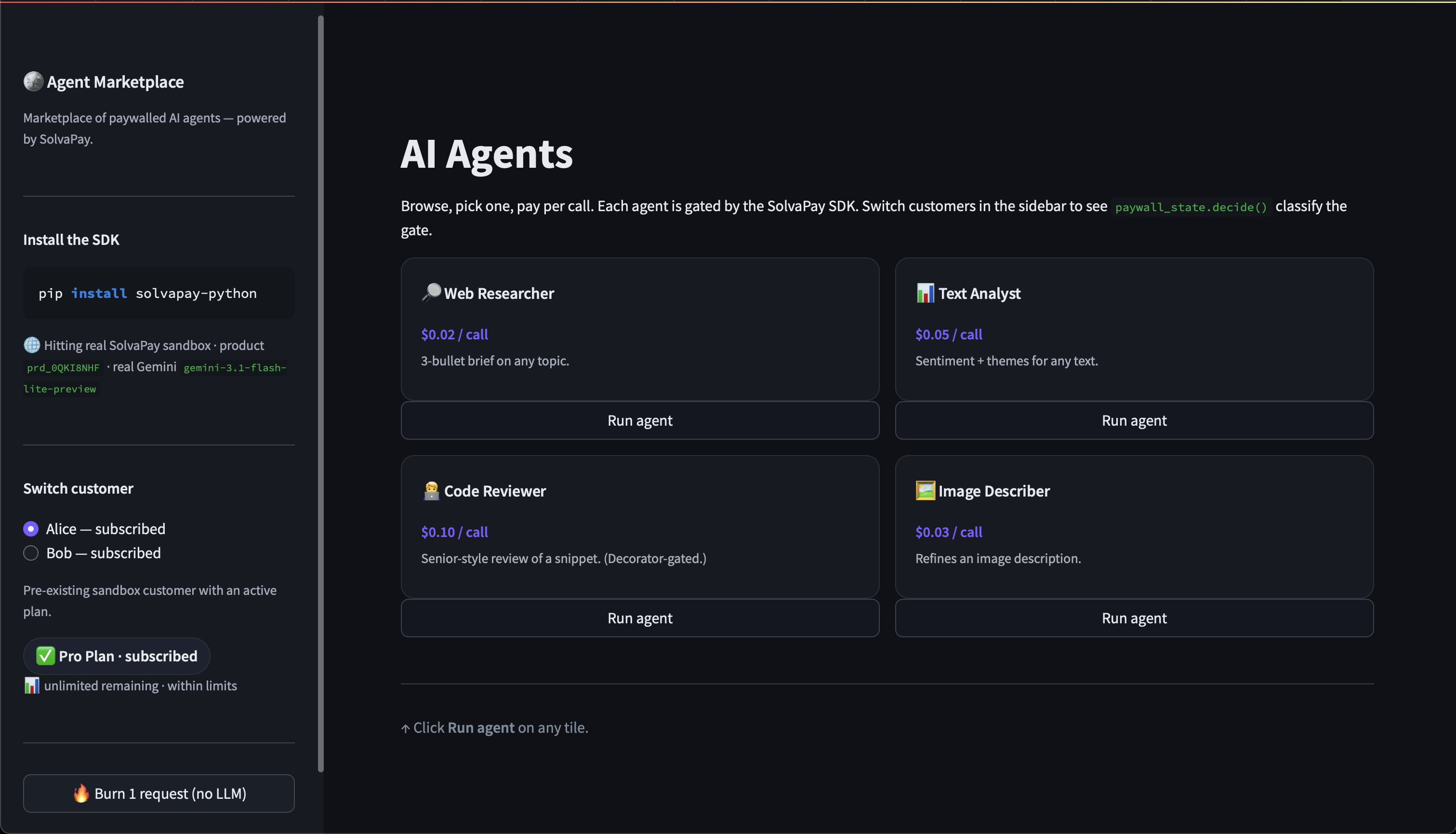
Paywalled AI-agent marketplace built with this SDK. Real SolvaPay sandbox. Real Gemini LLM. Two
demo customers — one subscribed (passes), one free tier (blocked with checkout URL). Source in
examples/marketplace/.
pip install solvapay-python                      # core: sync + async client, webhooks, paywall
pip install "solvapay-python[langchain]"         # + LangChain monetize_tool decorator
pip install "solvapay-python[fastapi]"           # + FastAPI webhook router
Requires: Python ≥ 3.10, Pydantic v2, httpx
Gate a FastMCP tool behind a SolvaPay paywall in three lines:
# server.py
import os
from fastmcp import FastMCP
from solvapay import SolvaPay
from solvapay.paywall import paywall

mcp = FastMCP("my-agent")
sv  = SolvaPay(api_key=os.environ["SOLVAPAY_SECRET_KEY"])

@mcp.tool()
@paywall.require(product="prd_xyz", client=sv)
def search_web(*, customer_ref: str, query: str) -> str:
    """Search the web. Requires an active SolvaPay subscription."""
    return do_actual_search(query)
When a customer hits their limit, PaywallRequired is raised with a ready-to-use checkout_url.
See examples/fastmcp-paywall/
for the full runnable demo (includes Claude Desktop config).
from solvapay.langchain import monetize_tool
from langchain_core.tools import Tool

raw  = Tool.from_function(name="search", func=do_search, description="Search the web.")
paid = monetize_tool(raw, product="prd_xyz")
# Over-limit: returns structured dict with checkout_url — agent surfaces it to the user naturally
See examples/langchain-paywall/
for a full ReAct agent that handles the paywall state in its trace.
from solvapay import SolvaPay

sv = SolvaPay()  # reads SOLVAPAY_SECRET_KEY from env

customer_ref = sv.ensure_customer("user_42", email="alice@example.com")
session      = sv.create_checkout_session(
    customer_ref=customer_ref,
    product_ref="prd_xyz",
    return_url="https://your-app.com/done",
)
print(session.checkout_url)Use async with — it is the only supported lifecycle pattern. AsyncSolvaPay owns an
httpx.AsyncClient pool and must be explicitly closed to avoid resource leaks.
from solvapay import AsyncSolvaPay

async with AsyncSolvaPay() as sv:
    customer_ref = await sv.ensure_customer("user_42")
    limits       = await sv.check_limits(customer_ref=customer_ref, product_ref="prd_xyz")
    if not limits.within_limits:
return limits.checkout_url # already minted by the decorator@paywall.require stacks cleanly under @mcp.tool() via functools.wraps — FastMCP introspects
the underlying signature and docstring, not the wrapper. No schema pollution.
@mcp.tool()
@paywall.require(product="prd_xyz", plan="pln_pro", client=sv)
def analyze_document(*, customer_ref: str, text: str) -> str: ...
Upcoming in v0.8: solvapay.mcp — a framework-neutral @payable_tool decorator and
payable_tool_schema() that generates a single Pydantic-derived JSON Schema usable across
FastMCP, LangChain args_schema, OpenAI function-calling, and Anthropic tool_use simultaneously.
monetize_tool wraps any BaseTool subclass. Returns a structured dict on gate-hit instead of
raising — LangChain agents handle dicts gracefully without corrupting the agent trace.
from solvapay.langchain import monetize_tool

paid = monetize_tool(tool, product="prd_xyz", customer_ref_arg="customer_ref")
# On block: {"paywall_required": True, "state": "UPGRADE_REQUIRED",
#            "message": "...", "checkout_url": "https://solvapay.com/c/..."}
Install: pip install "solvapay-python[langchain]"
from crewai import tool as crewai_tool
from solvapay.paywall import paywall

@crewai_tool("Search Web")
@paywall.require(product="prd_xyz", client=sv)
def search_web(*, customer_ref: str, query: str) -> str:
return do_search(query)from solvapay import AsyncSolvaPay
from solvapay.paywall_state import gate, PaywallState
async with AsyncSolvaPay() as sv:
decision = await gate(sv, customer_ref=customer_ref, product_ref="prd_xyz")
if decision.state != PaywallState.OK:
yield f"Upgrade required: {decision.checkout_url}"
return
# proceed with LLM callsolvapay.paywall_state maps a LimitResponse to a structured recovery action. The state machine
mirrors @solvapay/core's paywall-state.ts branching exactly.
from solvapay.paywall_state import decide, PaywallState

limits = sv.check_limits(customer_ref="cus_123", product_ref="prd_xyz")
if not limits.within_limits:
    d = decide(limits)
    print(d.state)          # PaywallState.UPGRADE_REQUIRED
    print(d.message)        # "You don't have an active plan..."
    print(d.recovery_tool)  # "upgrade"
    print(d.checkout_url)   # "https://solvapay.com/c/..."
States:
| State | Meaning | Recovery |
|---|---|---|
OK |
Within limits | — |
ACTIVATION_REQUIRED |
No active plan | Subscribe |
UPGRADE_REQUIRED |
Plan cap hit | Upgrade plan |
TOPUP_REQUIRED |
Out of credits | Buy credits |
REACTIVATION_REQUIRED |
Cancelled plan | Reactivate |
gate() — enriched one-call helper for real API responses
The live /v1/sdk/limits endpoint returns {withinLimits, remaining, meterName} only — no
plan, no checkoutUrl. Use gate() instead of calling decide() directly: it enriches the
bare response in one call (mints checkout URL if blocked, reads plan from customer purchases).
from solvapay.paywall_state import gate

decision = gate(sv, customer_ref="cus_x", product_ref="prd_y")
# Internally: check_limits → mint checkout_url if blocked → read plan from purchases
# Always returns GateDecision — never raises.Every SDK exception inherits from SolvaPayError. The hierarchy mirrors payments-industry
conventions — catch narrow exceptions for recovery, SolvaPayError as the catch-all.
APIError.request_id captures the x-request-id / x-correlation-id header for support correlation.
Full exception hierarchy + handling example
from solvapay import (
    SolvaPayError,        # catch-all
    APIError,             # base HTTP error — .status_code, .request_id
    AuthenticationError,  # 401
    NotFoundError,        # 404
    RateLimitError,       # 429 — .retry_after
    InvalidRequestError,  # other 4xx
    APIServerError,       # 5xx
    APIConnectionError,   # network failure
    APITimeoutError,      # request timeout
)

try:
    sv.get_customer("cus_missing")
except NotFoundError as e:
    print(e.request_id)              # x-request-id for support correlation
except RateLimitError as e:
    time.sleep(float(e.retry_after or 1))
except SolvaPayError:
raiseAll mutating operations accept idempotency_key. Pass the same key on retry — SolvaPay
deduplicates server-side. from_payload(*parts) generates a deterministic SHA256 key from
stable inputs, safe to reuse across process restarts.
from_payload() helper + full example
from solvapay.idempotency import from_payload

key     = from_payload("checkout", customer_ref, product_ref)  # SHA256 → 32-hex
session = sv.create_checkout_session(
    customer_ref=customer_ref,
    product_ref="prd_xyz",
    idempotency_key=key,
)
# Retry with the same key → same session returned, no duplicate charge
Changing the key on retry defeats server-side deduplication — the server sees it as a new request.
The SDK logs via logging.getLogger("solvapay.http") — INFO on success, WARNING on errors.
It never calls logging.basicConfig and never configures root handlers. Your app controls the
log format and destination.
import logging
logging.basicConfig(level=logging.INFO)  # in your app startup, not in the SDK

sv = SolvaPay(logger=logging.getLogger("myapp.payments"))  # optional: inject your own logger
API keys are never written to logs. The redaction contract is enforced by tests
(tests/test_redaction.py).
solvapay-python ships a py.typed marker (PEP 561). Downstream projects with mypy --strict
get fully typed imports — no implicit Any. The SDK itself passes mypy --strict clean.
verify_webhook implements HMAC-SHA256 signature verification byte-for-byte with the TS SDK.
import os
from solvapay.webhooks import verify_webhook
from solvapay import SolvaPayError

body = (await request.body()).decode()  # raw bytes — do NOT use request.json()
sig  = request.headers.get("sv-signature", "")

try:
    event = verify_webhook(body=body, signature=sig,
                           secret=os.environ["SOLVAPAY_WEBHOOK_SECRET"])
except SolvaPayError:
    raise HTTPException(401)

# Typed events (discriminated union — 13 event types):
from solvapay import WebhookEvent, PurchaseCreated
from pydantic import TypeAdapter
typed = TypeAdapter(WebhookEvent).validate_python(event)
if isinstance(typed, PurchaseCreated):
    grant_access(typed.data.customer_ref)
Critical: use
await request.body()(raw bytes), notrequest.json().
Re-serialising JSON reorders keys and breaks the HMAC signature.
Verification algorithm:
- Parse
sv-signatureheader:t={unix_ts},v1={hex_hmac} - Reject if
|now − t| > 300s(replay protection) - Compute
HMAC-SHA256(secret, f"{t}.{body}")over the raw body string hmac.compare_digest(expected, received)— constant-time, no timing leaks
FastAPI one-liner:
from solvapay.fastapi import webhook_router

app.include_router(
    webhook_router(secret=os.environ["SOLVAPAY_WEBHOOK_SECRET"], on_event=handle_event)
)
Install: pip install "solvapay-python[fastapi]"
Module dependency diagram
                  ┌───────────────────────────────┐
                  │      __init__.py (exports)     │
                  └───────────────┬───────────────┘
                                  │
      ┌──────────────┬────────────┼────────────┬──────────────┬──────────────┐
      │              │            │            │              │              │
      ▼              ▼            ▼            ▼              ▼              ▼
  client.py     webhooks.py  paywall.py   fastapi.py  paywall_state.py  langchain.py
      │              │            │            │              ▲              │
      ▼              ▼            ▼            ▼              │              │
  _http.py      exceptions   client +     webhooks +     (pure fn,       client +
      │                      exceptions   exceptions      no HTTP)      paywall_state
      ▼
  _config.py
      │
      ▼
  os.environ
_config.py and _http.py are leaf nodes — they know nothing about higher layers.
client.py is the only orchestration point. No circular dependencies. No global state.
Request lifecycle — paywall decorator
caller → decorated_fn(customer_ref=..., **kwargs)
           │
           ▼
    extract customer_ref from kwargs
           │
           ▼
    SolvaPay.check_limits(customer_ref, product_ref, plan_ref)
           │                    │
     within_limits=True         │  within_limits=False
           │                    │
           ▼                    ▼
    fn(*args, **kwargs)    checkout_url present?
    (pass-through)               │           │
                                yes          no
                                 │           │
                                 │           ▼
                                 │    create_checkout_session(...)
                                 │           │
                                 └───────────┘
                                             │
                                             ▼
                                raise PaywallRequired(checkout_url=...)
MCP → paywall → checkout flow
MCP Client          FastMCP Server       SolvaPay Decorator      SolvaPay API
(Claude Desktop)
    │                     │                      │                     │
    │──── tool call ──────▶                      │                     │
    │                     │──── check_limits ────▶                     │
    │                     │                      │── POST /limits ─────▶
    │                     │                      │◀── {withinLimits} ──│
    │                     │                      │                     │
    │         ┌───── within_limits=True ─────────┤                     │
    │         │           │                      │                     │
    │         │     execute tool fn              │                     │
    │◀─ result ───────────│                      │                     │
    │                     │                      │                     │
    │         └───── within_limits=False ─────────┤                     │
    │                     │                      │── POST /checkout ───▶
    │                     │                      │◀── {checkoutUrl} ───│
    │◀─ PaywallRequired ──│                      │                     │
    │   {checkout_url}    │                      │                     │
Webhook trust boundary
SolvaPay Platform            Internet             Your Server
        │                                              │
        │── POST /webhooks/solvapay                    │
        │   Body: raw JSON                             │
        │   sv-signature: t={ts},v1={hmac}             │
        │─────────────────────────────────────────────▶│
        │                                              │
        │                             verify_webhook() │
        │                         1. parse t + v1      │
        │                         2. |now-t| ≤ 300s    │
        │                         3. HMAC-SHA256(...)  │
        │                         4. compare_digest    │
        │                                              │
        │◀─ 200 OK (valid) ────────────────────────────│
        │◀─ 401 (invalid / replayed) ──────────────────│
All methods available on both SolvaPay (sync) and AsyncSolvaPay (async).
Core:
| Method | REST | Description |
|---|---|---|
create_checkout_session |
POST /v1/sdk/checkout-sessions |
Hosted checkout URL |
ensure_customer |
GET then POST /v1/sdk/customers |
Idempotent upsert |
get_customer |
GET /v1/sdk/customers/{ref} |
Fetch by ref or email |
check_limits |
POST /v1/sdk/limits |
Usage / purchase limit check |
verify_webhook |
— | HMAC-SHA256 signature verification |
Lifecycle ops — usage tracking, balance, subscriptions (5 methods)
| Method | REST | Description |
|---|---|---|
track_usage |
POST /v1/sdk/usages |
Record metered usage |
update_customer |
PATCH /v1/sdk/customers/{ref} |
Update email / name |
get_customer_balance |
GET /v1/sdk/customers/{ref}/balance |
Credit balance |
cancel_purchase |
POST /v1/sdk/purchases/{ref}/cancel |
Cancel subscription |
reactivate_purchase |
POST /v1/sdk/purchases/{ref}/reactivate |
Reactivate |
Admin ops — products, plans, merchant config (11 methods)
| Method | REST | Description |
|---|---|---|
list_products / get_product |
GET /v1/sdk/products |
Product catalogue |
create_product / clone_product / delete_product |
POST / DELETE |
Product management |
list_plans / create_plan / update_plan / delete_plan |
GET / POST / PUT / DELETE |
Plan management |
get_merchant |
GET /v1/sdk/merchant |
Merchant info |
get_platform_config |
GET /v1/sdk/platform-config |
Platform config |
Mutating ops (create_*, track_usage, cancel_*, reactivate_*, clone_*) accept
idempotency_key: str | None = None for safe retries.
Wire format identical (camelCase JSON). Python surface uses snake_case + keyword-only args — idiomatic Python, zero config to switch between SDKs.
Side-by-side example
// @solvapay/core
const session = await sv.createCheckoutSession({
  customerRef: "cus_123",
  productRef:  "prd_xyz",
});
# solvapay-python
session = sv.create_checkout_session(
customer_ref="cus_123",
product_ref="prd_xyz",
)No retries. No global state. No telemetry. No magic config. Type-first, thin transport.
All 7 principles
- No retries in core. Retry policy belongs to the caller. Use
tenacityor the upcomingsolvapay[retry]extra (v0.9). Payment retries are not like HTTP retries — a naively retriedPOST /checkout-sessionscan charge a customer twice. Safe retry requires idempotency discipline: generate a deterministic key withfrom_payload(...)and pass the same key on every attempt. The SDK provides the primitive; the retry loop is yours to own. - No global state. No module-level
_default_clientsingleton. Each caller constructs its ownSolvaPay(). Safe in multi-tenant and serverless environments. - No telemetry. The SDK never phones home.
- No magic config. No auto-loading of
.envfiles,~/.solvapay/config, or other ambient config. All inputs are explicit. - Async context manager is the contract.
async with AsyncSolvaPay() as svis the supported pattern.AsyncSolvaPayconstructed outside a context manager will warn on GC if the underlyinghttpx.AsyncClientpool is not explicitly closed. - Thin transport.
client.pyorchestrates HTTP + models + config. Zero business logic. Decision logic (paywall state, gate enrichment) lives inpaywall_state.py. - Type-first.
mypy --strictclean.py.typedmarker shipped. Pydantic v2 models useextra="ignore"so new API fields never break parsing.
| Path | What it shows |
|---|---|
examples/fastmcp-paywall/ |
FastMCP server with two @paywall.require tools + Claude Desktop config |
examples/langchain-paywall/ |
LangChain ReAct agent — monetize_tool, paywall state surfaced in agent trace |
examples/marketplace/ |
Streamlit demo — paywalled AI-agent marketplace, real SolvaPay sandbox, real Gemini LLM, two demo customers (one subscribed, one free tier) |
| Variable | Purpose |
|---|---|
SOLVAPAY_SECRET_KEY |
API secret key (required) |
SOLVAPAY_API_BASE_URL |
Override API base URL (optional, defaults to https://api.solvapay.com) |
SOLVAPAY_WEBHOOK_SECRET |
Webhook signing secret (required for verify_webhook) |
| Version | Theme | Status |
|---|---|---|
| v0.1 | Sync client, checkout, customers, limits, webhooks | ✅ shipped |
| v0.2 | @paywall.require decorator, FastAPI webhook router |
✅ shipped |
| v0.3 | FastMCP paywall demo | ✅ shipped |
| v0.4 | AsyncSolvaPay, lifecycle ops, typed webhook events |
✅ shipped |
| v0.5 | Paywall state classifier, LangChain monetize_tool |
✅ shipped |
| v0.6 | Admin endpoints, PyPI publish | ✅ shipped |
| v0.7.0 | Real-API wire-format fixes, paywall_state.gate(), marketplace demo |
✅ shipped |
| v0.7.1 | Structured error hierarchy, idempotency keys, py.typed, logging |
✅ shipped |
| v0.7.2 | Async resource leak fix, example dep fixes | ✅ shipped |
| v0.8 | solvapay.mcp first-class module, LangChain Protocol refactor, multi-framework demo, governance scaffold |
🔜 next |
| v0.9 | Webhook secret rotation, nonce cache, ASGI/WSGI/Lambda handlers, contract tests, solvapay[retry] |
🔜 planned |
| v1.0 | Stability contract — gated on official SolvaPay adoption signal | 🔒 gated |
v1.0 is intentionally gated on official adoption — the solvapay PyPI namespace is held for the
founders. This SDK ships as solvapay-python; the import surface (from solvapay import ...) is
unchanged regardless of distribution name.
git clone https://github.com/dhruv-sanan/solvapay-python
cd solvapay-python
uv sync --all-extras --dev    # install all optional deps + dev tools
uv run pytest                 # 142 tests, should be green
uv run ruff check src tests   # lint
uv run ruff format --check src tests  # format gate (separate from lint)
uv run mypy src               # strict type check
Before opening a PR:
- Add tests for new behaviour (
@respx.mockfor HTTP paths, direct call for pure functions) ruff formatapplied (not justruff check— they are separate gates)mypy --strictclean onsrc/- Conventional Commits format (
feat:,fix:,docs:,refactor:,test:,ci:)
All contributions welcome. See open issues for good first tasks.
MIT — see LICENSE.