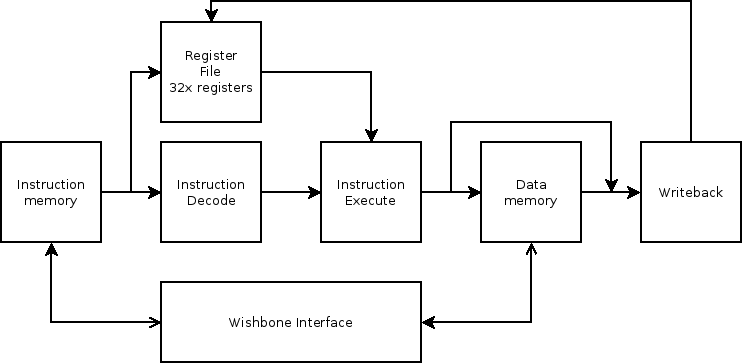
The Potato Processor is a simple RISC-V processor written in VHDL for use in FPGAs. It implements the 32-bit integer subset of the RISC-V Specification version 2.0 and supports large parts of the the machine mode specified in the RISC-V Privileged Architecture Specification v1.10.
The processor has been tested on an Arty board using the example SoC design provided in the example/ directory
and the applications found in the software/ directory. Synthesis and implementation has been tested on various versions
of Xilinx' Vivado toolchain, most recently version 2018.2.
- Supports the complete 32-bit RISC-V base integer ISA (RV32I) version 2.0
- Supports large parts of the machine mode defined in the RISC-V Privileged Architecture version 1.10
- Supports up to 8 individually maskable external interrupts (IRQs)
- 5-stage "classic" RISC pipeline
- Optional instruction cache
- Supports the Wishbone bus, version B4
The project includes a variety of Wishbone-compatible peripherals for use in system-on-chip designs based on the Potato processor. The main peripherals are:
- Timer - a 32-bit timer with compare interrupt
- GPIO - a configurable-width generic GPIO module
- Memory - a block RAM memory module
- UART - a UART module with hardware FIFOs, configurable baudrate and RX/TX interrupts
To instantiate the processor, add the source files from the src/ folder to your project. Use the pp_potato
entity to instantiate a processor with a Wishbone interface. Some generics are provided to configure the processor core.
An example System-on-Chip for the Arty development board can be found in the example/ directory of the source repository.
To program the processor, you need an appropriate compiler toolchain. Follow the instructions on the RISCV GNU toolchain repository site to build and install a 32-bit RISC-V toolchain.
Bugs and issues related to the Potato processor can be reported on the project's GitHub page.